

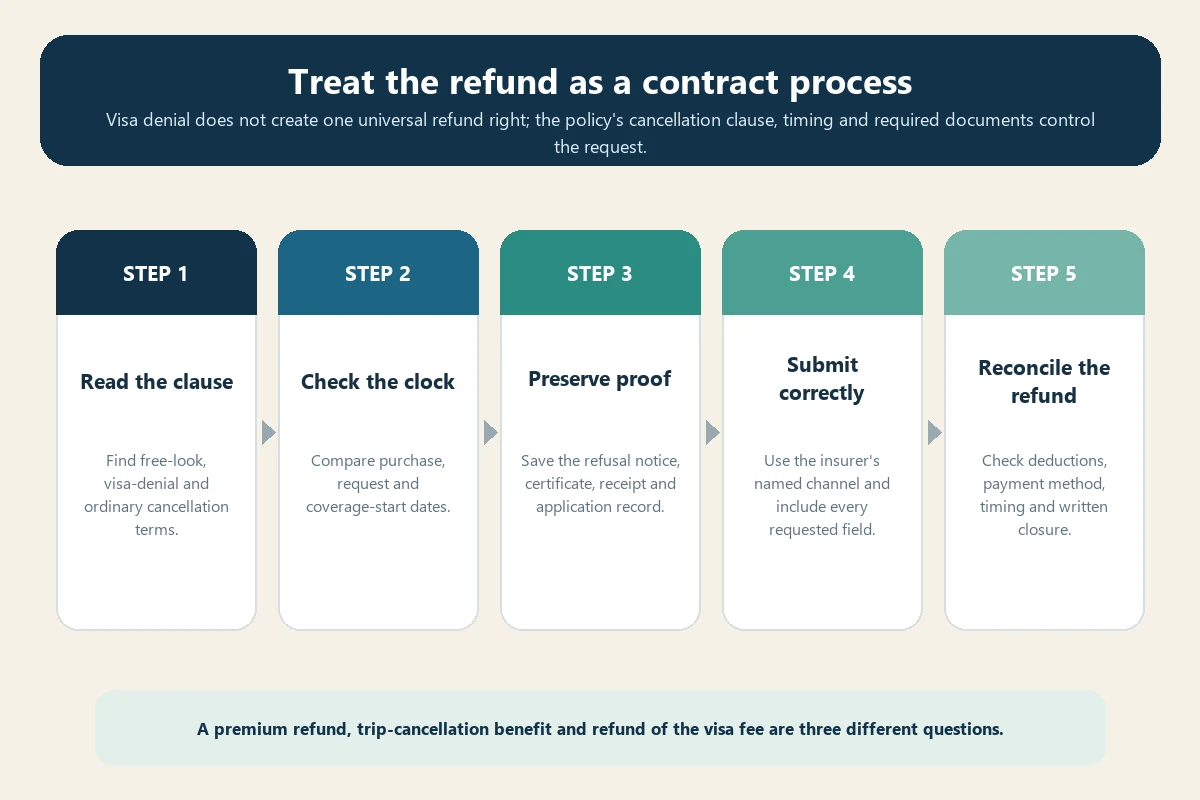
A Schengen insurance cancellation refund after visa denial is a contract request, not an automatic EU benefit. Some policies promise a full or partial premium refund when a visa is refused. Others allow cancellation only during a free-look period or before coverage begins. The applicant should read the policy, preserve the refusal notice and submit the request through the insurer’s required channel before any deadline.
Key takeaways
- No single Schengen rule guarantees a refund of every insurance premium after denial.
- A visa-denial refund, free-look cancellation and trip-cancellation claim are different processes.
- The policy purchase date, refund request date and coverage start date can all matter.
- Insurers commonly request the refusal notice, policy number and proof of payment.
- The visa application fee and other trip costs follow separate refund rules.
Identify which refund question you are asking
Four payments can be involved in one unsuccessful application:
- the travel medical insurance premium;
- the visa application fee;
- a service-provider or appointment fee;
- flights, hotels and other trip costs.
This guide addresses the first payment. An insurance premium refund does not determine whether the visa fee, appointment charge or reservation is refundable. Do not send every receipt to the insurer and assume one clause covers them all.
The official Netherlands insurance page says some insurers refund all or part of the premium if a visa is denied. “Some” is important. It directs the applicant back to the particular insurer and contract rather than creating a universal promise.
Three cancellation paths can look similar
| Path | Trigger | Typical evidence |
|---|---|---|
| Visa-denial refund | Official refusal under a policy-specific promise | Refusal notice, policy details and payment proof |
| Free-look cancellation | Buyer cancels within a stated review period, often before departure or a claim | Timely written request and unused policy |
| Ordinary cancellation | Buyer ends cover under the general cancellation clause | Request date, effective date and any required form |
| Trip-cancellation claim | A covered reason causes loss of insured trip costs | Claim form, cause evidence, supplier refunds and receipts |
The first three concern return of premium. The fourth asks an insurer to pay a covered travel loss. Visa refusal may be excluded, included as a named reason or addressed through a separate add-on. A premium refund of $40 is not the same as reimbursement of a $2,000 flight.
Read the contract before contacting support
Search the policy and fulfillment materials for “visa refusal,” “visa denial,” “cancellation,” “free look,” “refund,” “effective date” and “administration fee.” Record the exact section and every condition. A sales-page promise can be helpful, but save the policy version issued with the certificate.
The NAIC travel insurance overview explains that travel medical, trip cancellation, cancellation fee waivers and assistance services are different products. It also notes that eligibility for certain benefits can depend on purchase timing and cancellation restrictions. That distinction is essential when a seller uses the broad word “protection.”
Check whether the policy requires the refusal to occur before coverage starts. Some contracts refund fully before the effective date but deduct the used period afterward. Others require that no claim has been made. Identify any nonrefundable policy fee or tax.
Build the cancellation timeline
Place these dates in order:
- policy purchase and payment;
- certificate issue;
- visa appointment;
- decision or refusal notice;
- scheduled coverage start;
- refund request;
- planned departure.
A delay between refusal and request can change the result if coverage begins in the meantime. Submit promptly even when the traveler plans to appeal. Ask the insurer whether an appeal keeps the policy active and whether canceling the policy affects a later application.
The Europe insurance timing guide helps plan purchase and correction windows before an appointment. The Schengen insurance dates guide explains which travel dates belong on the original certificate.
Documents commonly requested for a visa-denial refund
- Official refusal notice: provide the complete readable document, not a cropped message.
- Policy or certificate number: copy it exactly.
- Insured person’s name: use the name shown on the policy.
- Purchaser details: identify the person and payment method used.
- Proof of payment: include the insurer receipt when requested.
- Cancellation form: sign and date the insurer’s form if one is required.
- Bank information: supply it only through a verified secure channel.
Redact unrelated personal information only if the insurer permits it. The refusal date, applicant identity and decision must remain verifiable. Never alter the notice or certificate.
Follow the insurer’s stated process
An insurer’s own page can illustrate how specific these procedures are. The Schengen Travel refund instructions, for example, describe cancellation before the coverage start and termination after the start, with different refund treatment. That page governs only its own product, not competitors.
Use the named email, portal or form. Put the policy number and applicant name in the subject or requested fields. Ask for a case number and written confirmation of the effective cancellation date. Keep the sent message, attachments and delivery receipt.
If a broker sold the policy, determine whether the broker or insurer processes the refund. Do not assume the visa application center controls an insurance purchase merely because it displayed the offer.
How to calculate the expected refund
Start with the premium paid. Subtract only amounts allowed by the contract, such as a disclosed administration fee or elapsed coverage. Currency conversion can make the amount posted to a U.S. card differ from the original transaction. The card issuer may use a new exchange rate on the refund date.
Record:
- original premium and currency;
- disclosed nonrefundable fee;
- any prorated used period;
- refund amount approved by the insurer;
- amount and currency received by the card or bank;
- foreign-transaction or conversion difference.
Ask the insurer to explain a deduction in writing. A small exchange-rate difference and an unexplained policy deduction are different issues. Keep the purchase receipt, cancellation confirmation and card statement until the credit settles. The Europe policy comparison worksheet can capture refund conditions before one plan is selected over another.
Visa fee and reservation refunds remain separate
The official Dutch family-and-friends checklist warns that the visa application fee is not refunded after rejection. Other authorities and service providers publish their own fee rules. Do not confuse an insurance refund promise with the visa authority’s charges.
Flights and hotels follow supplier terms unless a travel-insurance benefit applies. A visa denial is not automatically a covered trip-cancellation reason. Ask each supplier for available refunds first, then use a claim only when the policy lists an applicable trigger. The travel insurance claim documentation guide explains how supplier refunds affect a claim.
If the insurer declines the refund
Request the decision and cited policy section in writing. Compare the facts with the clause: refusal date, request date, start date, prior claim and required evidence. Supply a missing document promptly. If the denial conflicts with the contract, use the insurer’s complaint process.
U.S. regulation depends on the policy and state. The NAIC page links to state insurance departments and describes the current travel-insurance regulatory framework. Identify the legal insurer, not only the brand or assistance company, before contacting a regulator.
A payment dispute or chargeback is not a substitute for the contractual appeal process. Use accurate records and explain the specific promise that was not honored.
Do not confuse visa refusal with rejected insurance proof
A visa can be denied for many reasons. An application center can also ask for a corrected certificate before a final decision. If the problem is missing dates, territory or benefits, a reissued certificate may solve it. The Schengen insurance proof rejection guide handles those document defects.
Cancel only when the traveler no longer needs the current policy. If an appeal or new application is planned, compare the cost and eligibility of correcting dates against canceling and buying again.
Refund request checklist
- Correct policy and refund clause located.
- Purchase, decision, start and request dates recorded.
- Complete refusal notice saved.
- Policy number, insured and buyer identified.
- Request sent through the official channel.
- Case number and cancellation date received.
- Approved deductions explained.
- Refund reconciled to the original payment method.
Frequently asked questions
Is Schengen insurance always refundable after visa refusal?
No. Refund rights depend on the specific contract, applicable law and timing. Some insurers advertise full or partial refunds; others rely on general cancellation terms.
Can I cancel while appealing the visa decision?
You can request cancellation under the policy, but doing so may leave a later successful appeal without insurance. Ask about date changes or keeping the policy active before deciding.
Will the insurer refund flight and hotel costs?
Not through a premium-refund request. Those costs require supplier refunds or a separate trip-cancellation benefit that covers the cause.
Who receives the refund if a sponsor bought the policy?
The contract and payment method control. Refunds often return to the original payer. The insured applicant should coordinate with the buyer.
How long does a refund take?
Processing and bank posting times vary. Ask for the insurer’s service timeline, case number and transaction confirmation.
This guide provides general insurance-process information, not legal advice. Read the issued policy and use the insurer’s current official cancellation instructions.
