

Europe travel insurance for vacation rentals can protect eligible prepaid lodging when a covered event forces the traveler to cancel or interrupt the trip. It does not automatically cover a host cancellation, a fake listing, accidental damage to the property or the cost of any replacement home. Separate the booking-platform remedy, rental contract, property-damage protection and travel policy before paying.
Key takeaways
- Save the rental’s cancellation and refund rules before booking.
- Insure the eligible nonrefundable amount after platform refunds and credits.
- Host cancellation and traveler cancellation are different claim events.
- Relocation costs require a matching covered reason and benefit.
- Guest property damage is not ordinary trip-cancellation coverage.
Map the four contracts around a vacation rental
A short-term rental can involve four separate layers:
- The guest-host agreement sets house rules, deposits, damage responsibility and cancellation terms.
- The booking platform’s program may provide a refund or rebooking process when the host cancels or the listing has a serious problem.
- Vacation-rental damage protection may cover eligible accidental damage caused by the guest, often with a separate limit and exclusions.
- Travel insurance may cover eligible trip cancellation, interruption, delay, medical and baggage losses.
Do not use one product’s name to infer another product’s promise. A “booking guarantee” is not a travel policy. A “damage waiver” is not trip cancellation. A comprehensive travel plan does not necessarily include guest liability or accommodation damage.
The NAIC consumer guide emphasizes that each travel policy sets its own limits and covered or excluded situations. Obtain the certificate for the traveler’s state and compare its terms to the rental contract.
Build the insured lodging cost
Start with the amount paid, then remove value that can be recovered from the host, platform or payment provider. The remaining eligible nonrefundable exposure may include rent, mandatory cleaning fees and stated taxes, but the certificate decides what counts as trip cost.
| Invoice item | What to verify | Do not assume |
|---|---|---|
| Nightly rent | Cancellation schedule and refundable portion | The whole reservation is nonrefundable |
| Cleaning or service fee | Whether refunded after cancellation | Every fee is an insured trip cost |
| Security deposit | When it is charged and released | A refundable hold belongs in cancellation cost |
| Damage waiver | Separate terms and refundability | It covers trip cancellation or personal liability |
| Platform credit | Expiry, transferability and policy treatment | A credit has no recoverable value |
For a shared house, document each traveler’s financial responsibility. If one insured guest cancels but the rest still use the property, the entire rental has not necessarily been lost. Ask how the policy allocates a per-reservation cost among insured and uninsured occupants.
Use the Europe trip insurance checklist to record the first payment date, nonrefundable cost and policy update deadlines.
When the traveler cancels
Standard trip cancellation requires a covered reason. A qualifying illness, injury or other listed event may protect the eligible prepaid rental loss after refunds. A change of mind, poor weather forecast, changed work preference or concern unsupported by a covered event generally does not become covered merely because the host’s cancellation policy is strict.
Read the covered-reasons section, definitions, exclusions and duties after loss. The guide to trip cancellation coverage explains how the event, timing and proof must line up.
CFAR and strict rental terms
Cancel For Any Reason can provide partial reimbursement for some cancellations outside the standard list, but only if all purchase, insured-cost and cancellation-deadline conditions are met. Compare the added premium with the nonrefundable rental exposure that would remain after the benefit percentage.
The CFAR guide shows how to calculate the portion still carried by the traveler. It should not be bought as a substitute for understanding the rental contract.
When the host or platform cancels
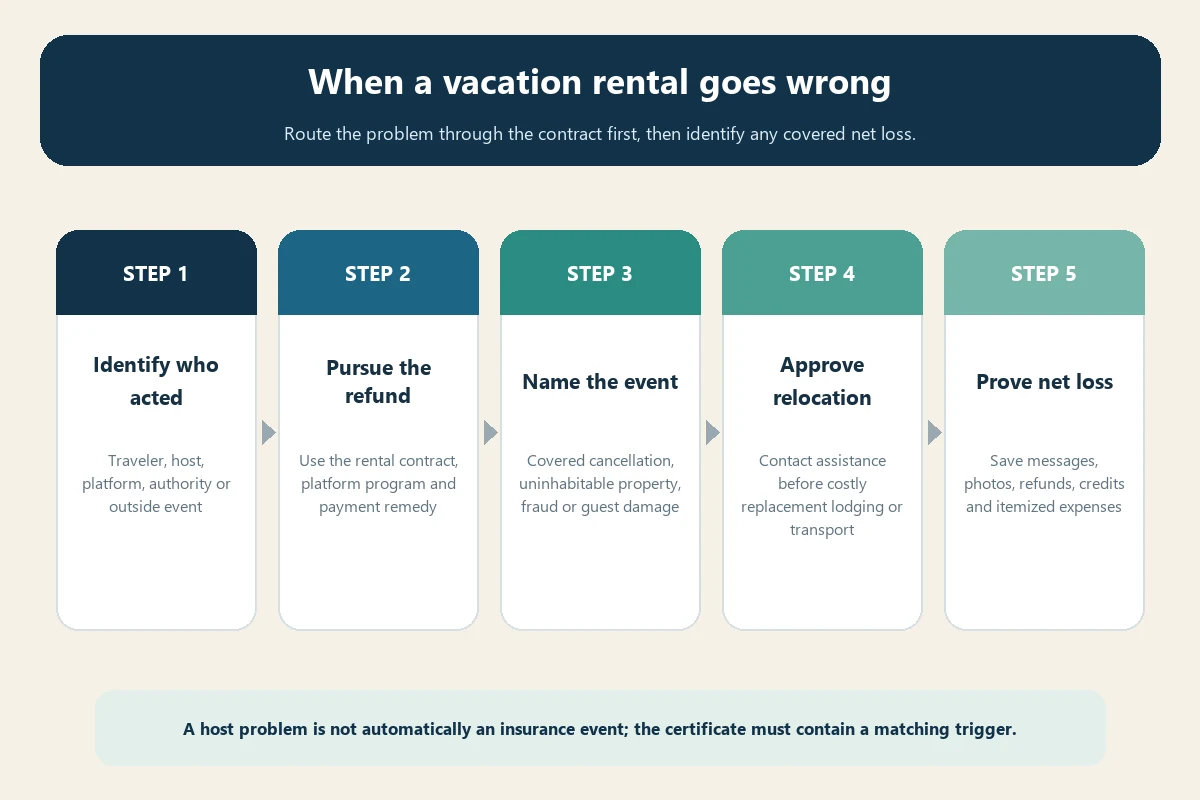
A host cancellation usually starts with the contractual refund or rebooking process. If the platform refunds the booking in full, there may be no insured lodging loss. Extra cost for a more expensive replacement is a separate question and is not automatically trip cancellation.
Ask the insurer:
- Is host cancellation itself a covered event?
- Would financial default apply, and to which entity?
- Can trip delay or interruption cover relocation after check-in?
- Must the property be uninhabitable for a listed reason?
- Is the reimbursement limited to the original prepaid amount?
- What platform refund or card remedy must be pursued first?
Do not cancel the reservation on the guest’s side merely because the host asks. The action can change the refund record and make it harder to prove who canceled. Preserve all messages inside the booking platform and request a written statement of the reason.
When the property is unusable or unsafe
A policy may use terms such as “uninhabitable,” but the definition controls. Fire, flood, storm damage, burglary or loss of essential utilities may qualify under specific wording. Missing amenities, construction noise, weak internet, cleanliness disputes or a disappointing view do not automatically meet that definition.
When a serious problem is discovered:
- Photograph or video the condition immediately.
- Contact the host and platform through the documented channel.
- Allow a reasonable opportunity to correct the issue when safe.
- Request written confirmation if the property cannot be used.
- Call insurance assistance before booking expensive replacement lodging.
The U.S. Department of State lodging-safety guide recommends researching accommodations, keeping backup options and checking locks, alarms, exits and accessibility. Safety planning can reduce the need to make a rushed relocation decision.
Relocation expenses after check-in
If the stay has begun, a covered problem may fall under trip interruption or delay rather than cancellation. Separate the costs:
- unused nights at the original rental;
- refund or platform credit;
- replacement lodging;
- transport to the replacement;
- necessary meals caused by the disruption; and
- extra cost created by a late booking.
A $2,000 replacement is not automatically a $2,000 insured loss. The policy may cap reasonable additional lodging, limit payment to the original arrangement or require a listed cause. The trip interruption guide explains how unused cost and additional transport are evaluated.
Use the benefit-classification guide to avoid submitting the same lodging cost under several sections.
Fake listings and payment fraud
A fake rental is primarily a fraud and payment-recovery problem. Travel insurance may exclude dishonest acts, scams or losses without a covered trip event. Start with the booking platform, card issuer or payment provider and report the fraud promptly.
The FTC warns against vacation-rental requests for wire transfers, gift cards, payment apps or cryptocurrency and recommends verifying the address and obtaining the contract before paying. Keep payment inside the recognized platform when that is the agreed booking channel.
Before booking:
- reverse-search listing photos and verify the address;
- compare the price with nearby properties;
- review the host or management company history;
- confirm the contact channel and check-in method;
- save the listing, amenities and cancellation terms; and
- avoid off-platform payment pressure.
Guest-caused property damage
Accidentally breaking a table, staining a sofa or damaging an appliance is not a trip cancellation claim. Possible sources include a vacation-rental damage plan, a security deposit, personal liability coverage or a homeowners or renters policy. Each has its own territory, exclusions and claims process.
Check:
- accidental versus intentional damage;
- named occupants and guests;
- pets, parties, smoking and prohibited use;
- valuable, fragile or outdoor property;
- deductible and maximum;
- wear, cleaning and maintenance exclusions; and
- claim notice and documentation deadlines.
Photograph the property at arrival and departure. Report damage promptly, keep the host’s repair invoice and do not agree to an unexplained amount. The insurer or platform may require proof that the charge reflects repair rather than improvement or ordinary wear.
Medical and accessibility planning
A vacation rental lacks the staffed front desk and standardized services of a hotel. Confirm stairs, elevator access, heating or cooling, smoke and carbon-monoxide alarms, emergency exits and distance to medical care. If a traveler has mobility or health needs, obtain written answers before the refund window closes.
Travel medical coverage remains separate from the lodging booking. Use the Europe travel medical guide to verify treatment, evacuation, payment and assistance terms.
The vacation-rental evidence file
- Listing page, address, photos and amenities.
- Guest-host contract and house rules.
- Cancellation schedule and platform guarantee terms.
- Payment receipt, refund statement and credits.
- Host and platform messages.
- Check-in instructions and failed-access evidence.
- Arrival and departure condition photos.
- Replacement lodging quotes and itemized receipts.
- Police, fire, utility or local authority records when relevant.
- Policy certificate and written insurer approvals.
Use the Europe policy comparison worksheet to record how each candidate treats lodging cost, uninhabitability, supplier default, interruption and property damage.
A vacation-rental insurance checklist
- □ Property and host identity independently verified.
- □ Cancellation and refund schedule saved before payment.
- □ Payment stays in a traceable authorized channel.
- □ Eligible nonrefundable lodging cost calculated.
- □ Shared-rental cost allocation confirmed.
- □ Host cancellation and relocation wording checked.
- □ Uninhabitable-property definition reviewed.
- □ Guest damage and personal liability handled separately.
- □ Safety, accessibility and backup lodging considered.
- □ Listing, contract, policy and evidence stored offline.
Frequently asked questions
Does travel insurance cover a nonrefundable vacation rental?
It can cover the eligible nonrefundable amount when the traveler cancels for a listed covered reason and all conditions are met. Refunds, credits and recoveries reduce the insured loss.
What happens if the host cancels my European rental?
Use the host or platform refund and rebooking process first. Travel insurance covers extra or unreimbursed costs only if the certificate contains a matching event and benefit.
Will insurance pay for a more expensive replacement apartment?
Not automatically. A covered relocation may have a benefit limit, reasonable-expense test, prior-approval rule or cap tied to the original booking. Ask before committing to a large replacement cost.
Does ordinary travel insurance pay for damage I cause to the rental?
Usually that risk requires a specific accommodation-damage or personal-liability benefit, a separate damage plan or another policy. Do not infer it from trip cancellation, baggage or medical coverage.
