

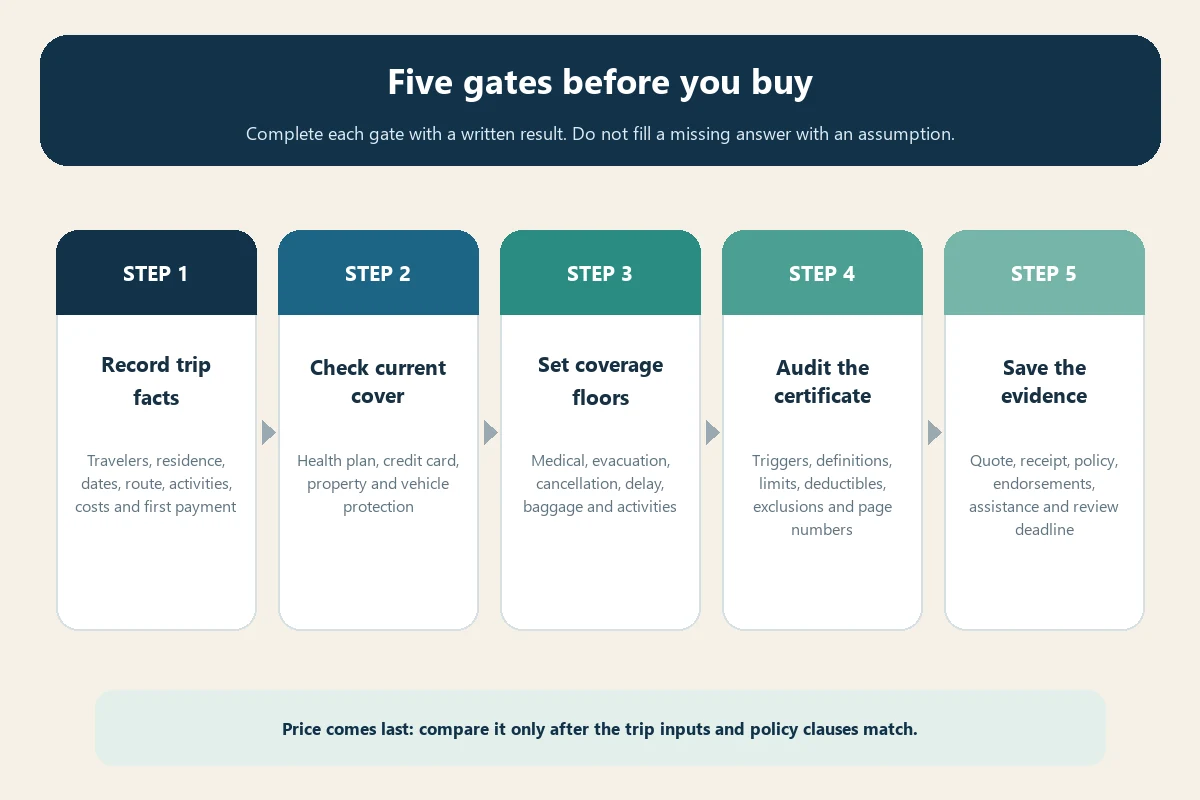
A useful Europe trip insurance checklist does more than name benefits. It records the facts an insurer will use, identifies coverage you already have, preserves time-sensitive options, and ties every decision to the policy certificate. Complete the steps below before checkout so that the policy you buy matches your actual route, costs, health needs and activities.
Key takeaways
- Record the first trip-payment date before requesting quotes.
- List every traveler, date, country, prepaid loss and planned activity.
- Check existing health and credit-card coverage before buying overlapping benefits.
- Compare the state-specific certificates, not only quote cards.
- Save the final quote, certificate, endorsements and assistance details together.
The five checkpoints before you buy
| Checkpoint | What to produce | Why it matters |
|---|---|---|
| 1. Trip facts | A dated itinerary and cost sheet | Quotes and eligibility depend on accurate inputs |
| 2. Existing coverage | A list of confirmed benefits and gaps | Prevents both duplication and dangerous assumptions |
| 3. Coverage floor | Your minimum acceptable terms | Keeps price from becoming the only comparison |
| 4. Certificate review | Page references for each answer | The contract controls the claim |
| 5. Evidence file | Saved documents and contact details | Shows what was bought and supports a later claim |
This sequence is intentionally different from a list of recommended dollar amounts. Limits should reflect the trip and the loss you could not absorb. Use the Europe coverage-limits framework after documenting the exposure.
Checkpoint 1: freeze the facts that drive the policy
Create one source-of-truth sheet for the trip. Do this before opening several quote tabs, because even small input differences can make two prices incomparable.
Travelers and eligibility
- Full legal name and date of birth for each insured traveler.
- State of residence and any residency eligibility stated by the plan.
- Whether anyone is traveling separately or returning on a different date.
- Any age band, trip-length cap or enrollment rule that may apply.
Dates, route and activities
Record the day you leave home, the overnight travel dates and the day you return home. List every destination, transit country, cruise port and side trip. A route through London, Paris and Morocco is not adequately described by entering only “France.” For a complex itinerary, complete the multi-country Europe insurance worksheet.
Add every activity someone might realistically book: skiing, trekking, cycling, scuba diving, sailing, scooter rental, organized sport or paid work. The activity schedule can be more important than the policy’s headline name.
Trip payments and the first-deposit date
Make two columns for each booking: amount paid and amount that would be nonrefundable on the date of a covered cancellation. Do not automatically insure refundable reservations or future spending. Keep the receipt for the earliest trip payment and note its date, because some optional benefits and waivers measure eligibility from that event.
Deadlines vary by plan and state, so this checklist does not assign a universal number of days. The Europe purchase-timing guide explains which terms to find and how later trip payments should be handled.
Checkpoint 2: verify what already protects you
Do not treat “covered abroad” as a complete answer. Ask each current provider to point to the governing document and confirm the applicable limit, deductible, network rule and payment process.
- US health plan: emergency care abroad, out-of-network treatment, prescriptions, medical transport and whether you must pay first.
- Credit card: which bookings must be charged to the card, covered reasons, trip-length limits, per-person caps, common-carrier rules and claim deadlines.
- Homeowners or renters policy: personal-property coverage away from home, deductible and valuable-item sublimits.
- Auto coverage: whether any protection applies outside the United States; do not assume a travel policy replaces local vehicle liability coverage.
The CDC Yellow Book advises travelers to review domestic health coverage, consider supplemental health or evacuation insurance for unmet needs, and be prepared for providers abroad to require payment before reimbursement. The U.S. Department of State likewise recommends checking health, evacuation and trip-cancellation protection and notes that US auto insurance might not apply abroad.
If a card is part of the plan, compare its actual guide to the risks that remain. Our credit-card versus standalone policy guide separates card benefits from medical and evacuation coverage.
Checkpoint 3: write a coverage floor
A coverage floor is a short list of terms a policy must meet before price is considered. Build it from the trip facts and current gaps.
- Emergency medical treatment and the amount you could not self-fund.
- Medical evacuation, repatriation and any separate search-and-rescue need.
- Trip cancellation equal to the eligible prepaid loss you choose to insure.
- Trip interruption, including extra transport and unused arrangements.
- Delay and missed-connection terms that fit the itinerary’s tightest transfer.
- Baggage terms that match high-value items, depreciation rules and deductibles.
- Coverage for every planned activity and vehicle use.
- Acceptable treatment of medical history and any time-sensitive waiver.
The latest NAIC consumer guide emphasizes that each policy has its own limits and covered or excluded situations. It also recommends checking credit-card protection and asking the insurer exactly what the policy covers. That is why a personal floor is more useful than copying another traveler’s limits.
Checkpoint 4: test the certificate clause by clause
Download the certificate or policy wording for the traveler’s state of residence. Also save the schedule of benefits and every endorsement. Then use the Europe policy comparison worksheet to place candidates on the same inputs.
For every required benefit, write down five things:
- the event that triggers coverage;
- the maximum and any smaller sublimit;
- the deductible, coinsurance or waiting period;
- the exclusion or condition most likely to remove coverage; and
- the certificate page supporting the answer.
Read definitions before deciding that ordinary words have ordinary meanings. “Family member,” “traveling companion,” “common carrier,” “initial trip deposit,” “pre-existing condition” and “uninhabitable” can all have contract-specific meanings. The guide to reading a travel insurance policy gives a fast review order.
Check the deductible’s frequency, not only its amount. It may apply once per policy, per traveler, per trip or per incident. The Europe deductible guide shows how the same displayed deductible can produce different out-of-pocket costs.
Resolve territory and advisory wording
Confirm that every country and territory is eligible on the travel dates. Then separate geographic eligibility from exclusions for war, civil unrest, sanctions, government advisories or known events. A destination can be inside the policy territory while a particular cause of loss remains excluded. Use the Europe country exclusions guide for that two-part check.
Resolve medical history before checkout
Do not decide for yourself that a condition is too minor or too old to matter. Review the look-back definition, waiver conditions and medical-fitness language, then obtain a written answer from the seller or insurer if the application is unclear. A waiver is not blanket cover for every health-related event. Our pre-existing condition waiver guide explains the common eligibility tests.
Understand authorization and payment
Write down when the assistance company must be contacted, who authorizes an evacuation, whether medical coverage is primary or secondary, and whether the traveler may need to pay first. Confirm how to reach assistance from abroad and whether collect-call or app options exist. A large benefit limit does not eliminate a prior-authorization requirement.
Checkpoint 5: perform a checkout audit
Before submitting payment, compare the final application against the source-of-truth sheet. Check spelling, birth dates, residence, travel dates, destinations and insured trip cost. Confirm that every traveler is listed and that selected upgrades appear on the final quote.
After purchase, save these items in one offline-accessible folder:
- dated quote and payment receipt;
- declarations or confirmation page;
- schedule, certificate and state endorsements;
- assistance and claim contact details;
- first trip-payment receipt and current cost sheet;
- written answers supplied by the insurer or seller; and
- the review-period deadline and cancellation instructions.
Read the issued documents during the review or free-look period. Confirm that they match the version examined before purchase. If an itinerary change increases the nonrefundable cost or adds a country, activity or travel day, ask whether the policy must be updated and by when.
A copyable Europe trip insurance checklist
- □ I recorded the first trip-payment date and kept the receipt.
- □ I listed all travelers, dates, countries, transits and activities.
- □ I separated refundable spending from eligible nonrefundable cost.
- □ I confirmed existing health, card, property and auto protection in writing.
- □ I wrote minimum acceptable terms before comparing premiums.
- □ I obtained the certificate and endorsements for my state.
- □ I tied each coverage answer to a certificate page.
- □ I checked definitions, exclusions, sublimits and authorization rules.
- □ I resolved medical-history and activity questions before payment.
- □ I checked the final issued documents during the review period.
- □ I saved the assistance number where another traveler can find it.
- □ I know how and when to update later trip payments or itinerary changes.
Common checklist failures
Comparing different trip costs. A plan insuring $8,000 of cancellation exposure should not be compared on premium with one insuring $3,000.
Relying on a summary label. “Comprehensive,” “premium” and “Europe” are marketing descriptions, not standardized promises.
Buying before obtaining the certificate. If the governing wording is unavailable, the key questions cannot be verified.
Using a checklist as a recommendation. This page organizes the decision; it does not determine whether a particular plan, limit or deductible is suitable for a traveler.
Frequently asked questions
What information do I need to buy Europe trip insurance?
At minimum, gather traveler ages and residence, travel dates, every destination, the first trip-payment date, eligible nonrefundable cost, planned activities and existing coverage. Medical-history questions depend on the plan’s application and certificate.
Should I buy the policy before booking the whole trip?
You can often buy after the first trip payment and update insured cost as additional nonrefundable arrangements are booked, but deadlines and update rules vary. Use the actual certificate and ask the insurer how later payments must be reported.
Is a credit card enough for a Europe trip?
It depends on the card’s current Guide to Benefits and how the trip was paid. Many cards concentrate on cancellation, delay, rental vehicles or baggage rather than full emergency medical and evacuation protection. Compare the card’s documented terms to your coverage floor.
Which document should I trust if the quote page and policy differ?
The issued certificate, schedule and applicable endorsements govern. Ask the insurer to resolve any conflict in writing before the review period expires.
