
Original Medicare may cover medically necessary care on a cruise ship only when the ship is in a U.S. port or no more than six hours from a U.S. port when the service is provided and the shipboard doctor meets Medicare’s requirements. When the ship is more than six hours away, Medicare says it does not cover the shipboard service—even in an emergency. A scheduled itinerary, foreign port, or U.S. departure does not replace the location-and-time test.
This article is educational, not medical, legal, financial, or insurance advice. Medicare, Medicare Advantage, Medigap, cruise-line, and travel-policy terms can change. Confirm the current rules and your exact plan before sailing.
Key takeaways
- The six-hour rule is measured when the medical service occurs, not when the cruise began or ended.
- Medicare may cover shipboard care in a U.S. port or within six hours of arrival at or departure from one, subject to provider and service rules.
- More than six hours from a U.S. port generally means no Original Medicare coverage for shipboard care.
- Foreign-port hospitals, local ambulances, ship-to-shore rescue, evacuation, and return home are separate claim segments.
- Medicare Advantage or eligible Medigap coverage may add benefits, but the exact contract controls.
Reviewed: August 16, 2026.
What the Medicare six-hour cruise rule says
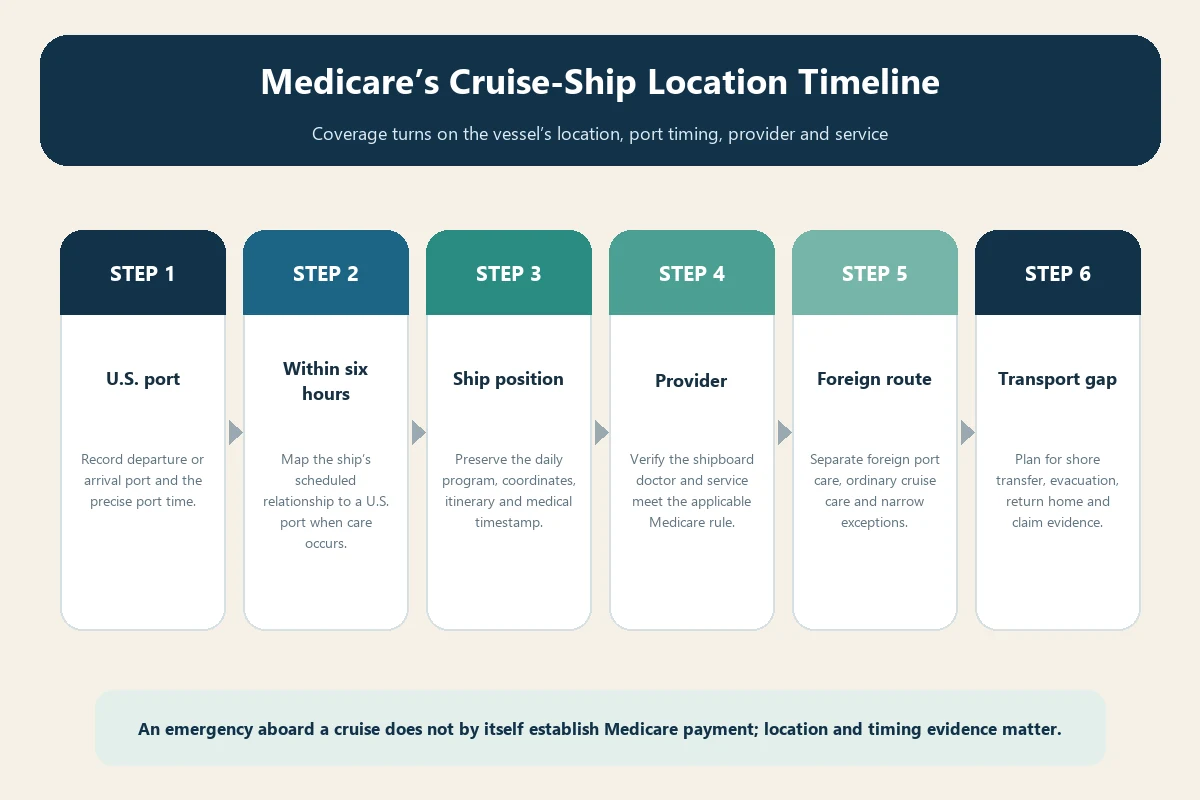
Medicare’s April 2026 publication explains that medically necessary shipboard care may be covered when the vessel is in a U.S. port or no more than six hours from a U.S. port. The shipboard doctor must be legally allowed to provide Medicare services on the vessel. The publication also states that Medicare does not cover services received when the ship is more than six hours from a U.S. port.
The rule can apply while a ship is departing from or arriving at a U.S. port. It is a proximity-in-time rule, not a promise that every service within the window is payable. Normal Medicare requirements, deductibles, coinsurance, medical necessity, and claim procedures remain.
The clock starts with the service, not the diagnosis
A passenger may feel ill at 8 a.m., call the cabin steward at 9 a.m., and see the ship’s doctor at noon. Coverage analysis should identify when each medical service was furnished and where the ship was in relation to a U.S. port at that time. A symptom that began within six hours does not necessarily preserve coverage for treatment later outside the window.
Ask the ship for a navigation or port-time statement when timing matters. Keep the itinerary, daily program, medical-center timestamps, ship’s time zone, and U.S. port schedule. Do not rely solely on the passenger’s phone clock, which may change time zones automatically.
A U.S. departure does not create voyage-long coverage
A seven-day cruise from Miami may spend most of its route more than six hours from a U.S. port. Conversely, a foreign-flagged ship approaching a U.S. port may enter the six-hour window. The cruise line, flag, booking currency, and embarkation city do not decide the Medicare rule by themselves.
Create a simple itinerary map with every U.S. port, foreign port, sea day, and approximate transit time. Mark where the ship is expected to be more than six hours from a U.S. port. Those are the periods when a senior should plan as though Original Medicare will not cover shipboard care.
Doctor and service eligibility still matter
Even inside the time window, the doctor must meet the legal requirements Medicare describes, and the care must be medically necessary and otherwise eligible. Cruise medical centers often operate outside ordinary U.S. provider networks and may require immediate payment. The presence of a Medicare card does not guarantee the medical center will bill Medicare or accept the Medicare-approved amount.
Before sailing, ask the cruise line whether the medical center submits Medicare claims, supplies itemized records in English, identifies the treating professional, and provides vessel-position evidence. The answer is operational guidance, not a coverage guarantee.
Separate five possible claim segments
- Onboard evaluation: examination, testing, medication, or observation in the ship medical center.
- Ship-to-shore movement: tender, rescue boat, helicopter, or port transfer.
- Local ambulance: transport from the dock or airport to a facility.
- Foreign hospital care: emergency department, inpatient stay, physicians, imaging, or surgery.
- Later transfer or return: movement to another hospital or medically supported travel home.
One covered segment does not make the others covered. Medicare’s shipboard rule addresses eligible care on the vessel. Foreign hospital coverage follows separate, narrow rules. Evacuation and return travel require their own authorization and benefit language.
What happens in a foreign port?
Care received after disembarkation in another country is no longer shipboard care. Original Medicare generally does not cover foreign health care except for limited situations involving a closer foreign hospital during a U.S. emergency, certain direct travel through Canada between Alaska and another state, or a U.S. resident whose closest appropriate hospital is across a border.
A normal Caribbean, European, Asian, or South American port visit usually does not fit those exceptions. The traveler may need travel medical coverage, an applicable Medicare Advantage supplemental benefit, or eligible Medigap foreign emergency coverage. Our Medicare in Europe guide explains the general foreign-care baseline.
Medicare Advantage may add cruise or worldwide benefits
A Medicare Advantage plan may offer benefits beyond Original Medicare, including plan-specific worldwide emergency, urgently needed, or emergency transportation coverage. Never infer the scope from the insurer’s brand. Read the current Evidence of Coverage for the exact contract and year.
Ask whether shipboard care beyond six hours is included, how the plan defines emergency and urgent services, whether foreign-port care qualifies, what cost sharing and maximum apply, and whether the plan pays the provider directly or reimburses the member. Also ask when continued care becomes post-stabilization treatment and needs authorization.
Medigap can help, but it is not cruise insurance
Certain standardized Medigap plans provide a foreign travel emergency benefit. Medicare describes 80% payment for certain medically necessary emergency care after a $250 calendar-year deductible, subject to a $50,000 lifetime maximum and a requirement that the emergency begin during the first 60 days of the trip. The actual policy and remaining lifetime balance control.
This benefit does not create trip cancellation, missed-port, cabin-confinement, baggage, or broad evacuation coverage. A local emergency service and an air transfer home may be treated differently. Verify the policy rather than treating Medigap as a cruise package.
Medical evacuation is a different decision
A ship may disembark a passenger at the nearest practical port, while a travel insurer’s evacuation benefit may require transport to the nearest appropriate medical facility. That endpoint can be far from the traveler’s home and may not be the hospital the family prefers.
Our cruise medical evacuation guide maps ship, port, ambulance, hospital, aircraft, and return-home segments. Also review who approves an evacuation. A captain’s disembarkation decision, a doctor’s transfer recommendation, and an insurer’s coverage authorization are related but not identical.
Prescription medicine supplied onboard
Medicare drug plans generally do not cover prescription drugs purchased outside the United States. A ship’s pharmacy or medical center may dispense medication under its own billing system. Even if a medical visit is Medicare-eligible, do not assume every medicine will be paid under Part D.
Carry enough permitted medication for the voyage plus a reasonable disruption buffer, in original labeled packaging. Confirm refill limits, storage, controlled-substance rules, and destination laws. The travel prescription medication guide helps build a document and supply plan.
Billing and claim evidence
Passengers are often asked to pay the ship medical center before disembarkation. Request an itemized statement showing service dates and times, diagnoses, procedures, drugs, provider identity, currency, and proof of payment. Obtain the medical record, not just the cabin folio charge.
For a Medicare claim, determine whether the provider will submit it or whether the beneficiary must use the Patient’s Request for Medical Payment form (CMS-1490S). For a Medicare Advantage or travel-insurance claim, use that plan’s form and deadline. Keep the same source documents but do not assume the insurers use identical definitions or exchange claims automatically.
Build a cruise coverage matrix
| Event | Original Medicare question | Other coverage to verify |
|---|---|---|
| Onboard care in U.S. port | Provider and service eligible? | Plan cost sharing and direct billing |
| Onboard care within six hours | Exact time and port proximity? | Evidence of vessel position |
| Onboard care beyond six hours | Generally not covered | MA, Medigap, or travel medical |
| Foreign-port hospital | Does a narrow foreign exception apply? | Travel medical and assistance |
| Ship-to-shore evacuation | Not assumed from shipboard rule | Evacuation authorization and endpoint |
| Return home | Not general Medicare transport | Repatriation or membership language |
Pre-cruise verification questions
- Which points of the itinerary are within six hours of a U.S. port?
- What time source will document the location when care occurs?
- Does the onboard doctor meet Medicare’s requirements?
- Will the medical center submit Medicare or plan claims?
- What itemized records will the ship provide?
- Does the exact Medicare Advantage plan add shipboard or worldwide benefits?
- Does the Medigap policy include foreign emergency coverage, and what lifetime balance remains?
- Which travel policy covers onboard treatment beyond the Medicare window?
- Who arranges ship-to-shore transfer or evacuation?
- Is the covered endpoint the nearest appropriate facility or another destination?
- What happens after stabilization?
- How are companion lodging, missed cruise, and return travel handled?
Three scenarios to rehearse
Illness four hours after leaving Seattle
The timing may fall within Medicare’s cruise window, but the provider and service still must qualify. Preserve the ship’s departure time, service timestamp, medical record, and bill.
Injury on a mid-ocean sea day
Original Medicare generally will not cover shipboard care more than six hours from a U.S. port. Test the exact MA, Medigap, and travel policy, including evacuation authorization and payment mechanics.
Emergency after disembarking at a foreign port
This is foreign land-based care, not shipboard treatment. Separate hospital, local ambulance, trip interruption, and later repatriation claims. The cruise insurance clause guide helps review interruption and missed-port language.
FAQ
Does Medicare cover emergencies anywhere on a cruise?
No. Original Medicare’s shipboard rule depends on being in a U.S. port or no more than six hours from one when the service occurs, plus other eligibility requirements.
Does the six-hour rule apply only to emergencies?
Medicare’s publication describes medically necessary shipboard health care and focuses on location, timing, and provider status. Every service still must meet Medicare rules.
Will Medicare pay for a helicopter from the ship?
Do not assume so. Ship-to-shore rescue and medical evacuation must be analyzed separately from shipboard care, with medical necessity, route, supplier, authorization, and destination documented.
Can Medigap cover care when the ship is farther away?
An eligible Medigap policy may cover certain foreign travel emergencies, subject to its first-60-days rule, deductible, coinsurance, lifetime limit, and definitions. Verify the exact contract.
Bottom line
Medicare cruise ship coverage is a timestamped location test, not voyage-wide protection. Map U.S. port proximity, record when each service occurs, confirm the doctor and claim process, and separate onboard care from foreign hospital treatment, evacuation, and return home. Fill each uncovered segment before sailing.
