
To request Medicare payment for qualifying foreign medical care when the provider does not file, use the Patient’s Request for Medical Payment form, CMS-1490S, and attach the itemized bill plus evidence showing why Medicare’s narrow foreign-coverage rule applies. Mail the packet to the Medicare Administrative Contractor listed in the current form instructions. Filing a form does not create coverage; the hospital, location, route, service, timing, and Medicare eligibility must still qualify.
This article is educational, not legal, medical, tax, or insurance advice. Forms, addresses, deadlines, and contractor instructions can change. Download the current form from CMS and confirm the submission route with Medicare before mailing sensitive records.
Key takeaways
- Foreign hospitals and doctors are not required to submit Medicare claims.
- CMS-1490S is the beneficiary request form, not proof that the foreign service is covered.
- Attach an itemized bill and records proving the relevant foreign-coverage exception.
- Send the packet to the correct Medicare Administrative Contractor using the current address table.
- Keep a complete copy, delivery evidence, and the Medicare Summary Notice for follow-up or appeal.
Reviewed: August 16, 2026.
First decide whether Original Medicare could cover the foreign care
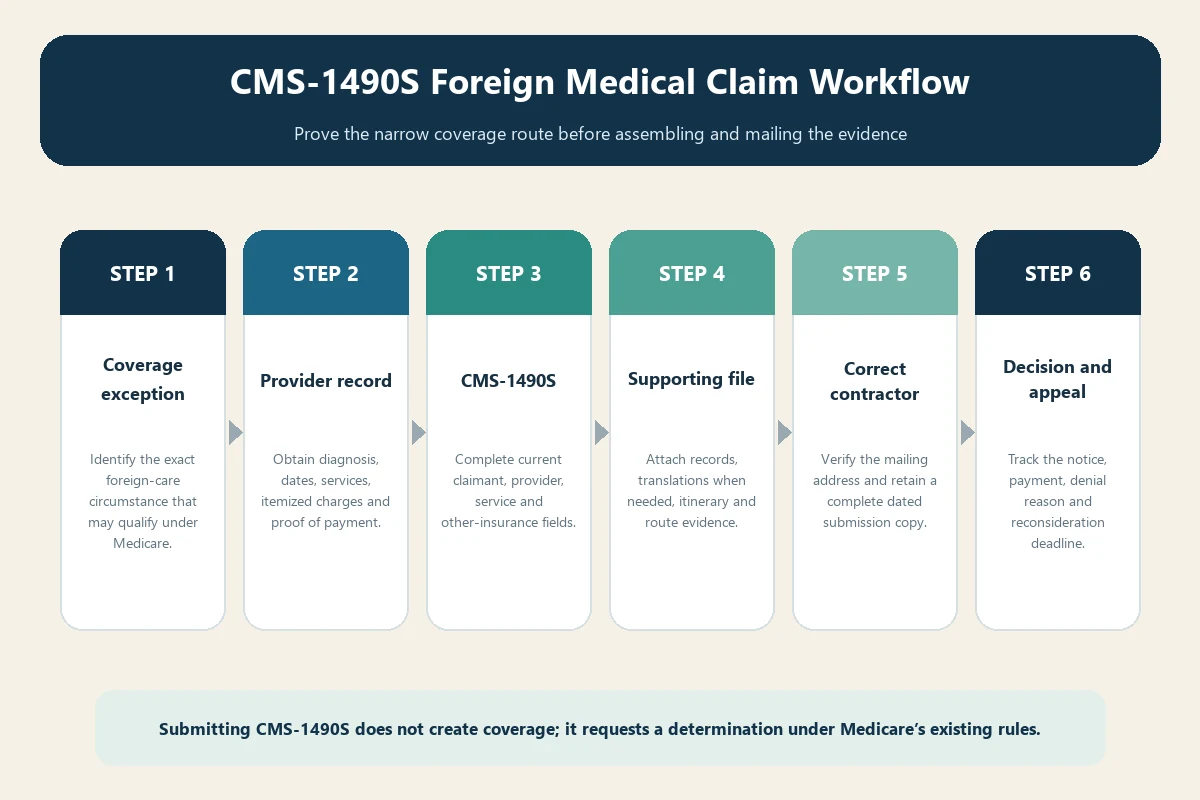
Original Medicare generally does not cover health care outside the United States. CMS-1490S is useful only when there is a reasonable Medicare payment question. Medicare’s April 2026 publication describes limited foreign hospital situations:
- An emergency begins in the United States and a foreign hospital is closer or easier to reach than the nearest U.S. hospital able to treat the condition.
- An emergency occurs in Canada during travel without unreasonable delay by the most direct route between Alaska and another state, and the Canadian hospital is closer or easier to reach.
- A beneficiary lives in the United States and a foreign hospital is closer to the home than the nearest U.S. hospital able to provide the needed care.
Medicare also describes limited shipboard coverage when a vessel is in a U.S. port or no more than six hours from one and the doctor meets Medicare requirements. Ordinary tourism abroad usually does not qualify. Our Medicare in Europe guide explains the baseline.
CMS-1490S cannot replace missing eligibility facts
The form identifies the beneficiary, service, provider, payment request, and reason the provider did not file. The attachments show why the service may be payable. A receipt saying “hospital” or “emergency” is rarely enough for a complex foreign exception.
Build a short claim theory before completing the form:
covered situation + eligible service + medical necessity + correct amount + timely filing.
If one element is uncertain, call 1-800-MEDICARE and ask which evidence applies. Record the date, representative, and reference number, while understanding that a call does not guarantee the contractor’s decision.
Download the current form and instructions
Use the CMS form page or Medicare’s filing-a-claim page, not a saved copy from an old blog. Confirm the edition date, instructions, Medicare Administrative Contractor address table, and whether a special foreign-travel attachment applies. Fillable forms are generally completed electronically, printed, signed, and mailed with the records specified by CMS.
Checked October 21, 2026: CMS’s CMS-1490S form page says only the revised 01-18 version of the form has been accepted since April 1, 2019, that the form can be filled in online, then printed and mailed, and that the contractor addresses are on pages 7 through 18 of the instructions. Medicare.gov’s filing a claim page lists what to send: the completed form, the itemized bill, a letter explaining why you are submitting the claim yourself, and any supporting documents.
Do not mail the packet to a random Social Security, Medicare Advantage, Medigap, or insurance office. The correct contractor depends on the claim and instructions. Verify the address immediately before sending.
Information the form requests
The current CMS-1490S asks for beneficiary and claim information such as the Medicare number, contact details, description of illness or injury, whether the condition is related to employment or an accident, and the medical services received. It also requests the reason the provider did not submit the claim and a signature certifying the request.
Match names, dates, and numbers exactly to the Medicare card and provider documents. Explain abbreviations. If a representative signs or communicates, include the required authorization or representation documentation.
The itemized bill
An itemized bill should identify the patient, provider or facility, address, dates of service, each service or supply, charges, diagnosis or reason for treatment, and amount paid. Ask for a detailed clinical invoice rather than a credit-card slip or single total.
Foreign facilities may use unfamiliar codes, bundled charges, or a different calendar and number format. Do not alter the original. Add a labeled English explanation or certified translation if the contractor requests one, while retaining the source record. Preserve the original currency and payment evidence; do not invent a conversion rate.
Proof of payment
Attach receipts, card statements, bank evidence, or hospital account statements showing what the beneficiary actually paid and any refund or balance. Redact unrelated transactions while keeping the payer, provider, date, amount, and currency visible. If another insurer paid part of the bill, include its Explanation of Benefits and show the remaining amount.
A provider invoice and proof of payment answer different questions. The invoice establishes the service and charge; the receipt establishes the transaction.
Evidence for a U.S.-border emergency
For an emergency that began in the United States and led to a foreign hospital, include the origin, symptom onset, dispatch record, ambulance run sheet, route, timestamps, and the capability of the nearest U.S. and foreign hospitals. Explain why the foreign facility was closer or easier to reach.
A map alone may not show that a hospital could treat the condition. Add a clinician or dispatch statement when available. If ambulance care is claimed, our ambulance coverage guide helps organize origin, destination, and medical necessity.
Evidence for travel through Canada to or from Alaska
Show that the traveler was moving between Alaska and another state without unreasonable delay by the most direct route. Useful records include the itinerary, border entries, reservations, fuel receipts, lodging, route maps, road closure or weather notices, and the emergency location.
Also identify the nearest U.S. hospital able to treat the condition and why the Canadian hospital was closer or easier to reach. A long discretionary detour can raise a different question than a necessary overnight stop or road closure.
Evidence for a U.S. border resident
Include proof that the beneficiary lives in the United States, the home location, the needed service, and the closest U.S. and foreign hospitals able to provide it. Show distance and practical route, not merely straight-line mileage. This exception may apply to qualifying emergency or non-emergency care, but capability and proximity remain central.
Evidence for cruise-ship care
For shipboard services, preserve the date and local time of each treatment, vessel position, last or next U.S. port, scheduled arrival or departure, itinerary, provider identity, and proof the doctor met the relevant legal requirements. More than six hours from a U.S. port generally falls outside Original Medicare coverage.
Separate shipboard medical charges from a foreign-port hospital, rescue, local ambulance, evacuation, or return-home transport. They may follow different rules. A complex transfer benefits from the medical evacuation claim-document checklist.
Doctors, ambulance, and inpatient services may be separate
When Medicare covers an eligible foreign inpatient hospital stay, Part A can address qualifying inpatient care, while Part B may address certain ambulance and doctor services immediately before and during the stay. Each supplier may issue a separate bill. Organize attachments by provider and date.
Do not merge all charges into one self-created total. Submit the documentation as CMS directs and clearly cross-reference related services. A return ambulance home after discharge is generally not covered under Medicare’s foreign rules.
Coordinate with Medigap, Medicare Advantage, and travel insurance
CMS-1490S requests Original Medicare payment. A Medicare Advantage plan uses its own claim process, and the Evidence of Coverage controls international supplemental benefits. A Medigap carrier may need Medicare’s determination or may process an eligible foreign emergency benefit under separate instructions.
A travel insurer can also require proof that Medicare denied or paid first. Call each payer and ask for the order, deadline, and required Explanation of Benefits. Our assistance-line versus claims-team guide explains why arranging care and deciding reimbursement are separate functions.
Mailing and privacy safeguards
- Use the current contractor address from the CMS instructions.
- Keep the original records unless CMS specifically requires them.
- Mail a complete, legible copy with the signed form.
- Use trackable delivery appropriate for sensitive information.
- Record the mailing date, tracking number, and packet page count.
- Do not email medical records to an unverified address.
- Store the duplicate securely and limit exposed Medicare numbers.
Deadlines
Medicare’s filing guidance says claims generally must be filed no later than 12 months after the date of service. Do not wait for the last month. Foreign records, translations, other-insurer decisions, and contractor questions can take time. Confirm the deadline for the exact claim with Medicare and submit a complete packet promptly.
If a provider says it will file, monitor the Medicare Summary Notice rather than assuming submission occurred. When a deadline is approaching, ask Medicare for instructions.
Track the claim after submission
Watch the Medicare account and Medicare Summary Notice. Keep notes of every call, request for information, response, and deadline. If CMS returns the packet or asks for a missing document, preserve the envelope and respond to the stated address and time frame.
A silence from the contractor is not approval. A payment amount also does not prove another insurer has received the decision. Forward the Medicare notice to Medigap or travel insurance only through the channel that policy specifies.
If Medicare denies the claim
Read the reason code and explanation. A denial may involve noncoverage outside the United States, missing evidence, an ineligible provider or service, filing timing, medical necessity, or payment coordination. Correcting a missing document is different from disputing Medicare’s interpretation.
The Medicare Summary Notice explains appeal rights and deadline. Build the appeal around the stated reason and controlling rule. Do not simply resend the same packet. For a separate travel-insurance denial, use the process in our travel insurance claim-denial guide.
Foreign claim packet index
- Cover letter with the claimed exception and timeline
- Signed current CMS-1490S
- Medicare card information as instructed
- Itemized provider bills
- Clinical and hospital records
- Proof of payment and currency
- Route, location, residence, or vessel evidence
- Ambulance or transport records
- Other-insurer Explanation of Benefits
- Translations or explanations
- Delivery and follow-up log
The general travel insurance claim documentation guide can help standardize filenames and evidence, but submit only what Medicare requests.
FAQ
Can a foreign hospital bill Medicare directly?
It is not required to. The beneficiary may need to pay and submit CMS-1490S with itemized bills and supporting records.
Does submitting CMS-1490S mean Medicare will pay?
No. The form requests payment. The foreign service must fit a Medicare coverage exception and all other requirements.
Where should CMS-1490S be mailed?
Use the Medicare Administrative Contractor address in the current official instructions. Verify it immediately before mailing.
Is a credit-card receipt enough?
Usually not. Include an itemized medical bill plus proof of payment and evidence supporting the foreign-coverage exception.
Bottom line
A successful foreign Medicare submission is an evidence project, not a form-only task. Identify the precise exception, obtain itemized clinical and payment records, document geography and timing, use the current CMS-1490S instructions, mail the packet to the correct contractor, and preserve every page for follow-up or appeal.
