
Travel insurance for seniors planning pacemaker international travel must be evaluated against the underlying heart condition, implant date, recent symptoms or procedures, medication changes, and policy definitions. Carry the device identification card and clinical summary, confirm airport-screening guidance for the exact implant, identify capable destination care, and understand how emergency medical, cancellation, interruption, and evacuation benefits treat a pre-existing condition.
This article is educational, not medical, device, aviation, legal, or insurance advice. Fitness to travel, electromagnetic precautions, remote monitoring, and emergency response require the cardiology or electrophysiology team and device manufacturer. Seek urgent care for concerning symptoms or device alerts.
Key takeaways
- The implanted device and the condition it treats can both matter during underwriting and claim review.
- Recent implantation, lead revision, generator change, hospitalization, shock, symptoms, or medication changes deserve specific policy review.
- Carry the device card and ask the manufacturer how security screening and magnets affect the exact system.
- Map the nearest hospital with cardiac rhythm and device capability at each destination.
- Emergency medical care and medical evacuation are separate benefits with different decision-makers and endpoints.
Reviewed: August 16, 2026.
Pacemaker and ICD are not the whole diagnosis
A pacemaker helps manage certain slow or irregular rhythms. An ICD can detect and treat dangerous rhythms. Travelers may also have coronary disease, heart failure, atrial fibrillation, congenital disease, or other conditions. The insurance application and certificate can ask about diagnoses, treatment, devices, symptoms, and recent changes.
Do not answer only “pacemaker” if the application requires the reason for implantation or related care. Accurate disclosure follows the actual questions, not a guess about what the insurer considers important.
Clinical clearance before booking
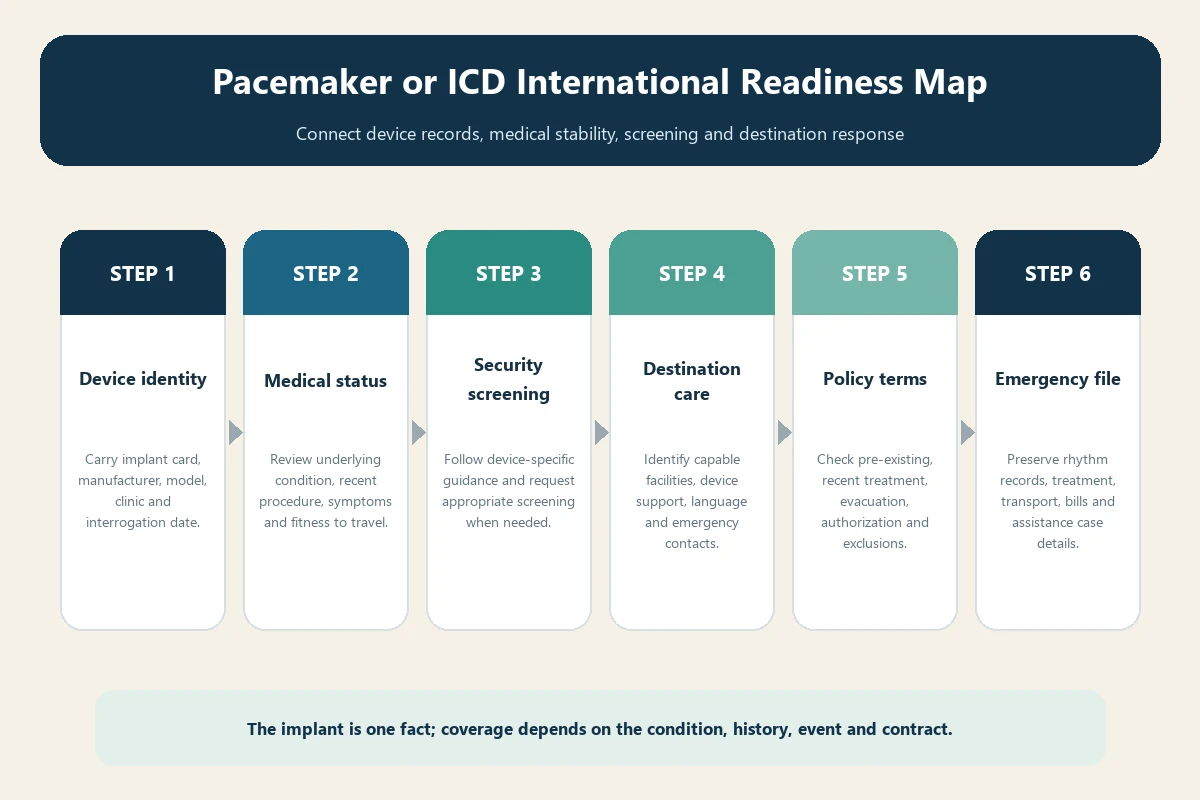
Ask the cardiology or electrophysiology team whether the traveler is stable for the flight duration, altitude, exertion, heat, remote itinerary, cruise, or high-elevation destination. Review recent procedures, wound healing, device checks, battery status, symptoms, shocks, hospital visits, and follow-up schedule.
The clinician should decide activity, medication, compression, hydration, and movement advice. Insurance cannot turn a medically unsuitable trip into a safe one. Delay nonrefundable commitments until the clinical and policy questions are resolved.
The pre-existing-condition timeline
Travel policies can exclude losses connected to a pre-existing condition unless a waiver applies. The policy’s look-back period may examine symptoms, diagnoses, treatment, testing, prescriptions, and changes before coverage begins. A device implanted years ago with stable follow-up can present a different record from a generator change last week.
Create a dated timeline of implantation, revisions, interrogations, remote alerts, shocks, emergency visits, medication changes, and clinician clearance. Use our senior pre-existing-condition questions to compare the record with the certificate.
A waiver has conditions
A pre-existing-condition waiver commonly requires purchase within a specified period after the initial trip payment and may have other eligibility rules. It removes the exclusion only for an otherwise covered loss. It does not create coverage for a planned procedure, routine device check, non-medically necessary transfer, or an excluded activity.
Ask the insurer to address a hypothetical cancellation after a new arrhythmia and an emergency hospitalization abroad. Obtain the controlling language in writing.
Carry the device identification card
The device card should identify the manufacturer and implant system. Carry it in an accessible place, separate from a phone case that may contain magnets. Keep the electrophysiology clinic and manufacturer support numbers and a concise medical summary with implant date, device type, medicines, allergies, and relevant diagnoses.
Do not publicly expose the full medical record. A short emergency card and secure digital access can balance speed and privacy.
Airport security screening
TSA instructs travelers to tell the security officer about an implanted medical device and provides screening alternatives. Device manufacturers may publish specific instructions for walk-through detectors, handheld wands, body scanners, and manual screening. The exact implant and screening equipment matter.
Show the device card, follow manufacturer guidance, and allow extra time. U.S. procedures do not automatically apply at a foreign airport. Contact the return and transit airports or airline assistance service if needed.
Magnets and electronic devices
The FDA warns that some consumer electronics contain magnets that can interfere with certain implanted cardiac devices when held very close. Follow the implant manufacturer’s current distance and use instructions for phones, watches, headphones, charging cases, magnetic clasps, and medical or security equipment.
Do not create a universal safe-distance rule from a general article. Keep device-specific instructions and ask the electrophysiology team what to do after suspected interference or an alert.
Remote monitoring abroad
A home monitor may depend on cellular service, Wi-Fi, power, an app, or a region-supported connection. Ask the device clinic whether monitoring should travel, whether transmissions work in the destination, and what loss of connectivity means clinically. A dashboard that stops updating is not necessarily a device failure, but only the care team can interpret it.
Confirm power input, plug type, privacy, data roaming, account access, and technical support. Never place the monitor in checked baggage if the clinic says it is needed during the trip.
Destination cardiac capability
Identify hospitals that can evaluate the traveler’s likely emergencies and, where relevant, interrogate the specific device. A general clinic may treat symptoms but lack electrophysiology or manufacturer equipment. Confirm capability through the care team or assistance provider rather than an unverified directory entry.
For cruises, islands, safaris, or rural trips, map local stabilization and the route to a regional cardiac center. Record emergency numbers, language support, transport, and after-hours contacts.
Medication continuity
Many travelers with implanted devices take anticoagulants, antiarrhythmics, blood-pressure medicines, diuretics, or other prescriptions. Arrange an adequate lawful supply from the United States, original labels, time-zone plan, and storage. Medicare Part D generally does not cover retail prescriptions bought outside the United States.
Our travel prescription medication guide explains refills, labels, and foreign replacement. Never change a medicine because the time zone or itinerary is inconvenient.
What emergency medical insurance may cover
A travel medical benefit can pay eligible unexpected treatment for an illness or injury, subject to the pre-existing-condition rules, deductible, coinsurance, limits, exclusions, and coordination. A device interrogation after symptoms can be part of emergency evaluation, while a scheduled routine check is planned care.
Ask how the policy treats an ICD shock without symptoms, palpitations, fainting, chest pain, device alert, suspected lead problem, infection, or generator issue. The treating clinicians decide medical care; the insurer decides payment under the contract.
Direct billing and payment
A foreign hospital may request a deposit before admitting or transferring the traveler. Assistance might locate a cardiac center, arrange a guarantee for a covered event, or only provide a referral. Confirm the operating model before travel.
The direct-billing guide separates provider acceptance, assistance, and reimbursement. Carry payment access without assuming it replaces insurance.
Medical evacuation and endpoint
Evacuation coverage commonly applies when the assistance company and medical professionals determine that local care is inadequate. The normal endpoint may be the nearest appropriate facility with cardiac capability, not the United States or the traveler’s preferred hospital.
Device presence may influence monitoring, escort, aircraft, medication, fit-to-fly, and receiving-facility needs. Use the evacuation approval guide and fit-to-fly guide to map the decision.
Trip cancellation after a cardiac change
Cancellation can be eligible when a covered illness or complication makes the traveler medically unable to go and the policy’s documentation and pre-existing-condition rules are satisfied. A clinician’s recommendation not to travel is important but does not override an exclusion.
Keep the initial trip payment date, policy purchase date, diagnosis or symptom timeline, clinician record, supplier refund, and nonrefundable balance. Do not insure refundable costs as though they are lost.
Trip interruption after an event
Interruption may reimburse eligible unused arrangements and additional transport when a covered event occurs after departure. A medical return home can require authorization, fare class, escort, oxygen, and fit-to-fly clearance. Emergency medical and interruption benefits may pay different pieces.
Ask who books the return and whether self-arranged travel is reimbursable. Save medical records, insurer instructions, airline change documents, invoices, refunds, and receipts.
Device failure versus medical emergency
A suspected device problem can create property, medical, and trip claims. The implant itself is not baggage, but an external home monitor, charger, phone, or programmer-related accessory may be personal property. The medical evaluation follows the health benefit; lost external equipment follows property language.
Keep the evidence separate. If the event leads to evacuation, use the evacuation claim-document checklist.
Emergency rehearsal
- Airport screening concern: show the card and request the device-appropriate procedure.
- Phone magnet exposure: follow manufacturer and clinical instructions.
- Device alert abroad: contact the clinic or emergency service as the clinical plan directs.
- ICD therapy occurs: seek care according to the clinician’s emergency instructions.
- Local hospital lacks device capability: coordinate the treating team, insurer, assistance vendor, and receiving center.
Document packet
- Device identification card and manufacturer information
- Implant and recent interrogation summary as recommended
- Cardiology or electrophysiology contacts
- Diagnosis, medication, allergy, and emergency list
- Travel fitness or airline letter when required
- Remote-monitor instructions and support
- Destination hospitals and assistance contacts
- Medicare, MA, Medigap, and travel policy documents
- Trip payments, refunds, and receipts
- Secure authorization for a companion to communicate
Questions for the insurer
- How do the heart condition, pacemaker or ICD, and recent care fit the pre-existing-condition definition?
- Is a waiver available and valid for this purchase timeline?
- What medical services and device interrogation are covered in an emergency?
- Is a routine check excluded?
- Which destination hospital qualifies?
- Can assistance guarantee payment?
- When is medical evacuation authorized?
- Is the endpoint nearest appropriate care or another location?
- How are cancellation and interruption documented?
- Which payer is primary to Medicare-related coverage?
FAQ
Does a pacemaker prevent a senior from buying travel insurance?
Not automatically. Availability and terms depend on the insurer, condition, recent care, age, destination, and policy. Accurate disclosure and certificate review are essential.
Can a pacemaker go through airport security?
Follow TSA or local security procedures and the exact manufacturer’s guidance. Tell the officer about the implant and carry the device card.
Will travel insurance cover an ICD shock abroad?
An emergency evaluation may be eligible, but the pre-existing-condition provision and all medical benefit terms apply. Seek care according to the clinical plan.
Will evacuation return the traveler home?
Not necessarily. Many benefits authorize transport to the nearest appropriate facility. Hospital-of-choice or return-home coverage requires explicit language.
Bottom line
Travel insurance for a senior with a pacemaker or ICD begins with clinical stability and device-specific preparation. Document recent care, carry the device card, plan screening and remote monitoring, identify capable hospitals, and test pre-existing-condition, emergency, cancellation, interruption, and evacuation provisions before booking.
Sources
- TSA — Special Procedures for Implanted Medical Devices
- FDA — Magnets and Cardiac Implanted Electronic Devices
- American Heart Association — Devices That May Interfere With ICDs and Pacemakers
- CDC Yellow Book — Travelers With Chronic Illnesses
- U.S. Department of State — Insurance Coverage Overseas
- U.S. Department of State — Travelers With Disabilities
