

Medical evacuation insurance approval is not one person saying “fly the patient.” The attending clinician supplies medical facts, an assistance medical team reviews necessity and transport fitness, the insurer or administrator applies the policy, a receiving facility accepts the patient, and the transport operator confirms that the mission can be performed safely.
This U.S.-focused guide is educational, not medical, insurance, aviation, or legal advice. In an emergency, seek appropriate local care first. Policies, state forms, provider capabilities, and circumstances vary; the issued policy, schedule, declarations, endorsements, and assistance instructions control.
Key takeaways
- The attending physician usually documents need; the physician does not promise insurance coverage.
- The assistance company or insurer commonly controls covered arrangements and authorization.
- A receiving hospital must accept the patient before many transfers can proceed.
- Medical fitness and transport operational safety can change during the case.
- When prior contact is impossible, notify the assistance team as soon as reasonably possible and preserve the emergency record.
Reviewed August 16, 2026. A benefit limit is only a ceiling. Medical necessity, authorization, destination, exclusions, and documentation can determine whether and how the benefit applies.
Approval is a chain, not a vote
Several people can agree that a traveler is seriously ill and still be answering different questions. The local physician asks whether the patient needs capabilities unavailable nearby. The assistance physician asks whether transfer is clinically appropriate. The insurer asks whether the policy conditions are met. The hospital asks whether it can accept the case. The transport team asks whether it can safely move the patient.
The assistance-line versus claims guide explains why real-time case coordination is different from later reimbursement. Contact information for both teams should be stored before departure.
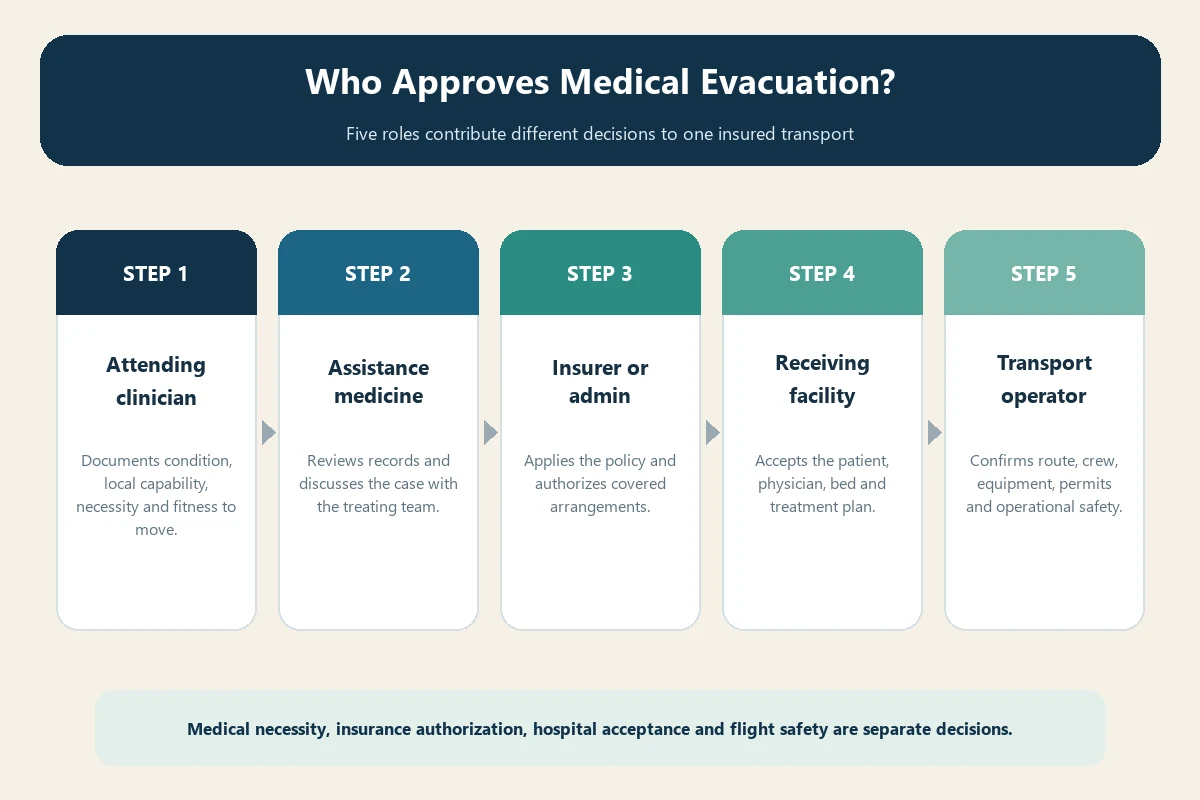
Actor 1: The onsite attending clinician
The treating clinician evaluates the patient and records diagnosis, severity, vital signs, interventions, local capabilities, anticipated care, and risks of movement. A policy may require that physician to order or certify the evacuation and state that adequate treatment is not locally available.
A current state-specific Travel Guard policy example requires the onsite attending physician to certify that the condition warrants evacuation and adequate treatment is unavailable locally. It also requires advance authorization, subject to its emergency-notification language. Other forms can differ.
What the physician does not decide
The local clinician does not ordinarily interpret the insurance contract, determine whether an exclusion applies, guarantee payment, or choose a benefit simply because the family requests it. A sentence such as “patient would prefer treatment at home” is not the same as medical necessity for an insured air ambulance.
Ask the clinician for facts: which service is needed, why the current facility cannot provide it, the urgency, the safe transport window, and the required escort or equipment. Let the coverage administrator apply those facts to the contract.
Actor 2: The assistance medical team
The assistance team may include physicians, nurses, case managers, and regional specialists. They can speak with the treating team, obtain records, assess facility capability, locate a receiving hospital, and recommend a transport level.
The team may conclude that the patient should first be stabilized locally, moved by ground ambulance, transferred on a commercial flight with an escort, or transported by dedicated air ambulance. These are medical and logistical judgments shaped by the case, not simply by the maximum dollar limit.
Actor 3: The insurer or benefit administrator
The insurer or authorized administrator applies the definitions, covered event, exclusions, medical-necessity standard, authorization provision, limit, deductible, and coordination-of-benefits rules. In some programs, the assistance company acts as the insurer’s authorized representative for arrangements.
Ask for a case number and the identity of the entity giving authorization. Clarify whether a statement is a medical recommendation, a guarantee of payment, a preauthorization subject to policy terms, or only help arranging transport. Save the wording and time.
Actor 4: The receiving facility
A transfer destination generally needs an accepting physician, appropriate service, available bed, and administrative acceptance. A hospital that appears suitable on a map may lack the needed specialty, capacity, blood supply, isolation room, or permission to accept an international patient.
Ask who contacted the facility, the accepting physician’s name, service, bed status, financial requirements, and whether acceptance is conditional. A family request for a famous hospital does not create capacity or policy coverage.
Actor 5: The transport operator
The operator confirms aircraft or vehicle availability, crew duty time, weather, range, airport access, landing permits, visas, ground transfers, oxygen, infection-control needs, and medical equipment. The operator’s medical director may require additional stabilization before transport.
A transport can be medically desirable and contractually authorized but still delayed by weather, airspace, permits, bed availability, or patient instability. Ask for updated contingencies rather than treating every delay as a claim denial.
What the CDC says about decision control
The CDC Yellow Book says the decision to medically evacuate is at the discretion of the insurance company, not made at the traveler’s request. It notes that evacuation may be considered when multiple additional hospitalization days or specialized treatment unavailable at comparable quality is anticipated.
That government guidance is not the traveler’s contract, but it corrects a common expectation: buying evacuation insurance does not normally give the traveler an on-demand flight home.
When advance authorization is impossible
Life-threatening facts can make prior contact impractical. Emergency wording may require notice as soon as reasonably possible rather than before transport. Do not assume this language exists or that every independently arranged cost will be reimbursed.
If immediate action is necessary, preserve emergency call logs, dispatch records, physician orders, reasons contact could not occur, transport invoices, and the earliest notice to assistance. Ask the administrator how the policy handles unavoidable lack of prior authorization.
Medical necessity is not only severity
A serious diagnosis does not automatically establish evacuation. The question may be whether appropriate care is locally available and whether movement improves the treatment path without unacceptable risk. Conversely, a stable patient may need transfer because a specific surgery, imaging service, blood product, or specialty is unavailable.
Document both sides: the care required and the current facility’s limitation. General statements such as “care is poor” are weaker than a clinician’s specific record that a needed service cannot be provided.
Fitness to travel can change the plan
The patient may be too unstable to fly today but fit tomorrow after treatment. Cabin altitude, oxygen requirements, bleeding, intracranial pressure, recent surgery, infection control, and the ability to sit or lie flat can affect mode and timing.
A fit-to-travel assessment does not decide the insurance claim by itself. It informs the route, escort, equipment, and timing. The assistance team may request repeat records before departure.
Authorization does not settle the final claim
A real-time authorization can remain subject to eligibility, exclusions, benefit maximums, and later verification. Likewise, an assistance company can arrange a service without guaranteeing that the insurance will pay every charge.
Ask what has been approved, the destination, mode, vendors, estimated covered amount, cost the traveler must advance, and any conditions. Keep the written authorization with the claim-document file.
How the limit fits into approval
The maximum limit matters, but it does not answer whether transport is medically necessary or authorized. A policy with a high evacuation limit can still require the nearest adequate facility, a direct and economical route, and advance coordination.
Use the medical evacuation limit guide to compare benefit ceilings, sublimits, remote locations, escorts, and return travel. For remote itineraries, the remote-trip evacuation guide adds access and rescue questions.
Pre-existing conditions add another gate
Even when evacuation is medically justified, a pre-existing-condition exclusion may affect coverage unless a valid waiver reaches that benefit. The waiver does not remove the need for authorization, suitable-facility analysis, or transport fitness.
The pre-existing-condition evacuation guide maps those two gates separately. Ask the administrator to identify both the medical-evacuation provision and the waiver provision.
The approval call checklist
- Give the policy number, patient location, hospital, and treating clinician contact.
- Request a case number and secure method to transmit records.
- Ask what medical facts or tests are still needed.
- Ask whether adequate treatment is considered locally available.
- Confirm who is the assistance medical reviewer and coverage decision-maker.
- Ask whether a receiving physician and bed have been secured.
- Confirm transport mode, escort, equipment, route, and authorization.
- Ask what to do if the patient’s condition changes before movement.
Government support is not insurance approval
The U.S. Department of State’s travel-insurance guidance says the U.S. government does not pay citizens’ medical costs abroad and recommends evacuation insurance for higher-risk or limited-care areas. An embassy can provide information about local facilities, but it does not authorize the private insurance benefit.
Bottom line
Medical evacuation insurance approval is a chain of different decisions. The attending clinician establishes medical facts, the assistance medical team evaluates the transfer, the insurer applies the policy, the receiving hospital accepts the patient, and the operator confirms a safe mission. Get each decision, condition, and authorization in writing when possible, and do not confuse a physician’s order or a vendor quote with guaranteed insurance payment.
Authorization is a timed evidence process, not only an approval label. Follow the medical evacuation pre-authorization timeline from first notice and medical records through vendor arrangement, emergency exceptions and final claim proof.
A hospital-to-hospital evacuation needs six aligned gates. Use the international hospital transfer workflow to document medical necessity, unavailable capability, receiving acceptance, fitness, policy authorization, transport handoff, and final claim proof.
A medical evacuation claim needs more than receipts: eligibility, clinical necessity, assistance authorization, transport delivery and financial loss must agree. Use the medical evacuation claim documents guide to build a timestamped evidence ledger before, during and after the move.
