

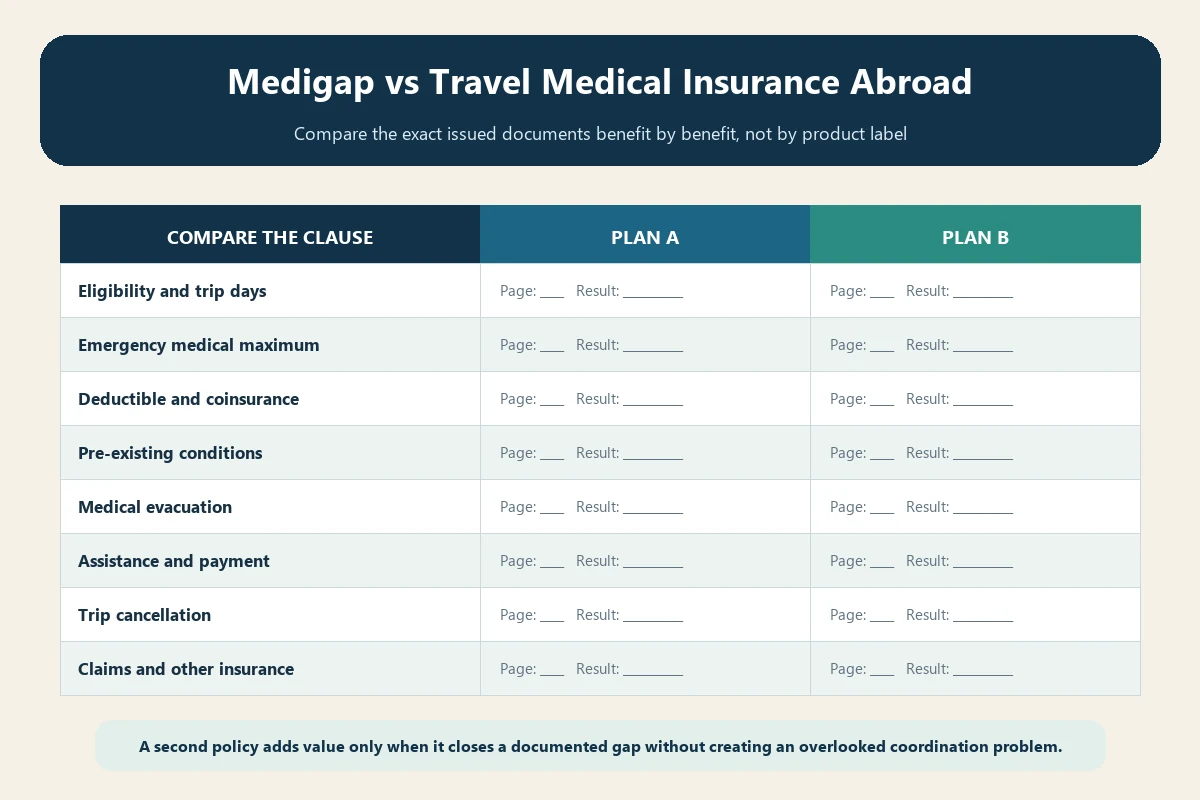
Medigap and travel medical insurance are not interchangeable. An eligible Medigap policy can pay part of certain foreign emergency medical charges, generally within the first 60 days of a trip and up to a $50,000 lifetime maximum. A travel medical policy can offer a trip-specific medical limit, assistance, and medical evacuation, but it also has eligibility rules, exclusions, authorization requirements, and a defined trip period. Compare the benefits line by line rather than choosing one by label.
This article is educational, not insurance, legal, medical, or financial advice. Medigap policies, state standardization, travel products, and benefit language vary. Read the current contracts and obtain written answers for the actual traveler and itinerary.
Key takeaways
- Medigap supplements Original Medicare; travel medical insurance is a separate temporary policy tied to a trip or covered travel period.
- Eligible Medigap foreign emergency coverage has a first-60-days rule and $50,000 lifetime maximum.
- Travel medical policies may offer larger trip-specific medical and evacuation limits, but the certificate determines what is covered.
- Direct billing, assistance, preauthorization, pre-existing-condition terms, and return-home transport can matter more than the headline limit.
- Layering policies does not permit double payment; coordination and claim order must be verified.
Reviewed: August 16, 2026.
The shortest accurate comparison
Medigap is long-term Medicare supplement insurance. Its foreign travel emergency provision, when included, is a limited benefit inside the broader Medigap contract. Travel medical insurance is designed for a defined journey or series of journeys and can bundle emergency medical care with assistance and evacuation. Comprehensive travel insurance may add cancellation, interruption, delay, baggage, and other trip benefits.
Neither label guarantees adequate coverage. A Medigap benefit can be too narrow for a long or remote trip. A travel medical plan can exclude a health condition, activity, destination, or route. The correct comparison uses the actual certificates.
Side-by-side coverage matrix
| Question | Eligible Medigap foreign benefit | Travel medical insurance |
|---|---|---|
| Purpose | Supplements Original Medicare | Temporary trip medical protection |
| Medical maximum | Generally $50,000 lifetime | Policy-specific, often per trip or period |
| Cost sharing | Generally 80% after $250 annual deductible | Deductible, coinsurance, and schedule vary |
| Trip length | Emergency must begin in first 60 days | Maximum trip or coverage dates vary |
| Evacuation | Do not assume broad evacuation | May be separate, with approval and endpoint rules |
| Trip cancellation | Not a Medigap benefit | Usually only in broader travel package |
| Assistance | Carrier procedure varies | Often 24-hour assistance, scope varies |
| Prior claims | Can reduce lifetime foreign balance | New limit may attach to new policy, subject to terms |
Medigap’s foreign emergency formula
Medicare’s April 2026 guidance identifies standardized Plans C, D, F, G, M, and N, plus legacy E, H, I, and J policies, as providing foreign travel emergency coverage. The standard description is 80% of certain medically necessary emergency charges after a $250 calendar-year deductible, up to a $50,000 lifetime limit. The emergency care must begin during the first 60 days of the trip and Medicare must not otherwise cover it.
Massachusetts, Minnesota, and Wisconsin standardize policies differently. Eligibility for some letter plans also depends on when a person became eligible for Medicare. Confirm the exact policy form, not only the letter or carrier.
The lifetime limit changes the risk calculation
A $50,000 lifetime maximum is not a fresh annual or trip limit. Prior foreign claims can reduce what remains for all future travel under that benefit. Ask the carrier for the current remaining balance in writing. Then model the deductible, 20% share, excluded charges, and any bill above the balance.
A traveler with the full lifetime amount and a traveler with $8,000 remaining do not have the same protection, even if both cards say Plan G. A travel medical policy may restore a larger trip-specific layer, but only according to its own certificate.
Trip duration: 60 days versus policy dates
Medigap’s standard foreign benefit requires the emergency to begin during the first 60 days of the trip. This can leave a gap on a 90-day visit, seasonal stay, or long cruise. The travel medical policy might cover the full itinerary, but it can also have a maximum trip length, renewal limit, or prohibition on buying after departure.
Build a dated timeline from U.S. departure through return. Mark day 60, the travel policy’s effective and termination times, border crossings, and any extension rules. Our senior long-trip guide helps test long-stay continuity.
Emergency medical care versus routine care
Medigap’s foreign provision focuses on medically necessary emergency care. Travel medical plans also commonly focus on unexpected illness or injury. Neither should be assumed to cover routine checkups, planned procedures, long-term maintenance, or predictable prescription refills.
Ask when an emergency becomes stabilized and how follow-up visits are treated. A hospital admission may qualify while rehabilitation, home nursing, replacement equipment, or a later specialist visit does not. Compare benefit definitions, not just dollar limits.
Pre-existing-condition rules
Medigap’s standardized foreign benefit and a travel policy can analyze health history differently. A travel policy may exclude losses connected to a pre-existing condition unless a waiver applies. Waivers often have purchase timing, eligibility, trip-cost, coverage amount, and fitness-to-travel conditions.
Do not answer the question from a diagnosis list alone. Follow the policy’s look-back period, symptom, treatment, medication, and stability definitions. Our senior pre-existing-condition checklist provides a structured review.
Medical evacuation is its own benefit
A high emergency medical limit does not automatically include medical evacuation. Travel insurance may provide a separate evacuation limit when the assistance company and medical professionals determine that local care is inadequate. The normal endpoint may be the nearest appropriate facility, not the United States or a hospital of choice.
Eligible Medigap emergency medical coverage should not be presumed to fund an international air ambulance or medically escorted return. Use the medical evacuation limit worksheet to model the actual route and the approval guide to identify the decision-maker.
Repatriation is not one concept
Medical repatriation can mean an air ambulance, a stretcher on a commercial flight, a medical escort, or ordinary travel after clearance. Repatriation of remains is a different benefit dealing with preparation and transportation after death. Neither should be inferred from “emergency medical.”
Review the definitions and endpoints. The repatriation of remains guide explains the documents and logistics of that separate benefit.
Trip cancellation and interruption
Medigap does not reimburse a nonrefundable tour because a traveler becomes ill. A travel medical-only policy may not either. Cancellation and interruption usually require a broader travel insurance plan and a covered reason. Supplier refunds and credits reduce the insured loss.
Compare prepaid nonrefundable cost, purchase date, covered reasons, medical certification, trip interruption return travel, single supplement, and unused arrangements. A medical plan can be adequate for hospital bills while leaving the entire trip investment uninsured.
Direct billing and cash flow
A foreign hospital may require a deposit or full payment. Ask the Medigap carrier and travel insurer whether either can guarantee payment, arrange direct settlement, or only reimburse later. An assistance line can be valuable, but “assistance” does not necessarily mean the company assumes the bill.
Compare 24-hour staffing, translation, provider referral, case management, family communication, payment guarantees, transfer coordination, and claim support. Save the international phone numbers offline and authorize a companion to communicate if needed.
Coordination when both policies might respond
Two policies do not permit recovery above the eligible loss. The travel plan may be primary or secondary, and it may require submission to Medicare or Medigap first. Medigap may wait for a Medicare determination when a narrow foreign exception could apply.
Ask each carrier:
- Which payer receives the claim first?
- Is an Explanation of Benefits or denial required?
- How are deductibles and coinsurance coordinated?
- Can assistance arrange care before payer order is resolved?
- What deadline applies if another insurer delays its decision?
Compare three traveler profiles
Ten-day city trip
A traveler with a full eligible Medigap lifetime balance may accept the medical risk but still need cancellation, evacuation, and direct-assistance layers. Price is not the only factor; the desired logistics matter.
Ninety-day family visit
The Medigap first-60-days condition creates a clear timing problem. A travel medical policy must cover the full stay or be validly extendable, with health-history and purchase rules satisfied.
Remote expedition cruise
The likely risk is not just a hospital invoice but ship-to-shore movement and long-range evacuation. Compare rescue exclusions, activity coverage, assistance authority, aircraft route, weather, and the nearest appropriate facility.
A no-duplication purchase method
- Confirm the exact Medigap plan and remaining lifetime foreign benefit.
- Map destination medical costs and plausible evacuation routes.
- Place the trip on a day-by-day timeline.
- List uncovered medical, transport, trip, and assistance needs.
- Compare travel policies only against those gaps.
- Verify coordination and claim order.
- Save written answers and the controlling contract pages.
Age can change travel-policy pricing, eligibility, and maximums even when Medigap remains unchanged. Use our senior travel insurance age-band guide before comparing quotes.
Questions to ask both carriers
- What foreign medical events qualify?
- What trip length and geographic boundary apply?
- What deductible, coinsurance, and maximum apply?
- Is the maximum lifetime, per trip, or per policy period?
- How are pre-existing conditions evaluated?
- Is direct payment available?
- What assistance is operational rather than informational?
- Are local ambulance, evacuation, and repatriation separate?
- Who chooses the transport destination?
- What trip cancellation or interruption benefit exists?
- Which payer is primary?
- What records and deadline control the claim?
FAQ
Is Medigap enough for international travel?
It may address part of a short-trip foreign emergency, but the 60-day rule, lifetime maximum, cost sharing, evacuation, trip loss, and assistance gaps require review.
Can travel medical insurance replace Medigap?
It is not a general replacement for Medigap. Travel medical coverage is temporary and trip-specific, while Medigap supplements Original Medicare under its own long-term contract.
Should a traveler buy both?
Possibly, when the travel policy fills defined gaps. Verify coordination to avoid paying for duplicate benefits that cannot produce duplicate recovery.
Which one pays for evacuation home?
Neither should be assumed to do so. Read the travel policy’s evacuation and repatriation provisions and the Medigap policy’s transport language, including authorization and endpoint.
Bottom line
Medigap versus travel medical insurance is a layer comparison, not a winner contest. Measure the Medigap lifetime balance and 60-day window, then test the travel policy’s medical, evacuation, assistance, trip-loss, and coordination provisions. Buy only the layers that close documented gaps for the actual itinerary.
