

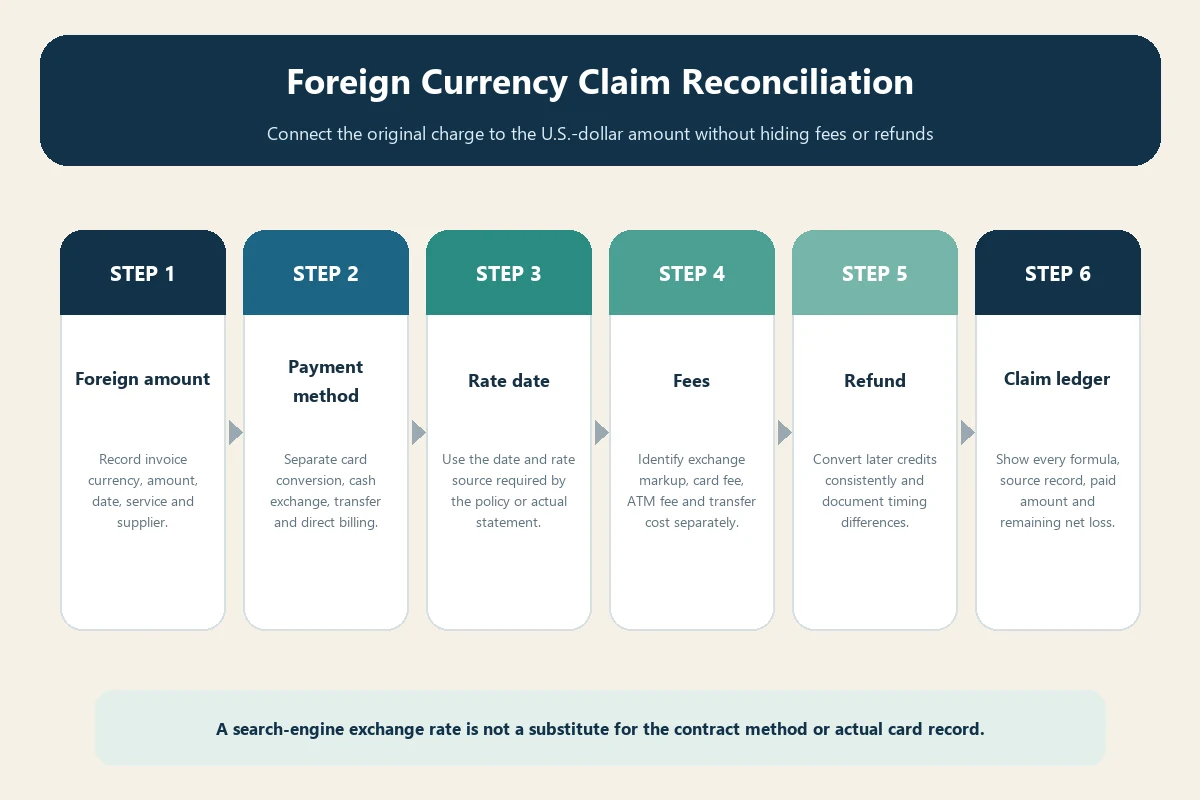
A travel insurance claim currency exchange rate reimbursement calculation should be traceable from the foreign invoice to the U.S.-dollar amount requested. A traveler may see at least four different figures: the provider’s local-currency charge, the card network’s conversion, the bank’s posted U.S.-dollar amount, and a public reference rate. They need not match.
The controlling method depends on the issued policy and claim administrator. Preserve the original currency and documents, identify every relevant date, show the actual payment when possible, and ask which rate source the insurer applies. Never rewrite the foreign receipt in dollars or choose a favorable rate without disclosure.
Key takeaways
- Keep the original amount and three-letter currency code on every claim line.
- A service date, transaction date, posting date, statement date, and refund date can produce different rates.
- The card’s posted U.S.-dollar charge is strong payment evidence but may include fees the policy does not cover.
- Cash payments need an exchange, withdrawal, or documented reference-rate trail.
- Later refunds must be converted and matched to the same loss line without hiding currency movement.
Why the numbers differ
Exchange markets move continuously. Card networks, banks, cash exchanges, hospitals, and public data sources can use different times, spreads, and fees. A merchant may offer dynamic currency conversion at the point of sale, while the card issuer could otherwise convert the local amount later. A pending card authorization can also differ from the settled posting.
The goal is not to make every number identical or erase legitimate conversion differences. It is to show which amount was charged, which method converted it, what the traveler actually paid, and which method the insurer used.
Identify the currency precisely
Do not write only “dollars,” “pesos,” or use an ambiguous symbol. Record the ISO-style code shown or confirmed by the provider, such as USD, CAD, AUD, MXN, or EUR. Some countries redenominate currency or use currencies with similar names and symbols.
When the invoice omits the code, ask the provider for clarification. Record the country and merchant, but do not infer a currency solely from the symbol if more than one is plausible.
Five dates that can matter
- Service date: when treatment, lodging, transportation, or another expense occurred.
- Invoice date: when the provider issued or finalized the bill.
- Transaction date: when the traveler paid or authorized the charge.
- Posting date: when the bank settled the converted amount.
- Refund date: when a later credit was calculated or posted.
A policy can specify one date or give the administrator discretion under its procedures. If the certificate is silent, ask what source and date will be used. Keep all dates rather than selecting the one that produces the largest claim.
Card payment: preserve both sides
Submit the foreign receipt showing local currency and the final card statement showing the U.S.-dollar posting. Keep the merchant, date, last account digits, local amount when displayed, converted amount, and any separately listed fee visible. A screenshot of a pending authorization is not a substitute for the final statement.
If the statement shows only dollars, pair it with the original invoice. If the merchant split the charge, reconcile each transaction. If a companion paid, identify the payer and relationship and provide any required authorization.
Foreign transaction fees
A card issuer can add a foreign transaction fee or other charge. Do not merge that fee into the provider’s medical or trip expense. List it separately and ask whether the policy treats it as an eligible loss. A charge being unavoidable or appearing on the same statement does not automatically make it covered.
Likewise, an ATM fee, cash-advance charge, interest, late fee, or poor exchange spread is not automatically part of the insured expense. The certificate governs.
Dynamic currency conversion
Some merchants offer to charge the card in U.S. dollars rather than local currency. This is often called dynamic currency conversion. The merchant or its service chooses the rate and may disclose a markup. The traveler may then have a U.S.-dollar receipt even though the underlying service was priced locally.
Keep the screen or receipt showing the choice, local price, conversion, and any markup. Do not reconstruct a lower local-currency equivalent after the fact unless the insurer specifically requests it. The actual transaction and policy method remain the evidence.
Cash payments
Cash creates a harder audit trail. Obtain an official paid receipt with the patient or traveler name, provider, date, service, amount, currency, and paid status. Preserve a bank withdrawal, cash-exchange receipt, ATM record, or other record showing how the funds were obtained.
A withdrawal does not by itself prove the cash was paid to the provider, and the provider receipt does not always prove the traveler’s conversion cost. Submit both and explain any difference. If no actual exchange record exists, ask which public reference rate and date the insurer accepts.
Public exchange-rate sources
U.S. Treasury, Federal Reserve, and IRS pages publish foreign-currency information for their own reporting or tax contexts. They are useful authoritative references, but none automatically controls a private travel insurance claim. Their frequency, methodology, and intended use differ.
When the insurer asks for a public rate, record the source URL, currency pair, quoted direction, date, retrieval date, and calculation. Save a PDF or screenshot with context. Do not cite a search-result snippet without the underlying table.
Direct billing and unpaid invoices
If an assistance company guarantees payment directly to a foreign hospital, the traveler may not have a card conversion. The claim file should show the local invoice, guarantee or payment arrangement, amount paid by the insurer or assistance provider, and any patient balance.
An unpaid foreign bill can be evaluated differently from a reimbursed expense. Do not convert it as if the traveler paid on a particular date. Ask the administrator how it values the obligation and whether direct settlement is available.
Secondary medical claims
A domestic health plan may process the same foreign bill with its own conversion method. The first payer’s EOB can show a U.S.-dollar allowed amount that differs from the traveler’s card posting. Submit both. The secondary travel insurer needs the first decision and the actual loss trail.
Use our Explanation of Benefits guide and the document structure in our foreign medical bill guide. Do not replace the original-currency invoice with the EOB.
Multiple charges and partial payments
Foreign hospitals may collect a deposit, add specialist bills, and issue a final balance. Convert or document each actual transaction separately because dates and rates can differ. Then reconcile the transactions to the final provider ledger.
Do not apply one average rate to all lines merely for convenience unless the policy or adjuster approves it. Show any deposit refund, overpayment, or transfer between accounts.
Later refunds in another currency
A supplier may refund the original local amount, while the card issuer posts a different U.S.-dollar credit because the rate changed. Report the actual credit and preserve the foreign refund confirmation. The difference can be a currency gain, loss, fee, or network effect.
Do not hide the refund or assume the insurer owes every exchange loss. Use the recovery workflow in our subrogation and later-refunds guide. Ask for a written calculation showing how the policy treats the difference.
Build a currency reconciliation table
Use one row per expense or transaction with these columns:
- provider and service date;
- invoice number and original amount;
- currency code;
- payment method and transaction date;
- rate source and rate direction;
- converted U.S.-dollar amount;
- separate bank or transaction fee;
- other-insurance payment;
- refund or credit with its own date and currency; and
- net amount requested.
Attach the relevant invoice, statement page, EOB, refund, and rate record to each row. The full submission method appears in our travel claim documentation guide.
Calculation mistakes to avoid
- reversing the quoted currency pair;
- multiplying when the source requires division;
- using the wrong “dollar” currency;
- mixing service, payment, and posting dates;
- adding a fee both to the rate and as a separate line;
- converting an amount already stated in U.S. dollars;
- rounding every line aggressively instead of the final total; and
- using today’s rate for a historical claim without instruction.
Protect deadlines during a rate dispute
Do not delay notice or proof of loss because the final conversion is uncertain. Submit original-currency records, the actual card posting if available, your disclosed calculation, and a question about the administrator’s method. Follow the notice and proof-of-loss workflow.
If the insurer uses a different rate, request the source, date, direction, rounding, and line-level calculation. An appeal should focus on the policy method and arithmetic, not merely that another website showed a better rate.
FAQ
Which exchange rate does travel insurance use?
There is no universal rate. The certificate and claim procedure can use the actual card conversion or a specified source and date.
Can I claim a foreign transaction fee?
List it separately and check the policy. It is not automatically an eligible medical or trip expense.
What if I lost the exchange receipt?
Provide the provider’s paid receipt and available withdrawal records, then ask which substitute rate evidence is accepted.
Why is my refund smaller in dollars?
The exchange rate or fees may have changed between purchase and refund. Preserve both postings and request a written reconciliation.
Bottom line
A defensible currency claim preserves the foreign amount, currency code, transaction evidence, conversion source, date, fees, and later refunds. Show the arithmetic openly and let the issued policy determine the method. The strongest record explains differences instead of forcing every figure to match.
Sources
- U.S. Treasury Fiscal Data — Exchange Rates
- Federal Reserve — Foreign Exchange Rates
- IRS — Foreign Currency and Exchange Rates
- CFPB — Foreign Transaction Fees
- NAIC — What to Know About Travel Insurance
- U.S. Department of State — Insurance Coverage Overseas
Reviewed August 16, 2026. This article is general educational information. Exchange-rate treatment, fees, eligible expenses, and reimbursement depend on the issued policy and claim decision.
