

Schengen travel insurance rejection can mean two different things: the insurance proof is not accepted, or the visa application is formally refused because adequate and valid insurance was not proved. Separate those events before acting. A missing certificate field may be correctable during processing, while a formal refusal follows the appeal or new-application rules of the Member State that made the decision.
Key takeaways
- Only the competent authority decides the visa; an intake issue is not automatically a formal refusal.
- The Visa Code lists failure to prove adequate and valid travel medical insurance as a refusal ground where insurance is required.
- Name, dates, territory, amount, benefits and issuer details must work together.
- Correct an insurer document by requesting a reissued original, never by editing it.
- After a formal refusal, follow the notice’s country-specific deadline and procedure rather than assuming a new certificate reopens the file.
First identify what “rejected” means
Search results often mix three separate situations:
- Intake feedback: a visa application center or consular counter identifies a missing or incomplete item when documents are submitted.
- Additional-document request: the authority asks for new or corrected proof while the application is still under examination.
- Formal visa refusal: the competent Member State issues a decision and provides the refusal reasons and available appeal procedure.
An external service provider can collect an application, but it does not decide the visa. The European Commission Visa Code handbook says external providers are not entitled to participate in assessment or decision-making. Treat counter guidance as important process information, then use the official notice or consular instruction to determine the application’s status.
There is another common search intent: whether an insurer refunds the premium after a visa is refused for any reason. That is a contract question governed by the policy’s refund terms. It is not the same as insurance proof causing a visa refusal, which is the subject of this guide.
The legal refusal ground
Article 32 of the consolidated EU Visa Code states that a visa shall be refused when an applicant does not provide proof of adequate and valid travel medical insurance, where the requirement applies. It also says the decision and reasons are notified using the standard form in Annex VI, and that appeals follow the national law of the Member State that made the final decision.
This does not mean every insurance typo automatically produces a refusal. Authorities can request additional documents in justified cases, and local procedures differ. It does mean the applicant should treat insurance proof as a substantive supporting document rather than a last-minute attachment.
Start with the Schengen visa insurance requirements overview for the governing coverage test. The failure modes below show how a policy or certificate can fall short of proving that test.
1. The wrong type of document was submitted
A payment receipt, insurance card, marketing page or employer memo may show that some coverage exists without connecting the applicant to the required benefits, territory and dates. Consulates review evidence, not the shopper’s purchase history.
Use an insurer- or administrator-issued certificate that identifies the covered person and the policy. The German Missions in the United States insurance sheet provides a clear jurisdiction-specific example: it requires confirmation issued by the health provider and says employer letters are not accepted.
Our Schengen insurance certificate guide explains which file to request and how to audit it before submission.
2. The applicant’s identity is missing or inconsistent
The certificate should name each visa applicant as an insured or covered person. A purchaser, sponsor or parent can buy the policy, but the proof still needs to identify the applicant covered by it. Compare spelling, name order and middle names with the passport and visa form.
For family or group policies, a shared policy number without a covered-person schedule can leave the evidence incomplete. Ask for an insurer-issued list that names every applicant. Do not create your own roster or attach an unsigned spreadsheet as a substitute.
3. Coverage dates do not match the intended stay
A common document defect is a gap at the beginning or end of the itinerary. Overnight flights, connections that enter the Schengen area, time-zone changes and a departure after midnight can produce different calendar dates than a quick trip-length count.
Check the exact start and end dates printed on the certificate. Match them to the itinerary used in the visa file and follow the responsible authority’s current date instructions. An expensive policy with a one-day gap still fails to prove continuous cover for that day.
4. Territory is vague or too narrow
The Visa Code requires coverage throughout the relevant Member State territory. A certificate saying only “Europe,” “international” or one destination may force the reviewer to infer a definition that is not printed. A policy can cover a broad marketing region yet exclude a destination, sanctioned area or particular service location.
Ask for explicit Schengen-area or all-Schengen-states wording. Check that the policy definition supports the certificate. If the trip includes the United Kingdom, Ireland or a non-European territory, analyze those places separately rather than assuming the word “Europe” resolves every border.
5. The minimum amount is missing or misunderstood
A certificate can omit the amount, state a fixed dollar figure too close to the moving euro threshold or show an aggregate limit shared by several applicants. It can also display €30,000 while reducing hospital or repatriation benefits through smaller sublimits.
The Schengen minimum coverage guide explains why the €30,000 floor, required expense categories, territory, dates and claim access form one test. Do not add unrelated cancellation, baggage and delay limits to reach the medical minimum.
6. Required benefits are not stated or are materially limited
The proof and underlying terms should address urgent medical attention, emergency hospital treatment, medical repatriation and death-related repatriation as the applicable authority requires. Generic “medical coverage” wording may not prove every function.
The Commission handbook warns consulates about policies that allocate very low amounts to expensive risks or contain significant exclusions. Review medical evacuation, repatriation of remains, emergency hospitalization and activity or condition exclusions. A product can bear a Schengen label while its actual schedule needs closer analysis.
7. A deductible, co-pay or reimbursement rule conflicts with local instructions
The general Visa Code minimum does not make every cost-sharing design acceptable in every application jurisdiction. The German Missions’ US sheet, for example, says no reimbursement, deductible or co-pay is accepted. Other authorities may describe the requirement differently.
Check the official page for the consulate handling the application, then use the Europe travel insurance deductibles guide to identify whether the cost applies per person, incident, claim or trip. “Zero deductible” still does not prove that the territory, benefits or dates are correct.
8. Claims may not be recoverable in a Member State
Article 15 requires consulates to consider whether amounts due from the insurer can be recovered in a Member State. The Commission handbook points to the insurer’s ability to meet obligations abroad and the availability of on-the-spot assistance rather than reimbursement only after the applicant returns.
Confirm the assistance provider, emergency contact, payment process and ability to arrange repatriation. If the certificate names no verifiable insurer or policy reference, ask for a corrected version. Do not rely on a screenshot from an unverified seller.
9. The certificate and application contradict each other
A document can be internally correct yet inconsistent with the rest of the file. Examples include insurance dates that differ from flight reservations, one destination on the certificate and another on the itinerary, or a covered-person name that differs from the passport.
Run one cross-document review before submission. The Europe trip insurance checklist helps align insurance, transport, lodging and traveler details. Consistency does not guarantee approval, but avoidable contradictions create questions that a careful preflight review can remove.
10. The applicant altered or submitted an obsolete file
Editing dates, adding wording, combining logos or annotating an insurer’s PDF can create doubts about authenticity. A certificate downloaded before a policy amendment may also be valid as a file but stale as evidence.
Request a newly issued original after every material correction. Save previous versions outside the upload folder and use a clear final filename. Read the policy-reading guide to ensure the revised certificate remains consistent with the contract.
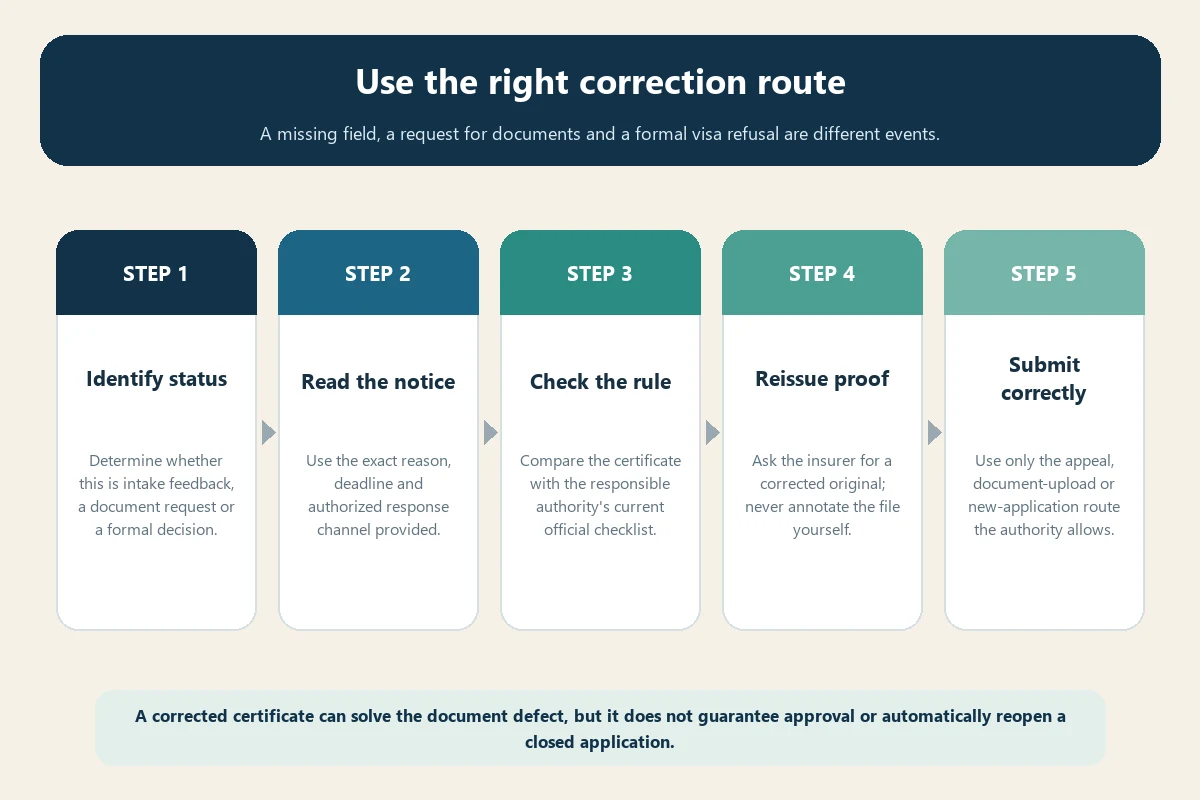
How to correct the problem before a formal decision
- Use the current official checklist. Identify the exact missing or conflicting field.
- Contact the insurer. Quote the official wording and request a reissued original.
- Recheck the whole file. A date correction can introduce a name or territory error.
- Use the authorized channel. Upload or deliver the document only through the process specified by the authority handling the application.
- Keep evidence. Save the request, corrected PDF and confirmation of submission with dates.
Do not send repeated documents through unofficial addresses or assume that a service-center employee can extend a deadline. If no correction request has been issued, verify whether unsolicited documents are accepted before transmitting them.
What to do after a formal visa refusal
Read the refusal notice rather than guessing from the timeline or a verbal comment. Identify every checked reason, the deciding Member State, the appeal route, deadline, language and delivery method. Insurance may be one of several grounds.
Article 32 provides a right of appeal, but the procedure is governed by the national law of the state that decided the application. The France-Visas FAQ, for example, publishes France-specific challenge information. That procedure should not be copied to a refusal by another country.
A corrected certificate can address the insurance defect, but it does not automatically reopen a closed file, extend a deadline or answer other refusal grounds. Use the official instructions to decide whether the permitted route is an appeal, a new application or another remedy. Obtain qualified immigration advice when the consequences or procedure warrant it.
Correction checklist
- Is this intake feedback, an additional-document request or a formal refusal?
- Which official notice or checklist controls the response?
- Does the certificate name every applicant exactly as shown in the passport?
- Do the dates cover the intended stay or transit?
- Is Schengen-wide territorial validity explicit?
- Are the medical amount and required benefits stated?
- Do sublimits, deductibles and reimbursement mechanics meet the applicable instructions?
- Can the issuer and policy be verified and claims met in the area?
- Was the corrected file issued by the insurer without applicant edits?
- Was it submitted through the authorized channel before the stated deadline?
General educational information, not legal, visa, medical or insurance advice. Procedures, deadlines and documentary practices vary by Member State and can change. Use the official notice and responsible authority’s current instructions for the specific application.
Was the visa denied? Use the Schengen insurance cancellation-refund guide to distinguish a premium refund from an insurance claim and submit the required proof before the deadline.
Preparing for arrival? Use the European border insurance-proof guide to separate visa-application evidence from the documents that support an entry check.
