

Schengen insurance territorial coverage should name or clearly include all 29 current Schengen countries, but the traveler’s real policy may need to extend farther. Europe, the European Union and the Schengen area are not identical. An itinerary can include Ireland, Cyprus, the United Kingdom, a microstate or another nearby destination that sits outside the common visa territory.
Key takeaways
- The Schengen area currently contains 29 countries: 25 EU members and four associated states.
- Bulgaria and Romania became full Schengen members on January 1, 2025.
- Cyprus and Ireland are EU members but are not full Schengen countries.
- A certificate can satisfy Schengen proof while the contract excludes another stop on the trip.
- Verify the live official list and the final itinerary before every purchase.
The current 29-country Schengen list
The European Commission’s Schengen area page states that the area has 29 countries: 25 EU Member States plus Iceland, Norway, Switzerland and Liechtenstein. It records Bulgaria and Romania as the most recent countries to join fully on January 1, 2025.
| Group | Current members |
|---|---|
| EU countries in Schengen | Austria, Belgium, Bulgaria, Croatia, Czechia, Denmark, Estonia, Finland, France, Germany, Greece, Hungary, Italy, Latvia, Lithuania, Luxembourg, Malta, Netherlands, Poland, Portugal, Romania, Slovakia, Slovenia, Spain and Sweden |
| Non-EU Schengen countries | Iceland, Liechtenstein, Norway and Switzerland |
The official Your Europe travel-document page publishes the same current list. It says EU visa rules do not apply in Cyprus and Ireland, which use national procedures. Use a dated official page because older PDFs can preserve a list that predates Croatia, Bulgaria or Romania.
Why Europe, EU and Schengen create confusion
“Europe” is a geographic and commercial label. A policy can define it broadly or narrowly. The European Union is a political and legal union of 27 Member States. Schengen is a travel area with 29 full members. Twenty-five countries belong to both, four Schengen countries are outside the EU, and two EU countries are outside full Schengen membership.
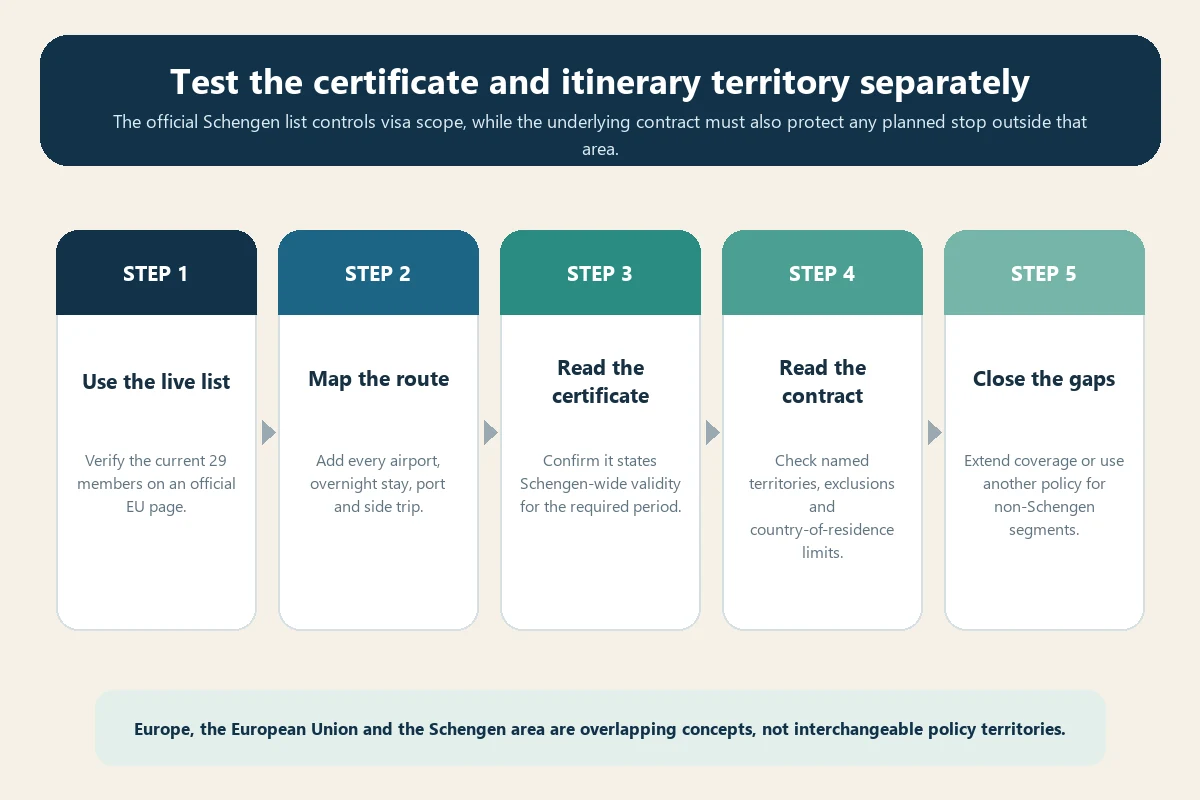
A sales page that says “Europe cover” may protect the United Kingdom and Ireland, yet the certificate could fail to state Schengen-wide validity. Another plan can issue a perfect Schengen certificate while excluding a separate stay in the United Kingdom. Read the certificate and territorial definition independently.
The Schengen visa insurance requirements guide explains the official proof. The multi-country Europe guide converts a complex route into policy tests.
What Article 15 requires from the insurance territory
Article 15 of the EU Visa Code says insurance must be valid throughout the territory of the Member States and for the complete intended stay or transit. A visa with limited territorial validity covering more than one Member State requires insurance in at least those states.
The safest certificate uses explicit wording such as “all Schengen countries” or a current complete list. A vague phrase like “international” does not prove which countries are included. A list that omits a newly joined country can also raise a document question even if the insurer intended broader coverage.
Use the Schengen insurance certificate audit to check the displayed territory. Do not write extra countries onto the PDF. Ask the insurer to reissue an accurate document.
Map every itinerary point, not only overnight countries
Build a route table containing:
- departure and return countries;
- airport transit points;
- every overnight destination;
- day trips and excursions;
- cruise or ferry ports;
- possible travel during a long stay.
Mark each point as Schengen, non-Schengen or uncertain. Confirm entry rules separately from insurance. A short airport connection can raise a transit question, while a policy may still cover the airport under a broad worldwide territory.
The Europe country-exclusion guide adds advisories, sanctions and restricted-region checks. Territory inclusion and exclusion can both apply: “Europe” in one clause does not override a named-country exclusion elsewhere.
Cyprus, Ireland and the United Kingdom
Cyprus participates in aspects of Schengen cooperation but internal border controls have not been abolished. Ireland is not a full Schengen member. The United Kingdom is outside both the EU and Schengen. A traveler visiting any of them should verify national entry rules and policy coverage.
Do not assume a Schengen visa alone authorizes every nearby stop. Likewise, do not assume a Schengen-only insurance territory covers a weekend in London, Dublin or Cyprus. Ask whether the policy includes those destinations by name and whether the certificate can preserve the Schengen wording required for the application.
Microstates and special territories
Andorra, Monaco, San Marino and Vatican City are not among the 29 formal Schengen members. Their practical border arrangements can make a visit feel like ordinary Schengen travel, but insurance should not be based on that impression. Confirm the microstate by name or under a clearly defined territory.
Overseas territories belonging to a European country are another trap. A destination can be politically connected to France, the Netherlands or Denmark without falling inside the same Schengen visa and insurance territory. Use the exact island or territory name when asking the insurer.
For a route that leaves and returns, check the visa’s entry conditions and the policy’s re-entry rules. The insurance should remain continuous if the traveler expects protection during the entire trip.
Certificate wording versus the territorial definition
| Document | Purpose | Territory question |
|---|---|---|
| Visa certificate | Summary proof for the application | Does it clearly state all-Schengen validity? |
| Schedule of benefits | Limits and effective period | Does it name a geographic plan or region? |
| Policy wording | Contract definitions and exclusions | How are Europe, worldwide and country of residence defined? |
| Endorsement | Change to the base contract | Does it add or remove a destination? |
| Assistance confirmation | Operational explanation | Will support and direct payment work in each stop? |
A certificate can be broader or shorter in wording than the policy definition. Resolve a contradiction in writing before the appointment. The contract should support, not undermine, the summary evidence.
Territory questions to ask before purchase
- Does the certificate say coverage is valid throughout all Schengen countries?
- Does the current definition include all 29 members?
- Are Ireland, Cyprus and the United Kingdom included for this itinerary?
- Are named microstates or overseas territories covered?
- Does the policy exclude the traveler’s country of residence?
- Do sanctions or government advisory clauses restrict any destination?
- Does transit count as entering the territorial area?
- Will a new destination require an endorsement and extra premium?
Save the response with the full policy. Use the Europe policy comparison worksheet to record territory alongside limits and deductibles.
When the itinerary changes
Update the route before departure. Airlines can reroute a connection, cruise lines can replace ports and travelers can add a side trip. Contact the insurer if the new point lies outside the named territory. Ask for a revised certificate only when the change affects visa evidence.
A policy may allow a geographic extension before travel but not after an incident occurs. Do not wait until a claim to ask whether the country was covered.
Territorial validity and benefit eligibility are two separate tests. A country can sit inside the policy’s geographic area while a particular event is excluded because it began before purchase, arose from an excluded activity or occurred after a government warning triggered a contract clause. Conversely, a strong medical benefit cannot help when the location itself falls outside the defined territory. Read the destination definition first, then apply the exclusions to the traveler’s actual plans.
Travelers with a limited-territorial-validity visa need an especially literal review. Match the policy certificate to every state printed on the visa and every insured transit point. If a later route change adds another Schengen country, ask both the visa authority and insurer whether updated permission or evidence is required. Keep any endorsement and revised certificate with the original documents.
Common territorial mistakes
- Using an old 26-country list after Schengen expanded to 29.
- Treating every EU country as a Schengen country.
- Assuming “Europe” automatically satisfies a consular certificate.
- Ignoring a non-Schengen airport, port or personal weekend.
- Assuming a European country’s overseas territory has the same status.
- Checking the certificate but not the contract’s exclusions.
- Failing to update coverage after an itinerary change.
Frequently asked questions
How many countries are currently in the Schengen area?
There are 29 full members as of this guide’s August 2026 review. Verify the live European Commission page before relying on the number.
Are Bulgaria and Romania covered by Schengen insurance?
They became full Schengen members on January 1, 2025. A current all-Schengen policy should include them, but outdated country lists should be corrected.
Does Schengen insurance cover the United Kingdom?
Only if the policy includes it under a broader territory. The UK is not a Schengen member, so all-Schengen wording alone does not prove UK cover.
Does the policy need to list all 29 countries?
A clear phrase covering all Schengen countries can be sufficient, subject to the authority’s checklist. If a list is used, it should be current and complete.
What if the itinerary includes a microstate?
Ask the insurer to confirm the named destination. Do not infer contractual territory from open or lightly controlled land borders.
This guide is educational and reflects official membership information reviewed in August 2026. Verify current entry rules, territorial definitions and exclusions before purchase.
