
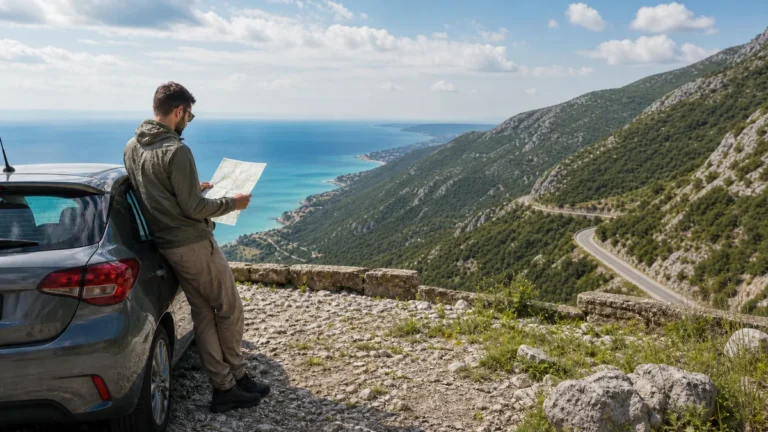
Travel insurance for Albania from USA trips should be designed around response time. A Tirana visit, the Llogara coastal pass, a ferry transfer and a trek in a remote valley can place the traveler very different distances from capable medical care. The policy has to support the transport chain that the itinerary may require.
Key takeaways
- Map the nearest clinic, hospital, passable road and backup transport for remote days.
- Separate ambulance, improvised transport, hospital transfer, evacuation and repatriation.
- Check rental, liability and roadside arrangements independently from travel insurance.
- Name hiking, boating, diving and off-road activity exactly.
- Save official road notices, coordinates, reports, medical files and payment evidence.
Planning information reviewed August 16, 2026. Road access, emergency capacity, seasonal health services, entry rules and insurance contracts can change. Confirm the route with current official sources before departure.
Score each day by remoteness
Write every overnight and excursion on one sheet. Add the nearest health center, higher-capability hospital, paved road, fuel stop and practical exit route. Mark whether the traveler controls the vehicle, depends on a host or must use a scheduled boat or bus.
The purpose is not to predict injury. It is to expose where a small problem can become a transfer problem. A medical maximum looks different when the traveler is hours from appropriate treatment and local response equipment is limited.
If the journey continues into Montenegro, Kosovo, North Macedonia or Greece, use the multi-country Europe guide to verify territory, transit days and border routes.
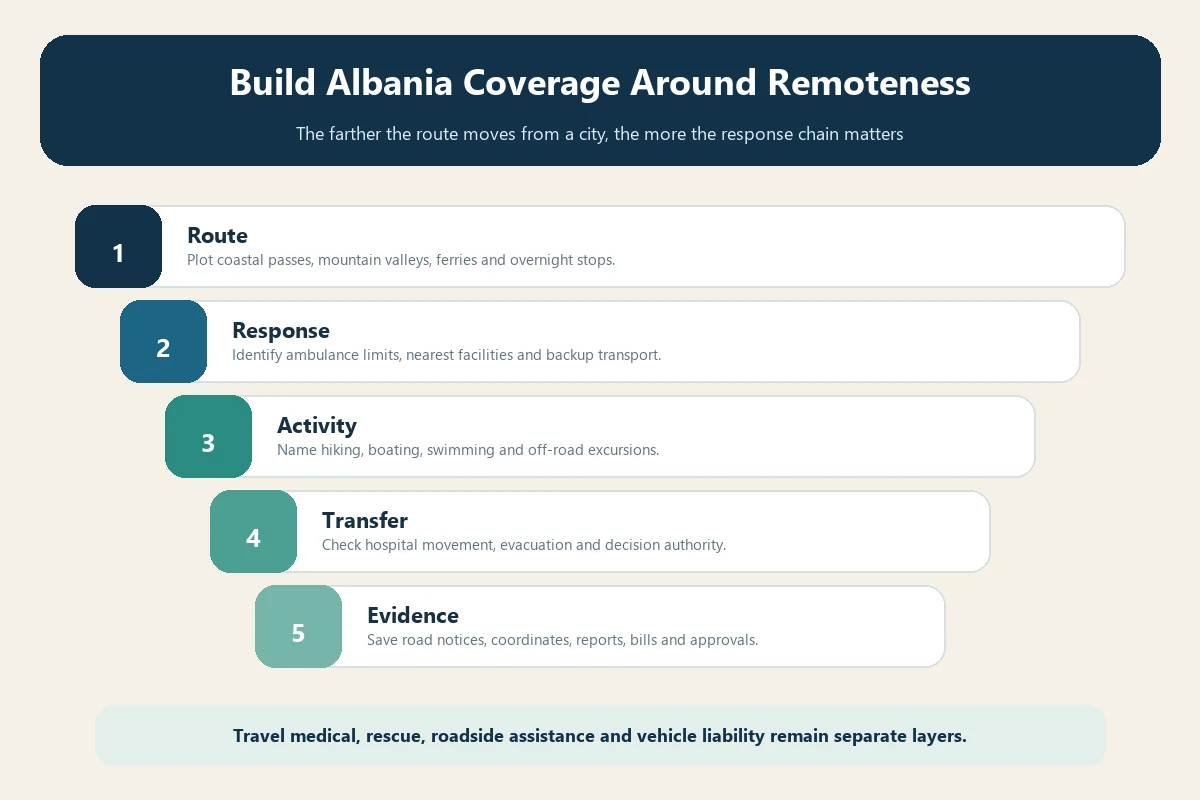
Use official response limitations in the plan
The U.S. Department of State’s official Albania country information warns that emergency response services are inadequate, first responders can have limited medical training and equipment, and accident victims may be transported by a passerby. It also advises against night driving, especially outside urban areas.
Albania’s Ministry of Health lists the National Emergency Medical Center and identifies 127 as the emergency medical number in its official dependent-institutions directory. Carry 112 and current local emergency details as well. In a life-threatening situation, follow official instructions and protect life first.
Ask the insurer how it handles transport when a standard ambulance is not available. Find out which documents can establish the reasonableness of alternative transport and when assistance must authorize it.
Separate five kinds of movement
Search or rescue brings someone out of terrain. An ambulance moves the traveler to initial care. Inter-hospital transfer moves the patient to a better-equipped Albanian facility. Medical evacuation may cross a border. Repatriation returns the traveler to the United States when the policy’s conditions are met.
Ask for the benefit and sublimit for each movement. Identify who decides medical necessity, who chooses the receiving facility, whether a companion is covered and how an unavailable local provider changes the process.
The evacuation and repatriation guide provides a transport-chain worksheet that applies even though Albania is outside Schengen.
Prepare for direct medical payment
Do not assume a U.S. insurance card will be accepted at an Albanian facility. Ask the assistance company whether it can arrange direct billing, when reimbursement is expected, which facilities are eligible and what itemized documentation must be collected.
The Ministry of Health announced additional medical staffing for tourist-area health centers during the 2026 summer season in its official tourist health-service update. Seasonal reinforcement is useful, but it does not prove that a particular center can provide a needed specialty or that it will bill an insurer.
Map a backup facility and carry reasonable payment capacity. The primary medical guide explains how first-payer wording changes claims handling without guaranteeing cashless care.
Audit coastal and mountain roads
The State Department describes variable road quality, poor rural conditions in bad weather, limited lighting and no formal nationwide roadside-assistance system. It also notes that third-party vehicle insurance is required. Verify the current license, insurance and rental terms for the actual pickup.
The Albanian Road Authority publishes official road-condition information. Its notices can identify snow, ice, closures, landslides and required winter equipment. Save the relevant notice with the date, road segment and recommended alternative.
| Road expense | First contract to inspect | Critical proof |
|---|---|---|
| Damage to another person | Required third-party motor insurance | Certificate and police report |
| Rental-car damage | Rental waiver, collision plan or card benefit | Agreement, pickup photos and assessment |
| Towing or mechanical failure | Rental assistance or separate roadside plan | Dispatch, location and authorization |
| Traveler treatment | Travel medical benefit | Diagnosis, bill and payment proof |
| Unused prepaid booking | Trip interruption if a covered cause applies | Incident evidence and refund statement |
Use the Europe road-trip insurance guide to test every layer without assuming the travel policy covers the vehicle.
Build a fallback for the Albanian Riviera
Coastal routes can depend on mountain passes, summer traffic and limited late-day alternatives. Do not place a nonrefundable flight immediately after a long road transfer. Record a safe stopping point, backup lodging and the last practical transfer.
Albania’s National Civil Protection Agency lists floods, fires, earthquakes, landslides and snow blockage among common hazards in its official civil-protection overview. Check current alerts rather than relying on seasonal assumptions.
For heat-sensitive travel, medication storage and coastal walking, the summer heat guide distinguishes prevention, medical evidence and a covered trip-disruption cause.
Classify hikes and excursions precisely
“Albanian Alps tour” is not a policy definition. Record the trail, maximum elevation, expected duration, guide, surface, river crossings, weather and exit options. Ask whether a marked trail, altitude cap, daylight rule or professional guide condition applies.
List boating, rafting, diving, paragliding, canyoning and off-road excursions separately. Search and rescue may have its own sublimit even when the named activity is covered. The activity-exclusion guide provides an exact-name audit.
Plan ferries and boats by operator
A public ferry, lake boat, private speedboat and guided coastal excursion can fall under different carrier and activity language. Record who operates the vessel, where passengers board, whether the service is scheduled and the refund terms.
If weather cancels the sailing, obtain the operator’s written reason, alternative and refund. A missed onward booking may require a minimum delay or common-carrier definition. The European ferry insurance guide shows how to document port and island disruption.
Match disruption to the remaining loss
A road closure, late bus, canceled ferry and medical interruption are not interchangeable. Identify the operator responsible for each leg, request its refund or replacement first and calculate only the remaining prepaid and necessary expense.
Check the policy’s covered cause, delay threshold, daily limit and reasonable-alternative requirement. The delay, interruption and cancellation guide provides a clean classification.
Run a remote-route policy test
Compare every plan with the same case: U.S. flights, Tirana nights, a rental car over Llogara Pass, remote mountain accommodation, a guided hike and a ferry connection. Add a landslide closure and an illness requiring transfer to higher-level care.
- Are all countries, roads and dates inside the territory?
- How is direct medical payment arranged?
- What alternative transport is eligible when an ambulance is unavailable?
- Who authorizes hospital transfer and cross-border evacuation?
- Are the exact hike and boat activities covered?
- Which official closure can trigger delay or interruption?
- What original records and notice deadlines apply?
Require page references, not a general assurance. Save the issued contract, schedule and clarification with the trip records.
Create a claim-ready timeline
Carry the policy, emergency numbers, itinerary, route, rental agreement, activity confirmations and medical summary offline. During an incident, record coordinates, time, road notice, assistance instructions, provider names and any reason standard transport was unavailable.
Keep the diagnosis, itemized bill, payment proof, police or operator report, carrier notice, original booking, replacement booking and refund statement. The claim filing guide turns these into a consistent chronology.
Measure the response time, not just the distance
A route can be only a few miles from a clinic and still require a long response because of road surface, weather, ferry hours or limited vehicles. For each remote overnight, estimate the drive in daylight and in the season of travel. Mark where mobile service becomes unreliable and save coordinates offline. Do not present an estimated time as a guarantee; use it to identify places where the itinerary needs a guide, earlier turnaround or stronger backup transport.
Give the assistance company a specific scenario before purchase: an injured hiker on the booked trail, a patient at the coastal accommodation or a rental breakdown beyond a mountain pass. Ask which service the traveler should call first, what assistance can coordinate from abroad and which expenses require advance approval. Record the answer and policy page without assuming that a general evacuation maximum includes local rescue or roadside recovery.
Share a check-in schedule with a trusted contact for remote days. Carry water, medication, charging capacity and a paper copy of critical numbers. These precautions are not insurance benefits, but they reduce the chance that a small delay becomes a medical emergency. If an incident occurs, the planned route, last check-in, coordinates and time-stamped notices also create a more reliable record for rescuers, providers and the eventual claim.
Bottom line
The best Albania coverage follows the response chain from a remote route to appropriate care. Verify roads and activities, separate vehicle and medical contracts, test transport authorization and preserve official evidence. A large benefit amount cannot replace a workable plan for distance and access.
