

Travel insurance for Bhutan from USA trips should match the certified-guide itinerary, altitude, road access and the possibility that serious treatment requires transfer beyond Bhutan. Insurance is no longer an entry requirement, but the medical and transport case for suitable coverage remains strong.
Key takeaways
- Do not repeat outdated claims that Bhutan requires insurance or a bundled tour operator.
- Current official guidance requires a certified guide, while travelers may book many trip elements independently.
- Give the insurer every trek, maximum altitude, road segment and remote overnight.
- Plan stabilization in Bhutan and possible transfer to higher-level care abroad.
- Ask how limited helicopter service, authorization and payment work.
Planning information reviewed August 16, 2026. Visas, guide rules, advisories, health guidance, transport and policy terms can change. Recheck Bhutan’s official tourism information and the issued certificate for the dates.
Correct the two common Bhutan assumptions
Bhutan’s official tourism FAQs state that mandatory travel insurance was lifted on April 23, 2024. They also state that visitors can book trip elements independently rather than purchasing the old fully bundled tour package.
The same official page says a certified guide is mandatory, and treks must be undertaken with an accredited guide or tour operator. Treat entry rules and insurance eligibility as different questions. A destination recommendation is not a policy benefit, and a policy does not replace compliance with local rules.
Build the route with the certified guide
List Paro, Thimphu, Punakha, Bumthang, eastern districts and every trek or day hike. Add road transfers, domestic flights, monasteries, remote camps, maximum altitude and highest sleeping point. Record the guide, driver and approved accommodation.
Give that itinerary to the insurer. “Bhutan sightseeing” is too broad when the route includes high passes or locations days from care. Preserve the guide’s certification or official service listing and any national-park permit.
Verify visa timing separately from insurance
Bhutan’s official visa page explains the advance process for most U.S. visitors, required trip information and the Sustainable Development Fee. Check it directly rather than relying on an insurer or old tour package page.
Visa fees, the SDF and trip deposits may have different refund rules. Ask the policy when coverage begins and how a visa-related loss is treated. Do not assume insurance reimburses a government fee or a traveler’s late application.
Review current advisory and medical capacity
The U.S. Department of State publishes current Bhutan travel guidance. Its country information describes limited medical capability for serious conditions, with stabilization in Bhutan followed by possible transfer to a regional center such as Bangkok or Singapore.
Ask what “nearest suitable facility” means in this geography. The closest clinic may stabilize but not provide definitive care. Save the assistance team’s process for receiving-facility acceptance, transport approval and medical escort.
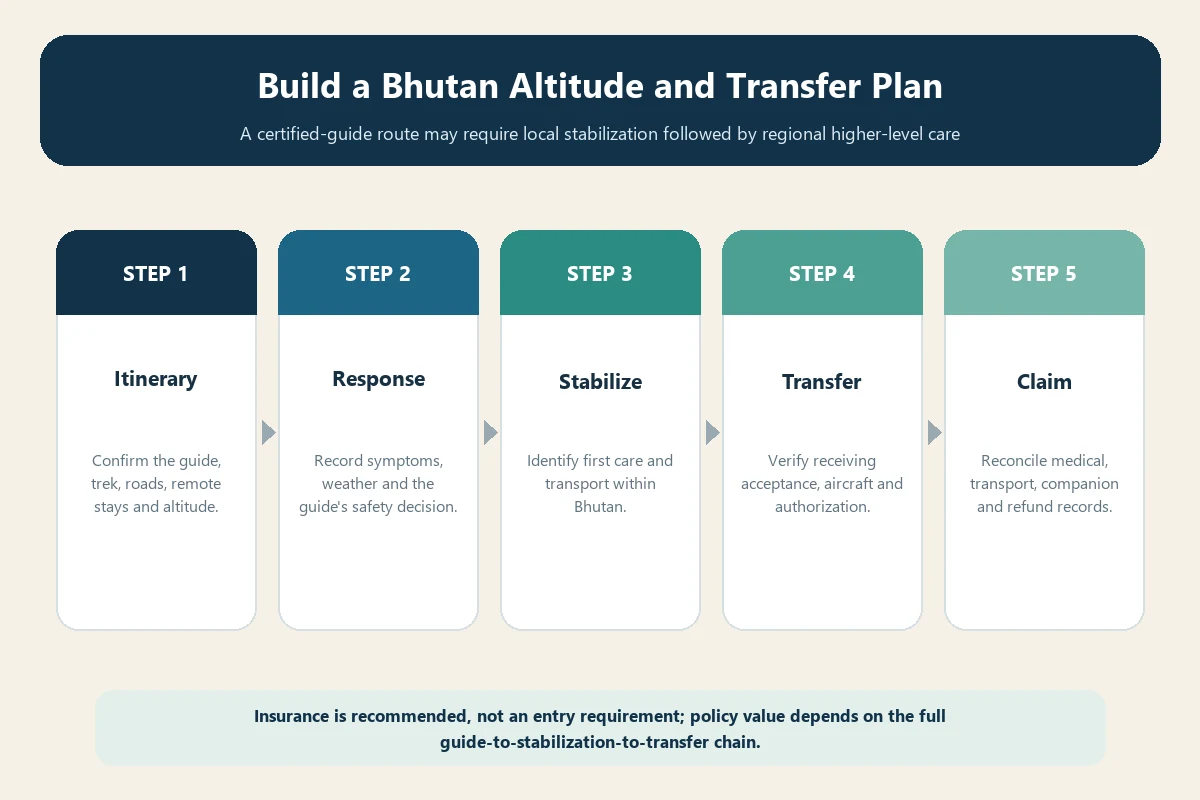
Separate stabilization from international transfer
For each remote stop, identify the first reachable clinic or hospital, the road or aircraft path to Thimphu or Paro, and the international connection that might support higher-level care. This is a scenario for comparison, not a guaranteed evacuation route.
The remote evacuation guide distinguishes local rescue, stabilization, medically necessary transfer and repatriation. Ask whether these stages share one limit.
Choose the evacuation limit from the full chain
Do not price only a road ambulance inside Bhutan. A serious case could require ground movement, domestic positioning, an international aircraft or scheduled flight with medical support, and care before the transfer. Ask which destination and transport are allowed by the certificate.
The evacuation-limit guide provides scenario questions. A high limit still depends on medical necessity, receiving acceptance, weather, aircraft availability and authorization.
Understand the helicopter constraint
Official U.S. guidance says helicopter evacuation from remote areas may be limited and at the traveler’s expense. Bhutan’s tourism information notes that helicopter services can be arranged for special itineraries, but that does not promise an emergency aircraft in every valley or weather condition.
Ask the insurer who requests the flight, which provider may be used, whether preapproval is required and how payment is guaranteed. Then ask the guide what happens when a helicopter cannot land or fly. Preserve the clinical reason and every operational decision.
Match altitude wording to every pass and trek
State guidance warns of altitude illness above roughly 8,000 feet, and treks may travel days from care. Give the insurer the highest point and highest sleeping altitude in both meters and feet. Ask whether height limits apply to hiking, trekking or the entire policy.
The activity-exclusions guide helps compare definitions, guide conditions and equipment rules. A certified guide does not override an insurance altitude exclusion.
Set acclimatization and turnaround rules
Agree with the guide on ascent pace, rest days, symptom reporting and who stops the route. Review altitude and health history with a clinician. Do not continue upward in order to protect prepaid costs or because an evacuation benefit appears large.
The CDC maintains current Bhutan traveler health guidance for vaccines, medicines, food and water, animal exposure and outdoor safety. Medical advice and insurance approval are separate.
Plan around mountain roads
Record each driver, vehicle, seat belts, pickup, expected travel time and daylight margin. Mountain roads, landslides and construction can affect access. Ask whether an ordinary road delay qualifies and whether a missed flight requires a common-carrier event.
Keep the driver or operator message, official instruction, airline response, refund and replacement receipt. The road-trip insurance checklist provides a documentation framework after Bhutan-specific arrangements are confirmed.
Use monsoon information as a route decision
Bhutan’s official tourism FAQs identify June through September as a period when monsoon conditions can disrupt transport and services. Ask the guide and operator about the exact district and road. A national weather label is less useful than a dated route decision.
The weather-delay guide explains why a forecast does not automatically trigger coverage. Preserve the road, airline, guide or authority action that created the actual loss.
Protect Paro flight connections
Bhutan has one international airport at Paro, with flights connecting through a limited set of regional cities. Record the inbound and outbound flight, separate tickets, connection buffer, baggage and nonrefundable onward booking.
Ask what missed-connection and trip-delay benefits require. If the carrier changes the schedule, preserve the notice, alternate offered, refund and added lodging. The benefit-classification guide helps label the result.
Prepare for direct medical payment
Ask assistance which facilities it can contact and whether it can issue a payment guarantee. Carry secure backup funds because a provider or transport company may require payment. Keep itemized bills, diagnosis, clinical notes, prescriptions, transport records and proof of payment.
The health insurance abroad guide structures the U.S. plan call. Do not assume Medicare or a domestic network operates in Bhutan.
Compare one Bhutan scenario
Use identical traveler ages, dates and prepaid costs. Include the certified-guide itinerary, two high road passes, a multiday trek, monsoon road disruption, altitude symptoms, local stabilization and a physician-recommended transfer to higher-level care abroad.
- Is the exact activity and altitude covered?
- Which guide or permit conditions apply?
- What happens when roads or helicopters cannot operate?
- Who selects the suitable receiving facility?
- How is international transfer approved and paid?
- Which refunds reduce the final claim?
Compare the complete policy wording. “Bhutan covered” is not a sufficient answer.
Use assistance as a documented coordination channel
Store the policy number, international line, guide, driver, allergies and medicines offline. Give a companion a clear instruction to open the case. Record each representative, time, case number, instruction and failed contact attempt.
The assistance versus claims guide explains why a referral or coordinated transfer does not guarantee every charge. It does create an important operating record.
Build the stabilization-to-claim file
Preserve the itinerary, visa timing, guide record, altitude profile, symptom timeline, first care, transfer recommendation, authorization, receiving acceptance, transport invoice, medical records, payment and refunds. Label currencies and travelers clearly.
The claim documentation guide explains reconciliation. Show the original charge, supplier return, health-plan or card payment and final unreimbursed amount.
Keep a certified-guide decision log
Ask the guide to record route conditions, altitude, symptoms, weather, road status and any instruction to stop or move. The guide’s operational record is not a medical diagnosis, but it can establish where the group was and why a safe itinerary change occurred.
Keep the original message, handwritten note or agency report with its time and author. If the traveler chooses a different option, document the alternatives and reason. Separate unused prepaid services from new medical transport and lodging so each amount can be evaluated under the correct benefit.
Prepare the regional receiving-facility packet
If a patient may be transferred to Bangkok, Singapore or another location selected by assistance, the receiving team will need clinical information, identification and travel documents. Keep passport copies, medicine and allergy lists, initial diagnosis, imaging or test results, treatment, fitness-to-fly decision and the referring clinician’s contact ready.
Ask who obtains receiving acceptance, visas or transit permission when relevant, and who books a medical escort or commercial seats. A family member’s travel may have separate eligibility. Preserve the acceptance, authorization, tickets, medical escort record and arrival note. The chain should show why the destination was suitable, not merely preferred.
Protect essential medicines on remote routes
Carry enough permitted medication for the trip and plausible delays, with generic names and prescribing information. Ask about temperature, moisture and altitude effects on storage. Give the guide only the emergency information necessary to help.
If medicine is lost or damaged, contact a qualified clinician and assistance. Keep the incident record, prescription and receipt. Replacement medicines, preventive supplies and an evacuation triggered by missed routine doses may be treated differently, so prevention and documentation both matter.
Bottom line
A strong Bhutan plan uses current rules: insurance is recommended rather than mandatory, independent booking is possible, and a certified guide remains required. Match coverage to altitude, roads and the full medical-transfer chain, then preserve evidence from first care through final reconciliation.
