
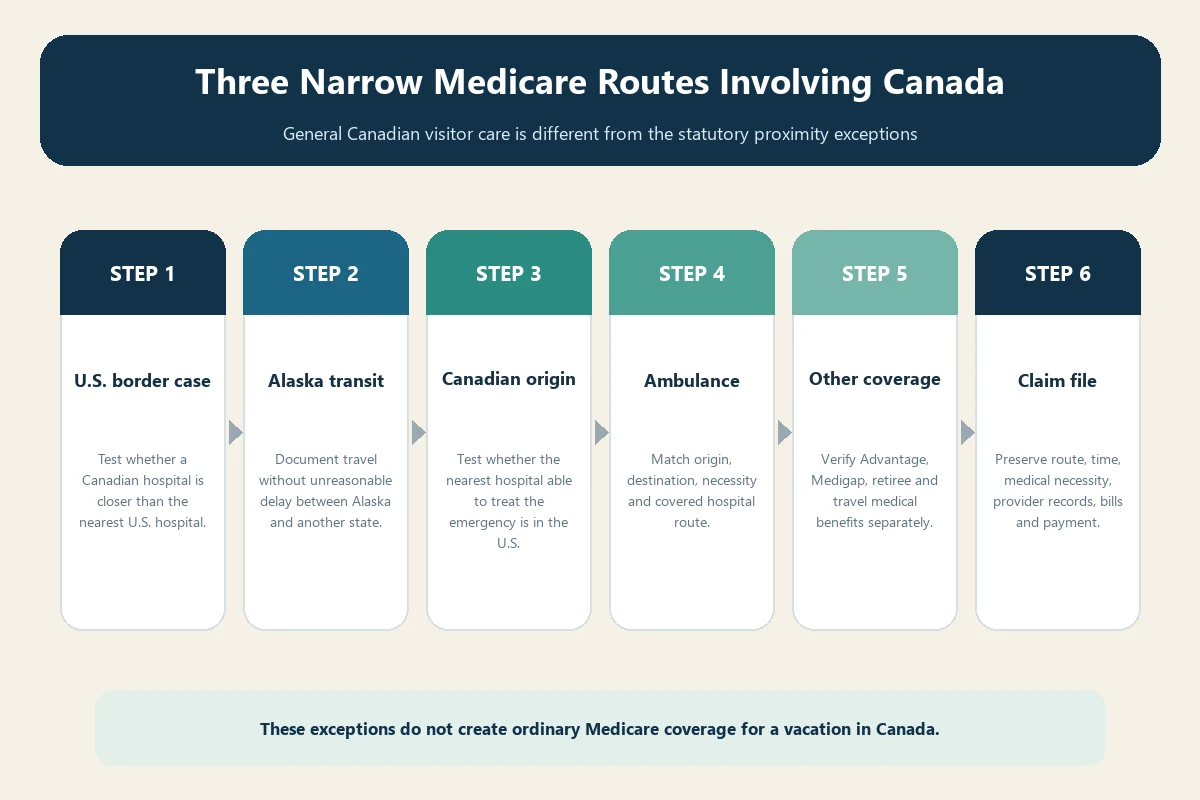
Original Medicare generally does not cover a U.S. visitor’s medical care in Canada. It may cover a Canadian hospital in three narrow situations: a U.S. emergency when the Canadian hospital is closer or easier to reach, an emergency during certain direct travel between Alaska and another state through Canada, or care for a U.S. resident whose closest appropriate hospital is in Canada. A vacation, short drive across the border, or Canadian address on an itinerary does not create general Medicare coverage.
This article is educational, not medical, legal, insurance, or financial advice. Medicare and private-plan decisions depend on the facts, current contract, provider, and documentation. Verify coverage before travel and seek emergency care without delaying for an insurance call.
Key takeaways
- Ordinary tourism in Canada is usually outside Original Medicare coverage.
- A Canadian hospital may qualify when it is closer or easier to reach during an emergency that begins in the United States.
- The Alaska-through-Canada exception requires an emergency during travel without unreasonable delay by the most direct route.
- A U.S. resident may have a proximity exception when a Canadian hospital is closer than the nearest U.S. hospital able to treat the condition.
- Canadian providers are not required to file Medicare claims, so payment and documentation must be planned.
Reviewed: August 16, 2026.
The default rule for Canada
For Medicare purposes, Canada is outside the United States. Original Medicare therefore follows the foreign-care rule: no coverage in most circumstances. Canada’s publicly funded health system does not make hospital care free for American visitors, and a U.S. Medicare card is not a Canadian provincial health card.
A traveler should plan ordinary Canadian trips with a separate medical-payment and assistance strategy. Our travel insurance for Canada from the USA guide covers destination-wide risks. This article focuses only on the narrow Medicare pathways.
Exception one: a U.S. emergency and a closer Canadian hospital
Medicare may cover care in a Canadian hospital when a person has a medical emergency while in the United States and the foreign hospital is closer or easier to reach than the nearest U.S. hospital able to treat the condition. This can matter in border communities where geography, roads, ferries, or facility capability make the Canadian hospital the practical emergency destination.
Four facts need evidence:
- The emergency began while the beneficiary was in the United States.
- The condition required immediate medical attention.
- The Canadian hospital could provide the necessary treatment.
- It was closer or easier to reach than the nearest capable U.S. hospital.
A preferred Canadian specialist or shorter appointment wait is not the same as emergency proximity. Preserve ambulance dispatch records, origin location, route, timestamps, and the capability of the compared facilities.
Exception two: direct travel between Alaska and another state
Medicare describes a special rule for a person traveling through Canada between Alaska and another U.S. state. A Canadian hospital may qualify if a medical emergency occurs while the traveler is in Canada, the traveler is going without unreasonable delay by the most direct route, and the Canadian hospital is closer or easier to reach than the nearest U.S. hospital able to treat the condition.
This is not blanket Canadian coverage for every Alaska road trip. Route and purpose matter. Long sightseeing detours, extended stays, or a path unrelated to travel between Alaska and another state can complicate the analysis. Record the planned route, reservations, fuel and lodging stops, border entries, and the location and time of the emergency.
What “without unreasonable delay” means for planning
Medicare evaluates the facts. A normal overnight stop, weather delay, road closure, or necessary rest may be different from a multiweek vacation detour. Travelers should not try to self-interpret the rule as a guaranteed number of hours. Ask Medicare how it applies to the planned itinerary and preserve objective evidence if an emergency occurs.
Exception three: a U.S. resident lives closer to Canada
Medicare may cover medically necessary care at a Canadian hospital when a beneficiary lives in the United States and the foreign hospital is closer to the home than the nearest U.S. hospital able to treat the condition. Medicare’s publication says this situation can apply whether or not an emergency exists.
The comparison is not simply mileage to any hospital. The facilities must be able to provide the needed service. Document the U.S. residence, road or transport route, closest U.S. facility with the required capability, Canadian facility capability, and the clinician’s reason for the destination.
This exception is relevant to some border residents, not a portable benefit for a person living temporarily throughout Canada. Permanent or long-term residence abroad raises enrollment, plan-service-area, and access questions beyond a single claim.
Hospital coverage and professional services
When Medicare covers an eligible foreign inpatient hospital stay, Part A can cover the qualifying inpatient services. Part B can cover certain ambulance and doctor services received immediately before and during the covered stay. The beneficiary remains responsible for applicable deductibles, coinsurance, and services Medicare does not cover.
A hospital being eligible does not mean every associated bill is eligible. Canadian hospitals, physicians, ambulance suppliers, laboratories, and pharmacies may issue separate invoices. Match each service to the covered stay and Medicare rule.
Ambulance coverage follows the qualifying route
An ambulance to a qualifying Canadian hospital may be covered when it is necessary in connection with a covered foreign hospital situation. Medicare generally focuses on medically necessary transport to the nearest appropriate facility. A later transfer for convenience or an ambulance home after discharge is different.
Our travel medical ambulance guide explains origin, destination, and medical-necessity documentation. For a cross-border air transfer, do not assume the word “emergency” is enough; identify the aircraft, route, clinical need, and decision-maker.
Medicare generally does not pay the return ambulance home
Medicare’s foreign-coverage publication says it generally does not cover an ambulance trip back to the person’s home after discharge from the foreign hospital. This is a common planning gap. The hospital stay might qualify while the return transport does not.
Travel evacuation or repatriation coverage can address some transfers, but the endpoint may be the nearest appropriate facility rather than home. Use our medical evacuation limit guide to build a route-specific exposure and evacuation approval guide to identify who authorizes the move.
What about routine tourism, snowbirds, and day trips?
A senior driving from New York to Montreal, flying to Vancouver, taking a train to Toronto, or spending a season in Canada should assume Original Medicare will not cover ordinary Canadian medical care unless a narrow exception fits. Trip duration does not transform a vacation into the Alaska exception or border-resident rule.
For a longer stay, compare travel medical coverage for the entire period, maximum trip length, renewal or extension rules, pre-existing-condition language, routine-care exclusions, and emergency assistance. A policy marketed for Canadian visitors traveling out of Canada is not necessarily designed for a U.S. resident visiting Canada.
Medicare Advantage in Canada
A Medicare Advantage plan may add worldwide emergency, urgent, or emergency transportation benefits beyond Original Medicare. These benefits are plan-specific and can have separate maximums, cost sharing, reimbursement, and authorization rules.
Read the current Evidence of Coverage. Ask whether Canada is included, whether the benefit applies only to emergencies, what happens after stabilization, whether local ambulance or cross-border transport is covered, and whether spending counts toward the plan’s maximum out-of-pocket amount. A national carrier logo does not make every plan identical.
Medigap foreign emergency coverage
Certain standardized Medigap plans include a foreign travel emergency benefit. Medicare describes 80% payment for certain eligible emergency charges after a $250 annual deductible, subject to a $50,000 lifetime maximum and a rule that emergency care begin during the first 60 days of the trip. Confirm the exact policy and remaining lifetime balance.
Medigap is not comprehensive trip protection. It does not automatically cover cancellation, delay, baggage, search and rescue, evacuation home, or non-emergency Canadian care. A claim that Original Medicare covers under one of the three exceptions may also coordinate differently than a claim paid solely under the Medigap foreign benefit.
Part D and prescriptions purchased in Canada
Medicare states that drug plans do not cover prescription drugs purchased outside the United States. A covered hospital stay and a pharmacy purchase can therefore produce different results. Ask how drugs administered during an eligible inpatient stay are billed, but do not assume Part D will reimburse a retail Canadian prescription.
Carry a lawful supply from the United States, plan for delays, and check border and provincial rules. Our travel prescription medication guide explains labels, documentation, storage, and replacement planning.
Canadian providers may require payment
A Canadian hospital or physician is not required to file a Medicare claim. The beneficiary may need to pay the provider and submit a Patient’s Request for Medical Payment form (CMS-1490S) with itemized records. Foreign currency, translations, provider identifiers, and proof of payment can matter.
Before travel, keep the CMS-1490S instructions, Medicare contact information, plan-assistance number, and secure access to policy documents. After an event, request diagnosis and treatment records, admission and discharge dates, itemized bills, ambulance notes, proof of payment, and a statement of the service location.
Build a closest-hospital evidence packet
- Exact origin of the illness, injury, or transport
- Date, local time, and border location
- Emergency symptoms and clinician assessment
- Dispatch record and ambulance destination decision
- Route distance and travel time to the Canadian facility
- Nearest U.S. hospital able to provide the necessary care
- Reason the Canadian hospital was closer or easier to reach
- Proof of U.S. residence for the border-resident exception
- Direct Alaska itinerary for the transit exception
- All medical records, itemized invoices, and payment evidence
If evacuation is involved, add the documents in the medical evacuation claim checklist.
Four scenarios to test
Emergency in northern Maine
A Canadian hospital is closer than the nearest capable U.S. hospital. Test where the emergency began, capability, route, and ambulance evidence under the first exception.
Direct drive from Washington to Alaska
An emergency occurs in British Columbia. Test the most direct route, absence of unreasonable delay, nearest capable hospital, and travel documentation.
Weekend in Toronto
A sudden illness occurs during ordinary Canadian tourism. Original Medicare generally does not cover it. Test MA, Medigap, or travel medical benefits.
U.S. border resident needs planned care
The closest capable hospital is across the border. Test residence, facility capability, distance, and Medicare’s third exception before arranging service.
Questions to ask before entering Canada
- Does any of the three Original Medicare exceptions plausibly fit this route or residence?
- Which U.S. and Canadian hospitals are capable of treating likely emergencies?
- Does the exact Medicare Advantage plan add Canadian emergency or urgent coverage?
- Does the Medigap policy include foreign emergency coverage?
- What remaining lifetime amount and first-60-days rule apply?
- Will a Canadian provider bill the plan or require payment?
- What ambulance and evacuation endpoint is covered?
- How will a later return to the United States be paid?
- Are prescriptions bought in Canada excluded?
- What records must be submitted, to whom, and by what deadline?
FAQ
Does Medicare cover an American tourist in Canada?
Usually not. Original Medicare has only narrow foreign-hospital exceptions. A Medicare Advantage, Medigap, or travel medical plan may provide additional coverage.
Does Medicare cover a Canadian hospital while driving to Alaska?
It may when an emergency occurs during travel without unreasonable delay by the most direct route between Alaska and another state and the Canadian hospital is closer or easier to reach than the nearest capable U.S. hospital.
Will Medicare pay for an ambulance back to the United States?
Do not assume so. Medicare generally does not cover an ambulance home after discharge from a covered foreign hospital stay.
Can a Canadian hospital bill Medicare?
It may not be required to file a claim. The beneficiary can be responsible for payment and a later claim submission with CMS-1490S and supporting evidence.
Bottom line
Medicare Canada emergency coverage is an exception map, not visitor insurance. Identify where the event begins, the route, U.S. residence, facility capability, and which hospital is closer or easier to reach. For ordinary Canadian travel, build separate medical, ambulance, evacuation, prescription, and payment plans before crossing the border.
