

Travel insurance for caregiver cancellation affecting a senior traveler may respond when the caregiver becomes ill or injured, but only if the person fits a covered definition and the event is a listed covered reason. A caregiver resigning, becoming unavailable, changing jobs, losing a visa, or deciding not to go is often not equivalent to a covered medical event. Insure the caregiver when appropriate, compare “traveling companion” and “family member” definitions, and ask how replacement-care costs are treated before paying nonrefundable deposits.
This article is educational, not legal, employment, medical, or insurance advice. Policy definitions and state rules vary. Read the complete certificate and obtain written guidance for the actual caregiver relationship and trip.
Key takeaways
- The policy may define insured, traveling companion, family member, caregiver, and business partner differently.
- Caregiver illness can be covered while ordinary unavailability is not.
- A professional aide may not be a family member or traveling companion unless insured and traveling under the contract.
- Replacement caregiver cost, single supplement, and rebooking are separate expenses.
- Cancel only after checking supplier refunds, policy notice, medical documentation, and mitigation duties.
Reviewed: August 16, 2026.
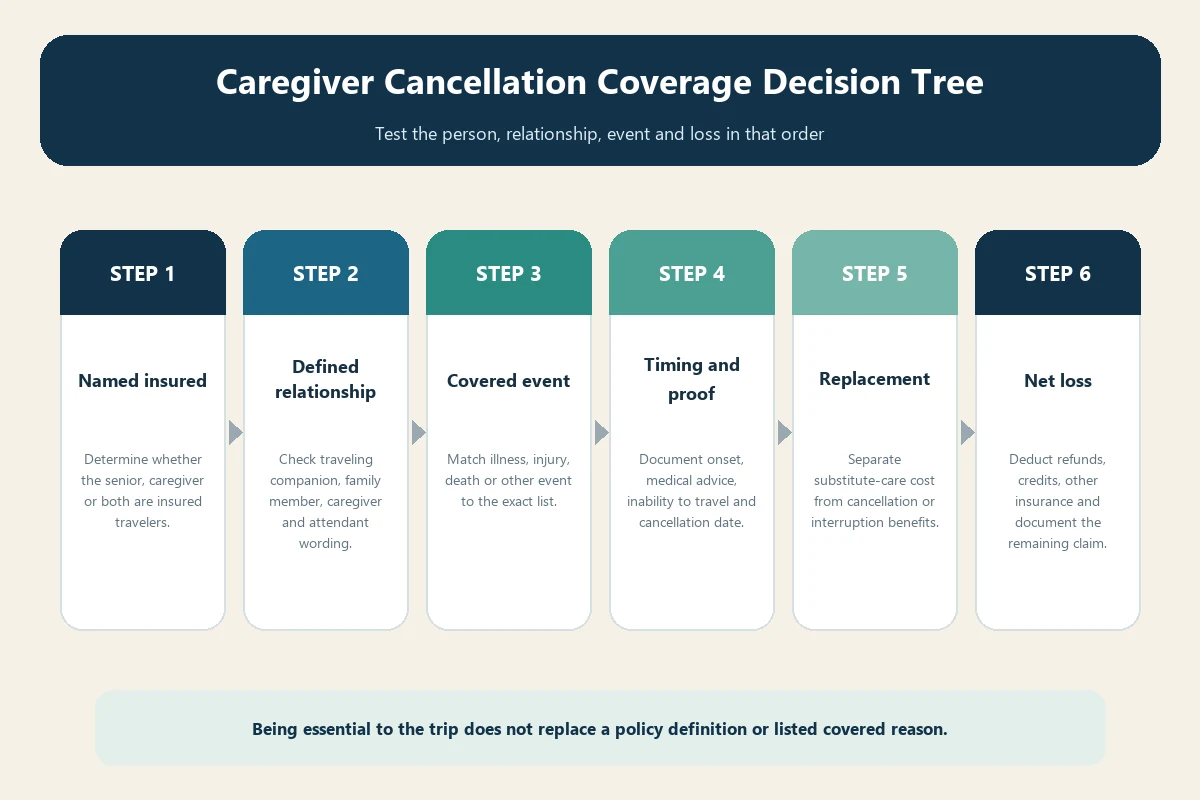
The two-gate test
Every caregiver cancellation claim should pass two gates:
- Person gate: who is the caregiver under the policy?
- Event gate: why can that person not perform or travel?
A medically serious event affecting a person outside every covered definition can fail. A covered family member who simply changes plans can also fail. Read both definitions and covered reasons.
Insured traveler
If the caregiver is named and insured on the same plan, their covered illness or injury can support their own cancellation and may support the senior’s claim when the policy covers a traveling companion’s event. Confirm both people’s trip cost and travel dates.
Insuring the caregiver does not guarantee that every inability to work is covered. The cause must still fit the contract.
Traveling companion
A traveling companion commonly means a person booked to travel with the insured and share arrangements, subject to the policy’s exact wording and maximum number. A caregiver on the same flights and itinerary may fit; a local aide meeting the senior at the destination may not.
Ask whether the companion must be insured, reside separately, share lodging, or appear on the same reservation. Do not rely on the everyday meaning.
Family member
Policies define family member through a list of relationships. A spouse, adult child, sibling, or in-law can be covered even when not traveling, depending on the contract. An unrelated friend who provides care is not a family member merely because the relationship is close.
Read the list. Do not assume step-relatives, domestic partners, guardians, or household members are included unless named.
Professional caregiver or aide
A paid aide can be an employee, contractor, agency worker, or traveling companion. Employment status alone may not create a covered policy relationship. If that person resigns, is reassigned, fails a background check, or has a scheduling conflict, the event may not be listed.
Ask the agency about substitution, refund, staffing, liability, and travel costs. Use a contract with a backup-care clause rather than expecting trip insurance to solve ordinary workforce risk.
Caregiver illness or injury
A covered illness or injury can trigger cancellation when it meets the policy’s definition, affects a covered person, is medically documented, and causes the trip to be cancelled. Some policies require a physician to examine the person and certify they cannot travel or provide care.
Pre-existing-condition rules can apply to the caregiver’s illness as well as the senior’s. Confirm whether the waiver extends to nontraveling family or traveling companions.
Caregiver’s family emergency
A caregiver may be healthy but need to care for their own ill relative. Coverage depends on whether that relative fits the policy’s family-member definition and whether the illness is a covered reason. The senior’s dependence on the caregiver does not replace the definition chain.
Map all three people: senior, caregiver, caregiver’s relative. Ask the insurer to confirm the chain before purchase.
Caregiver unavailability without illness
Vacation denial, job change, resignation, scheduling conflict, family preference, passport problem, ordinary pregnancy, missed alarm, or refusal to travel may not be covered. Some events can qualify under separate provisions, but “caregiver unavailable” is not a universal reason.
Build a backup caregiver and flexible supplier plan for nonmedical unavailability.
Visa, passport, and border problems
A professional caregiver may need a visa, work permission, vaccination record, or other document. A visa denial or missing passport can be excluded or covered only under narrow language. Work performed abroad can also raise immigration and licensing questions beyond travel insurance.
Confirm destination law and documents before the cancellation-penalty period.
Pre-existing-condition waiver
The senior and caregiver can each have medical history relevant to a claim. A waiver may require timely purchase after the initial deposit, insuring the required trip cost, and medical ability to travel. It applies only as the certificate states.
Use the senior pre-existing-condition guide and ask whose medical history the waiver protects.
Medical ability to travel
If the senior requires a caregiver to travel safely, the insurer may examine whether the senior was medically able to travel when coverage was purchased. A clinician’s care recommendation and policy language both matter.
Document the plan existing on the purchase date. Insurance should not be used to test an itinerary that was never medically viable.
Replacement caregiver cost
Even when cancellation is covered, the policy may reimburse forfeited trip cost rather than the cost of hiring a replacement aide. A new caregiver’s airfare, room, wages, insurance, and visa can be additional expenses without a listed benefit.
Ask whether change-fee, additional-occupancy, companion, or interruption benefits can apply. Obtain the answer in writing.
Single supplement and room repricing
If a caregiver cancels but the senior still travels, a cruise or tour may reprice the room. Some policies have a single-supplement benefit after a covered companion cancellation; others do not. The senior’s decision to continue can change the claim from cancellation to a limited extra-expense question.
Ask the supplier for the original invoice, revised price, refund, credit, and cancellation option.
Cancel for any reason
Cancel For Any Reason coverage can reimburse a stated percentage of insured nonrefundable trip cost when purchase timing, trip-cost insurance, and cancellation-deadline conditions are met. It generally costs more and does not reimburse 100%.
CFAR can address an uncovered caregiver problem, but it must be purchased before the problem arises and used exactly as the certificate requires. Availability varies by state and plan.
Trip cancellation versus trip interruption
Cancellation applies before departure. If the caregiver becomes ill after the trip begins, interruption may cover eligible unused arrangements and additional transport. A replacement caregiver, companion hotel, or bedside stay may have separate limits.
The trip interruption guide helps separate timing and expense categories.
Caregiver becomes ill during the trip
Prepare two plans: medical care for the caregiver and ongoing support for the senior. The policy might pay the caregiver’s eligible medical treatment and both travelers’ covered interruption, but it may not supply replacement personal care.
Name a backup person, agency, or destination service and authorize necessary communication. Costs require explicit coverage.
Senior becomes ill during the trip
The caregiver’s extra lodging, meals, flight change, or bedside travel may be covered only under companion or hospitalization benefits. Routine caregiving labor is different.
Our travel companion evacuation guide explains return and bedside provisions.
Medical evacuation with a caregiver
An evacuation benefit may cover the patient but not guarantee space or payment for the caregiver. Ask whether the caregiver is a traveling companion, escort, attendant, or medically required professional and which benefit applies.
A medically required nurse or escort is different from a familiar caregiver. The insurer and physicians decide necessity. Use the evacuation claim-document guide for a caregiver cancellation claim packet involving transport.
Supplier refunds and mitigation
Travel insurance pays eligible nonrefundable loss after supplier refunds and credits. Contact the airline, cruise, tour, hotel, and care agency promptly. Ask about transfer to another caregiver, name change, rebooking, credit, and partial refund.
Document every response. Delaying cancellation can increase penalties and create a mitigation dispute.
Claim evidence
- Policy and declarations
- Senior and caregiver booking records
- Caregiver agreement or agency contract
- Relationship evidence if required
- Medical diagnosis and inability-to-travel certification
- Trip deposit and policy purchase dates
- Original and revised invoices
- Supplier refunds and credits
- Replacement caregiver quote and decision
- Cancellation notices and claim timeline
The travel insurance claim guide helps organize the packet.
Five-scenario rehearsal
- Family caregiver is hospitalized: test family and traveling-companion definitions.
- Agency aide resigns: use the agency substitution clause and verify whether insurance responds.
- Caregiver’s child becomes ill: test the family-definition chain.
- Senior travels with a replacement: classify repricing and new caregiver costs.
- Caregiver becomes ill abroad: activate caregiver medical care and the senior’s backup support.
Questions for the insurer
- Is this caregiver an insured traveler, traveling companion, family member, or none?
- Must the caregiver be on the same reservation?
- Does the pre-existing-condition waiver protect the caregiver?
- What medical proof is required?
- Does ordinary unavailability qualify?
- Is caregiver replacement cost covered?
- Is a single supplement covered?
- What if the caregiver’s family member becomes ill?
- Does interruption cover a new caregiver or the original caregiver’s return?
- Does evacuation include the caregiver?
FAQ
Does travel insurance cover cancellation if a caregiver gets sick?
It may when the caregiver fits a covered definition, the illness is a covered reason, and all medical and pre-existing-condition requirements are met.
What if a paid caregiver quits?
Ordinary resignation is often not a listed covered reason. Review the agency contract, backup plan, and CFAR option.
Will insurance pay for a replacement caregiver?
Do not assume so. Cancellation coverage usually addresses forfeited trip cost, not new caregiver wages and travel.
Should the caregiver be insured?
Often it clarifies the caregiver’s own trip loss and medical coverage, but the exact plan and relationship definitions still control.
Bottom line
Caregiver cancellation coverage is a definition problem. Identify the caregiver’s policy status, the event that prevents travel, and each resulting expense. Build agency substitution and backup care for ordinary unavailability, then use insurance for the listed covered risks the certificate actually accepts.
