

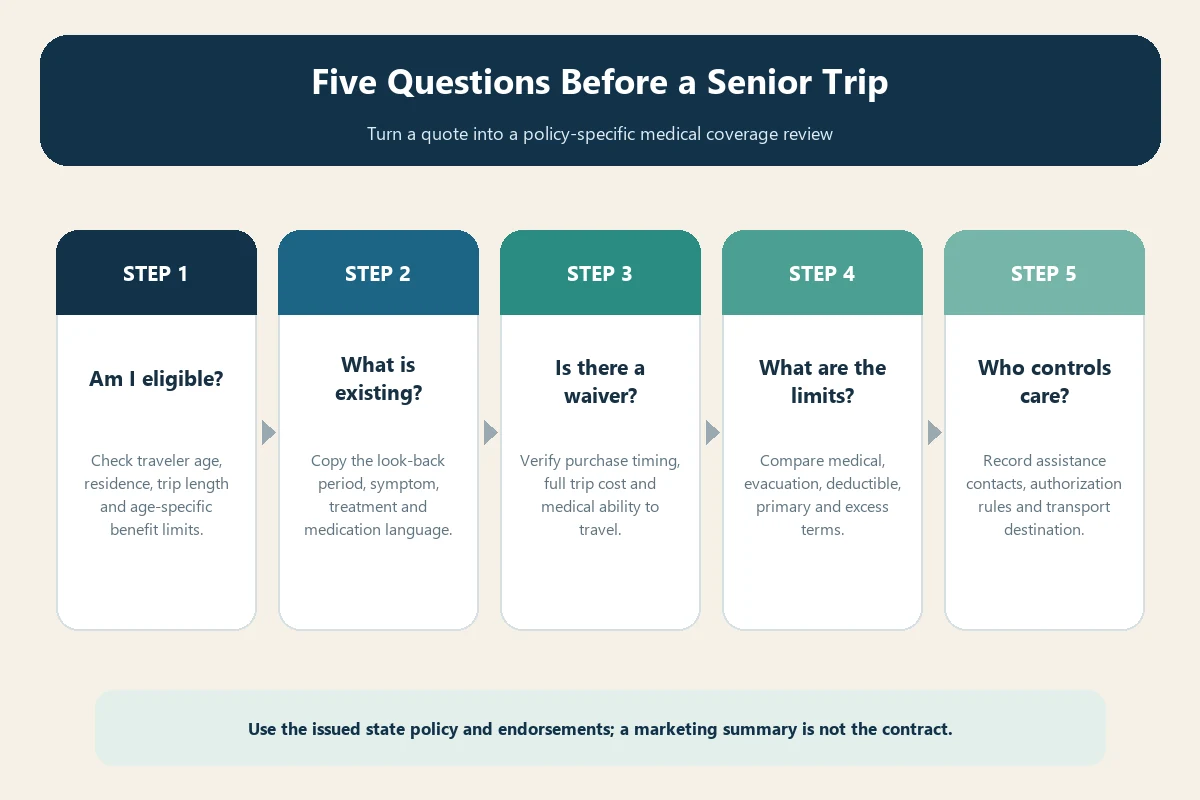
Senior travel insurance pre existing condition questions should begin with the policy definition, not the traveler’s diagnosis list. Ask how age affects eligibility, which recent symptoms or medication changes fall inside the look-back period, whether an exclusion waiver applies, and who controls emergency transport. A plan that looks generous on a quote screen can answer each question differently in the issued contract.
This U.S.-focused interview sheet is educational, not medical, insurance, or legal advice. Do not delay care or alter treatment to fit a policy rule. Forms, limits, age bands, and waiver requirements vary by plan and state; the issued policy, schedule, declarations, and endorsements control.
Key takeaways
- Ask whether your age changes eligibility, price, limits, or only the premium.
- Copy the policy’s actual look-back definition, including symptoms and medication language.
- Confirm every waiver condition separately and in writing.
- Compare medical expense and evacuation as different benefits.
- Keep a dated purchase, health, and trip-cost record before a claim exists.
Reviewed August 16, 2026. This checklist does not identify a “best” plan. It is designed to expose contract differences that matter to older travelers.
Question 1: Am I eligible at my age?
Ask whether the plan has a maximum issue age, an age limit for a particular benefit, or a maximum trip duration that changes by age. Then ask whether the quoted medical and evacuation limits are the same for every insured traveler. Do not infer these answers from a general carrier page.
The senior age-band guide explains how to compare age eligibility, benefit reductions, and trip-length caps without treating every plan alike. If a birthday occurs between purchase and departure, ask which date the contract uses to determine age.
Question 2: What does this policy call pre-existing?
A policy can examine a defined period before purchase or another stated date. Its definition may include a condition that caused symptoms, examination, diagnosis, care, treatment, a recommendation for care, or a prescription change. A formal diagnosis is not always required.
Ask the insurer to identify the exact definition and look-back period in the state form. The look-back period guide shows how the review window works, while the dated look-back examples help map appointments and symptoms to a calendar.
Question 3: Does a stable medication still matter?
Ask how the form treats a new prescription, dosage increase, dosage reduction, stopped medication, refill, generic substitution, or clinician-recommended change. Some definitions except a controlled condition when the prescription has not changed; others use different language.
Record what changed, why it changed, who recommended it, and the date. The medication-change guide separates routine pharmacy events from clinical changes. Never skip an appointment or decline an appropriate adjustment to protect an insurance argument.
Question 4: Is an exclusion waiver actually included?
A waiver does not make a condition disappear. It can remove the pre-existing-medical-condition exclusion from specified coverages when every eligibility condition is met. Ask which benefits receive the waiver and which exclusions remain.
Travel Guard’s current waiver guidance gives one carrier example: a time-sensitive purchase, coverage of required prepaid nonrefundable trip payments, and medical ability to travel. Allianz describes comparable concepts in its existing-medical-condition guidance. The numbers and definitions are examples, not universal rules.
Question 5: What starts the purchase clock?
Ask whether the time-sensitive period runs from the initial trip payment, initial deposit, first nonrefundable payment, final payment, or another defined event. A refundable deposit can still start the clock if the policy says “first payment” rather than “first nonrefundable payment.”
Write down the deposit date, insurance purchase date, and every later trip payment. Use the waiver eligibility checklist to test timing, trip cost, medical status, and other conditions one by one.
Question 6: Must I insure the entire trip cost?
Ask what “trip cost” means and which amounts must be insured: airfare, cruise, tour, hotel, vacation rental, transfer, excursion, taxes, fees, or later additions. Also ask how quickly the insured amount must be increased after a new nonrefundable payment.
Build a ledger with supplier, payment date, amount, refundable portion, cancellation penalty, and update confirmation. Underinsuring by accident can affect waiver eligibility in a form that requires all covered trip costs, even when the medical event itself is well documented.
Question 7: Who must be medically able to travel?
Ask whether the condition applies to the insured traveler, every insured traveler, or another person. Ask which date is tested and what the policy means by medically able to travel. A treating clinician documents medical facts; the insurer applies the contract.
The medically-able-to-travel guide identifies useful dated evidence without asking a physician to decide coverage. If travel is against medical advice, prioritize health and speak with the insurer about cancellation procedures.
Question 8: What does Medicare cover abroad?
Do not assume a Medicare card follows the traveler worldwide. Medicare’s official travel page says Original Medicare usually does not cover health care outside the United States except in limited circumstances. It also notes that Medigap may cover some foreign emergency care.
Ask a Medicare Advantage or Medigap plan for written overseas rules, including emergency definitions, deductibles, lifetime maximums, networks, and reimbursement. The answer determines whether travel medical coverage is primary, secondary, excess, or filling a near-total gap.
Question 9: What are the medical expense mechanics?
Ask for the emergency medical limit, deductible, coinsurance, primary-or-excess wording, dental sublimit, exclusions, and whether outpatient and inpatient care are treated differently. Confirm whether the traveler may need to pay the provider first and seek reimbursement later.
The CDC Yellow Book advises travelers to ask about preauthorization, out-of-network care, reimbursement, services, age exclusions, and access to a 24-hour physician-backed support center. Turn those prompts into written questions for the exact plan.
Question 10: Is evacuation a separate decision?
Yes. A policy can cover emergency treatment but apply different triggers, authorization, limits, and destinations to medical evacuation. Ask what medical necessity means, who must order transport, who authorizes it, what happens if advance contact is impossible, and whether the destination is the nearest suitable facility or a facility near home.
The evacuation-limit guide helps compare the amount and the operational conditions. A large number does not give the traveler unilateral control over an air ambulance.
Question 11: Does the itinerary fit the coverage?
Ask whether every country, cruise region, remote excursion, planned activity, and trip day is eligible. Confirm adventure-activity exclusions, high-altitude rules, alcohol provisions, war and civil-unrest exclusions, and sanctions restrictions when relevant.
The U.S. Department of State’s travel-insurance guidance recommends checking destination validity, trip duration, current medical conditions, emergency care, transport back to the United States, and 24-hour help. Government assistance does not replace insurance or pay the traveler’s medical bills.
Question 12: What evidence would a claim require?
Ask for the claim form and document list before departure. Keep the policy, schedule, proof of purchase, all trip invoices, refunds, medical records, itemized bills, receipts, assistance case number, and written authorizations. If another plan could pay, preserve its explanation of benefits.
The claim-document guide organizes the file into policy, health, causation, trip-cost, and financial proof. A waiver does not remove the requirement to prove the covered loss.
A one-page call script
- Confirm the exact plan name, state form, and issue-age rule.
- Ask the representative to locate the pre-existing-condition definition.
- Copy the look-back period and medication-change language.
- Locate the waiver and list every eligibility condition.
- Confirm the purchase deadline and full-trip-cost update rule.
- Record medical expense, deductible, and primary-or-excess wording.
- Record evacuation authorization and destination language.
- Request the answers and policy links by email.
Questions to repeat after the policy arrives
A quote is not the final review. When the fulfillment package arrives, confirm that the plan name, insured travelers, birth dates, residence state, destination, departure date, return date, and insured trip cost are accurate. Check whether an endorsement changes the definition or benefit shown in the sales summary.
Ask how long the free-look period lasts and how cancellation must be submitted if the policy does not match the application. Do not cancel existing protection until replacement coverage is issued and its effective dates are confirmed.
Questions for a traveling companion or caregiver
Older travelers sometimes depend on a spouse, adult child, caregiver, or organized tour escort. Ask whether illness of that person can trigger cancellation or interruption, whether a bedside-visit or medical-reunion benefit exists, and who pays the companion’s extra hotel and return travel.
Share the assistance number, policy number, medication list, clinician contacts, and document location with a trusted person. Confirm consent and privacy arrangements before an emergency. The best policy cannot help quickly if nobody can identify it or authorize release of relevant medical records.
Bottom line
The most useful senior travel insurance pre existing condition questions are contract questions: who is eligible, what recent medical facts count, whether a waiver applies, which trip costs must be insured, how medical benefits pay, and who controls evacuation. Put every answer beside the policy page and date. That record is more reliable than a label such as “senior plan” or “pre-existing coverage.”
An emergency family or bedside visit has its own hospitalization, visitor, fare, expense and authorization rules. Use the medical evacuation family-visit guide before booking a relative’s flight or assuming the patient’s evacuation approval pays for it.
Scheduled dialysis abroad, an unexpected medical emergency, and trip cancellation are three different coverage questions. Use this senior dialysis travel insurance planning guide to align treatment, pre-existing-condition rules, supplies, transport, and claims before booking.
A pacemaker or ICD does not answer the insurance question by itself; the underlying condition, recent procedure, stability, and destination care matter. Use this senior pacemaker and ICD travel insurance guide to verify screening, records, emergencies, evacuation, and pre-existing-condition rules.
Taking a blood thinner is not one insurance risk: the underlying condition, medication continuity, bleeding, thrombosis, cancellation, and evacuation follow different rules. Use this senior blood thinner travel insurance guide to plan supply, monitoring, emergencies, and claims.
Travel during chemotherapy is a treatment-timeline decision before it is an insurance decision. Use this senior chemotherapy travel insurance guide to separate planned care, immune risk, pre-existing-condition rules, cancellation, unexpected emergencies, and evacuation.
A past stroke or TIA does not answer whether a trip is medically ready or insurance-eligible. Use this senior post-stroke travel insurance timeline to review stability, recent care, medication, mobility, recurrence, cancellation, evacuation, and claims.
Travel insurance for epilepsy depends on the seizure timeline, medication stability, recent care, activity, and policy—not the diagnosis alone. Use this senior epilepsy travel insurance guide to plan medicine, support, emergency response, cancellation, interruption, and evacuation.
Severe-allergy travel requires avoidance, epinephrine continuity, clear communication, emergency response, and insurance. Use this senior severe-allergy travel insurance guide to test pre-existing conditions, airline limits, hospital care, evacuation, and claims.
The first trip payment date can start a time-sensitive insurance window even when the amount is small, refundable, or paid with points. Use this first trip payment date decision tree to audit deposits, credits, holds, memberships, and group bookings before purchase.
