

Travel insurance for China from USA trips should be evaluated as a payment and coordination system, not just a list of coverage limits. A traveler may need to fund a hospital deposit, navigate language and digital payment tools, move between facilities and later document reimbursement through more than one payer.
Key takeaways
- Verify how a hospital deposit will be paid before relying on reimbursement.
- Test direct billing at the facility level; do not infer it from a policy limit.
- Separate major-city care from rural or regional transfer needs.
- Use official weather and carrier records for domestic disruption claims.
- Insurance cannot cancel entry rules, local law or an exit restriction.
Planning information reviewed August 16, 2026. Advisories, entry rules, payment services, medical access, weather alerts and policy terms can change. Recheck official and supplier information for the travel dates.
Map the route before comparing policies
List every mainland destination, domestic train or flight, organized tour, business meeting and prepaid hotel. Add any high-elevation, rural or remote segment. Beijing, Shanghai and a western overland route do not create the same provider and transport dependencies.
Mark which bookings are refundable, changeable or tied to a group itinerary. Record the local supplier’s contact method and cancellation deadline. This inventory shows which losses need trip cancellation, interruption, delay or medical coordination.
The delay, interruption and cancellation guide helps classify replacement transport, added lodging and unused arrangements.
Prepare for a hospital deposit
Current U.S. Department of State China travel guidance says medical care is not free. It states that hospitals and doctors can require payment before service or admission, including in emergencies, and that a deposit may be requested.
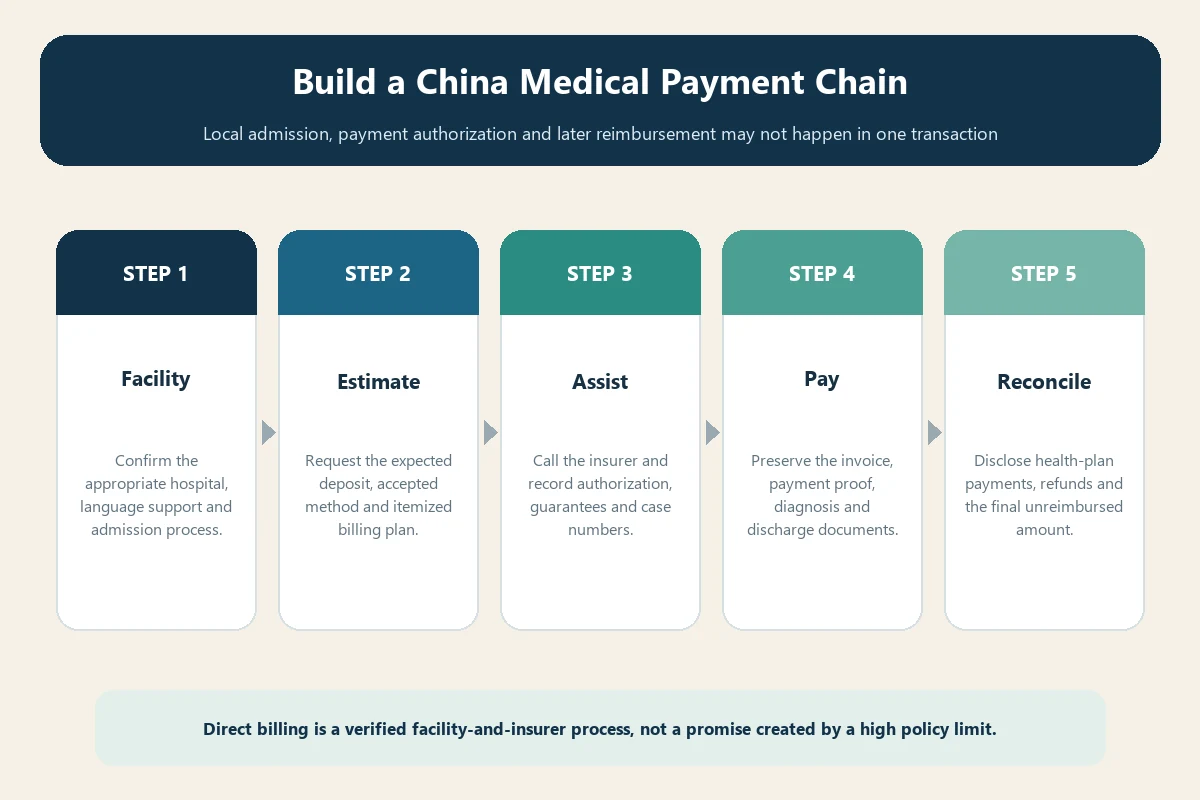
Ask the insurer what happens when a hospital requires funds before the claims team can complete a review. Determine whether assistance can issue a payment guarantee, whether the facility accepts it and how quickly the process works after hours.
Keep more than one lawful payment method. A reimbursement benefit does not remove the local payment obligation. The health insurance abroad guide structures the separate call to the U.S. health plan.
Build a three-method payment backup
China’s official payment service guide for overseas visitors explains options involving mobile payment, bank cards and cash. It also identifies certain tourist venues where domestic and overseas cards should be accepted.
That operational guidance is not a promise that every hospital, clinic, taxi or rural supplier will accept the same card. Ask the medical facility which method it accepts for deposits and final bills. Ask the insurer whether a digital wallet receipt is sufficient claim evidence.
Carry a reasonable cash backup, an enabled card and a tested mobile payment option. Preserve the invoice and proof of payment, not only a screenshot of the transaction total.
Test direct billing instead of assuming it
Ask assistance to explain the process for a non-life-threatening illness in the first city. Which facility will it contact? Who confirms acceptance? Does the traveler need a case number before arrival? Is a guarantee of payment available or merely requested?
Then test a second scenario outside a major city. If direct billing is unavailable, identify the deposit, documentation and reimbursement path. Record the deductible and whether the plan pays primary or waits for the U.S. health insurer.
The primary versus secondary coverage guide explains payer order. Local payment and claim order remain different questions.
Audit the facility and transfer chain
State Department guidance says facilities exist throughout China, but standards and resources vary. Rural clinics may lack basic supplies. It also notes that travelers generally pay the costs of moving to or between hospitals.
Ask who selects a receiving facility and authorizes a transfer. Confirm whether ground ambulance, scheduled transport and medically equipped transport have separate rules. A transfer within China may be the first covered stage before any international movement is considered.
The medical evacuation planning guide helps map stabilization, local transport, higher care and possible repatriation.
Plan for language and itemized records
Prepare the hotel address, allergies, diagnoses, medicines and emergency contacts in English and Chinese. Ask whether assistance offers interpretation for medical calls. Keep a companion authorized to speak with the insurer.
Request a diagnosis, itemized bill, prescription, discharge instruction and payment receipt. Preserve the Chinese originals. Translate working copies without discarding the source documents.
Ask the claims team before travel whether it requires certified translation or a particular currency-conversion record. The strongest file shows the clinical service, local amount, payment method and date.
Use official weather alerts as a starting point
China’s National Meteorological Center publishes official weather warning signals and regional conditions. Save the warning, affected province or city, issue time and hazard type.
Next, obtain the domestic airline, railway, tour or hotel decision. A weather alert may affect one corridor while another service continues. The insurer still needs the covered trigger, minimum delay and affected booking.
The weather-delay guide explains known-event timing and carrier evidence. Coverage purchased after a storm is foreseeable may not apply to that storm.
Separate domestic transport contracts
Record every high-speed rail ticket, domestic flight, airport transfer and organized-tour movement. Note whether the ticket is separate from the U.S. itinerary and whether the supplier offers a refund, credit or alternate service.
Ask the insurer which services meet its common-carrier definition. Determine how a missed connection on a separate ticket is treated. Keep the original and revised itinerary plus every refund record.
Do not claim a replacement cost before subtracting recovered value. The policy generally addresses eligible, unreimbursed loss, subject to its limits and definitions.
Read regional and advisory wording carefully
The State Department currently advises increased caution in China and describes distinct legal and regional risks. Policy wording may address government advisories, civil disorder, destination inaccessibility or excluded regions differently.
Ask whether coverage changes when the itinerary enters an area listed in an advisory or policy exclusion. Identify the applicable advisory date and exact geography. Do not infer that a country-level headline describes every city the same way.
The country exclusions and advisories guide provides a comparison method for territory, timing and named triggers.
Understand what insurance cannot solve
State Department guidance warns about arbitrary enforcement of local laws and exit bans. A travel policy cannot authorize departure, override local law or guarantee consular access. Medical evacuation benefits remain subject to lawful movement and operational permission.
Travelers with business, family, research or dual-nationality considerations should review official guidance and obtain appropriate legal advice when necessary. Do not market an evacuation limit as a solution to a legal restriction.
Separate insurable expenses from non-insurable legal or regulatory problems. Ask the policy whether legal assistance or security evacuation exists, and read the exclusions rather than assuming.
Check prescription legality before departure
The State Department directs travelers to verify that medication is legal in China. Carry lawful medicine in original packaging with the prescription and enough supply for reasonable delay.
Insurance cannot override customs rules or replace a confiscated prohibited item. If a health condition could affect travel, ask how the policy treats stability, look-back periods and purchase timing.
The pre-existing condition waiver guide explains the typical time-sensitive tests. Confirm them in the certificate.
Compare policies with one China scenario
Use the same traveler ages, dates and prepaid costs. Include two major cities, a separate high-speed rail booking, a regional excursion, a weather disruption and an emergency admission requiring a deposit.
- Can assistance identify an appropriate facility and accepted payment method?
- Who funds the hospital deposit and under what authorization?
- Which plan reviews medical costs first?
- How are inter-hospital transport and evacuation decisions made?
- Which domestic services qualify for delay or missed-connection benefits?
- What territorial, advisory and legal exclusions apply?
Read the certificate and endorsements. Avoid Google’s generic daily prices and universal limit suggestions. A useful plan must fit the route, payment capacity, health plan and documented supplier contracts.
Use assistance without mistaking it for approval
Call the insurer as soon as reasonably possible after urgent safety and care needs are handled. Record the representative, case number, facility, instruction and any authorization. Ask for written confirmation when available.
The assistance line versus claims guide distinguishes coordination from adjudication. A hospital referral does not prove network status or final reimbursement.
If the facility requires immediate payment, prioritize necessary care. Preserve evidence showing why prior contact was not practical and notify the insurer promptly afterward.
Reconcile the claim in one ledger
List each medical, transport and trip cost separately. Add the Chinese yuan amount, actual conversion, supplier refund, U.S. health-plan response and travel-insurer payment. Never submit a combined total without source records.
The travel insurance claim guide explains coordination and documentation. Keep the official alert, carrier notice and revised schedule with the affected booking.
A chronological ledger prevents duplicate recovery and shows the final unreimbursed amount. It also gives the insurer a clear trail from event to payment.
Test access before leaving the United States
Sign in to every payment and insurer account before departure. Confirm that verification codes can reach the traveler in China and that a trusted companion can access essential documents without opening financial accounts.
Store policy contacts, hospital instructions and an unmarked itinerary offline. A payment tool or insurer portal may be less useful when roaming, authentication or local connectivity fails. The backup should preserve privacy while keeping emergency facts available.
Bottom line
A strong China plan connects real payment methods, hospital deposits, provider access, domestic transport and official advisories. Verify the operational process before departure, then preserve every authorization, local document, refund and payment record needed to support the claim.
