
A request to sign a travel insurance claim release before payment deserves a document-by-document review. A release, settlement agreement, discharge, or covenant not to sue can give up legal rights. A proof of loss, medical authorization, payment election, tax form, or electronic-signature consent usually serves a different purpose.
Do not assume that every requested signature closes the claim, or that every document labeled “receipt” is harmless. Ask what the form does, which payment supports it, and what rights remain. This U.S.-focused guide provides a practical review process, not legal advice. Release rules vary by state, policy, claim type, and wording; obtain advice from a qualified attorney before signing if the effect is unclear.
First identify the document
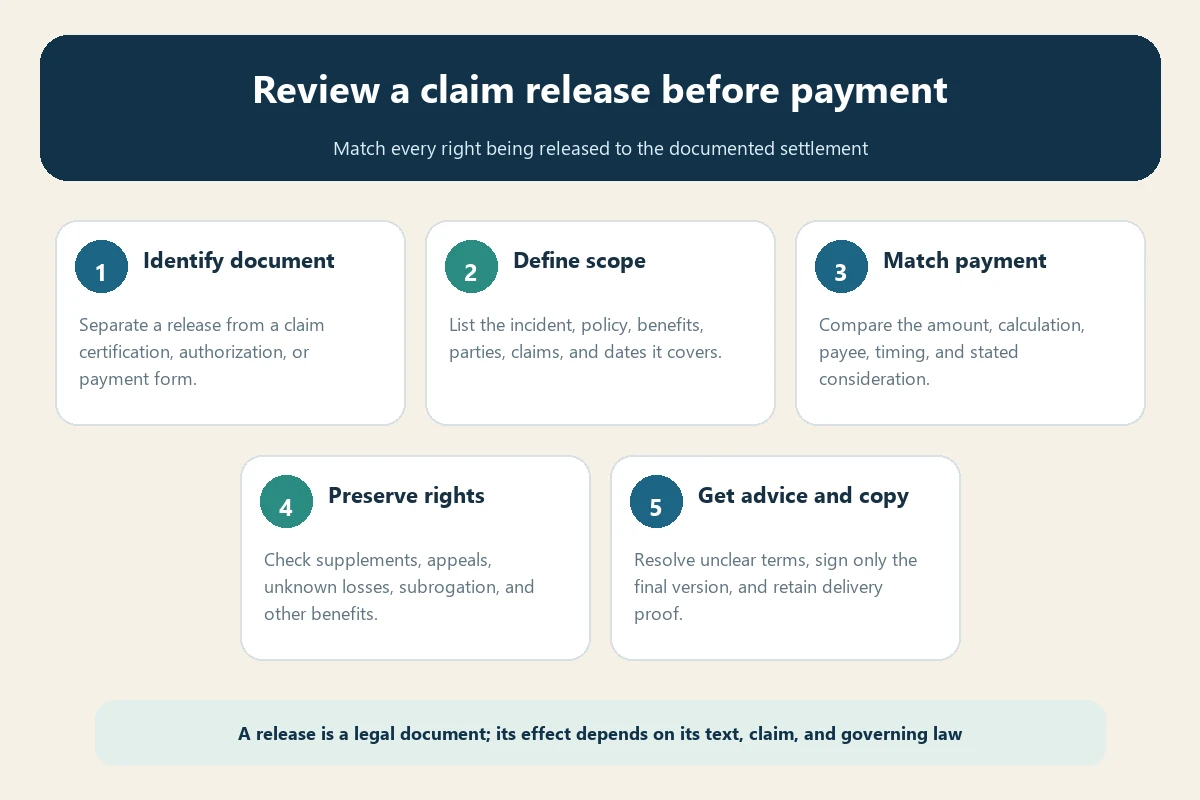
Read the title and every operative paragraph, not just the email description. A claims handler may use an informal label that does not capture the document’s legal effect. Search for terms such as release, waiver, full and final settlement, discharge, covenant not to sue, indemnify, hold harmless, known and unknown claims, and all persons or entities.
| Document | Typical function | Critical question |
|---|---|---|
| Claim certification or proof of loss | Confirms facts, loss, and supporting amount | Does it also contain release language? |
| Medical or records authorization | Permits specified information collection | Who may obtain what records, and for how long? |
| Payment election | Selects check, ACH, or another delivery method | Does accepting payment waive a dispute? |
| Assignment or subrogation form | Transfers or preserves specified recovery rights | Which rights, proceeds, or parties are affected? |
| Settlement and release | Resolves defined rights in exchange for consideration | Is the release no broader than the actual settlement? |
Determine whether the claim is being paid or settled
An insurer may be paying an approved benefit under the policy, paying an undisputed portion while another amount remains contested, or proposing a negotiated settlement of a dispute. Those are not interchangeable events. Ask the administrator to state in writing which one applies.
Request the coverage decision and line-item calculation: claimed amount, approved amount, policy limit, deductible, depreciation, exchange rate, prior payment, offsets, excluded items, and net payment. The no written decision letter guide explains how to obtain a decision that can be compared with the proposed document.
If the payment is only an undisputed amount, ask whether accepting it leaves the disputed balance, supplement, or appeal open. If the payment is consideration for a settlement, identify the exact disagreement it resolves. Do not rely on a telephone assurance that “the rest stays open” when the document says otherwise.
Match the release to a specific scope
A focused release should make it possible to identify the claimant, released parties, policy or plan, claim number, trip or incident, benefit category, relevant dates, payment amount, and resolved issue. Broad language may purport to cover other travelers, providers, future expenses, unknown injuries, unrelated benefit sections, third parties, affiliates, agents, or claims that have not yet been evaluated.
New York’s Department of Financial Services has explained, in an opinion concerning a release included with a proof of loss, that a required release cannot be broader than the scope of the settlement under that state’s rule. The opinion also says specificity and an explanation and calculation of settlement payments help define that scope. This is useful review logic, but it is New York authority—not a nationwide rule. See the official DFS opinion on a release in a proof-of-loss form.
A separate New York DFS opinion on third-party settlements says a release may be required before payment of a settled third-party claim when it complies with the state rule. Most travel-benefit claims are first-party claims against the traveler’s own coverage, but travel events can also create liability or recovery issues involving airlines, providers, tour operators, or other parties. Confirm which relationship the form addresses.
Review every released party and claim
List each person or entity being released. The named insurer may use a third-party administrator, assistance company, underwriter, payment vendor, affiliate, employer plan, credit-card benefit administrator, or program sponsor. A definition that sweeps in “all other persons” can reach beyond the party making payment.
Then list every claim or right described. Compare the list against each policy benefit and each claimant. A settlement of a baggage valuation dispute should not silently close an unresolved medical, trip interruption, accidental death, rental vehicle, or travel delay claim unless that is the informed agreement. Likewise, one traveler’s settlement should not casually waive another traveler’s separate rights.
Check partial payments, supplements, and later-discovered losses
A partial payment may cover only certain invoices or an initial calculation. A supplement can arise when a provider sends a corrected bill, a carrier issues a final refund, currency conversion is corrected, or additional covered costs become documented. Ask whether the release prevents a supplement or reopening.
The California Department of Insurance advises consumers to be wary of initial offers presented as full settlements that require a release of further liability. Its guide concerns residential property claims, not travel insurance, but it illustrates why “full settlement” wording matters and why state-specific guidance should be consulted. Review the official California Residential Property Claims Guide.
Use the travel claim partial payment guide to reconcile paid and unpaid line items. If new documentation may change the loss, the supplement and reopening guide provides a record-based follow-up process.
Inspect appeal and dispute language
Look for an express waiver of appeal, reconsideration, arbitration, litigation, regulatory complaint, class participation, or other review. Also inspect confidentiality, non-disparagement, governing-law, venue, attorney-fee, integration, severability, and no-admission clauses. These provisions can matter even when they are not called a release.
A policy deadline and a settlement acceptance deadline are different concepts. Record both, ask whether an extension is available, and do not allow urgency to replace review. The travel insurance claim appeal guide explains how to preserve a coverage challenge with the policy, decision, evidence, and deadline.
Understand indemnity, liens, and repayment obligations
A release gives up claims against another party. An indemnity or hold-harmless clause may instead require the signer to reimburse or protect someone against a later demand. Those obligations can be materially different. Do not treat them as boilerplate.
Check whether the document assigns recovery rights, addresses subrogation, requires repayment after an airline refund, allocates medical liens, or makes the claimant responsible for another person’s demand. Compare it with the policy’s recovery provisions and any separate assignment of benefits. Ask counsel to explain any duty that may exceed the payment received.
Verify consideration, payee, and payment sequence
The final document should accurately state what the signer receives in exchange: amount, currency, payee, method, timing, and any conditions. Confirm whether the amount includes prior payments, fees, interest, taxes, liens, or provider payments. Do not sign a recital saying funds were already received when they have not been received; request corrected wording or qualified legal advice about an appropriate sequence.
Confirm the request through a policy document, authenticated portal, or official contact independent of the incoming message. The claim payment scam guide covers impersonation, changed banking instructions, fake fees, and account-takeover indicators.
Special signers require verified authority
A parent or guardian signing for a minor, personal representative signing for an estate, agent using a power of attorney, attorney signing for a client, or representative acting for an incapacitated claimant may need specific authority and formalities. The insurer’s willingness to accept a signature does not independently establish that the signer can release every right.
Identify the legal claimant and payee, obtain the authority requirements in writing, and seek jurisdiction-specific advice. Do not alter a signature block or sign another person’s name merely to move payment forward.
Control the electronic-signature version
If the form arrives through an e-sign platform, download the complete review copy before signing. Compare the document identifier, page count, attachments, fillable fields, and version against the negotiated text. Keep the completion certificate, timestamp, delivery email, and final executed PDF.
Do not sign blank fields or permit material terms to be inserted afterward. If a correction is needed, require a clean revised version and restart the signature process. The electronic-signature claim guide provides a version-control checklist.
A practical pre-signing request
A concise written message can ask the administrator to:
- identify the form as a claim requirement, payment authorization, or negotiated settlement;
- provide the written decision and complete payment calculation;
- state whether any amount is undisputed and payable without settling the disputed balance;
- list the claim, benefit, incident, people, and entities the release covers;
- confirm whether appeals, supplements, later expenses, or other benefit claims remain open;
- explain any assignment, subrogation, indemnity, confidentiality, or repayment term;
- provide the governing policy provision and applicable state-law basis for the request;
- allow reasonable review time and provide the final countersigned copy.
State that the request seeks clarification and does not accept, reject, or modify the proposal. Preserve the original form and the response in the claim timeline.
Where to obtain state-specific help
Insurance regulation and complaint routes are state-specific. The NAIC directory of state insurance departments links to each regulator. Confirm the correct regulator for the insurer, policy, claimant residence, and issue before filing. A regulator may explain complaint procedures but generally does not act as the claimant’s private attorney.
For a material release, disputed amount, bodily injury, minor, estate, lien, unknown future loss, broad indemnity, or threatened deadline, consult an attorney licensed in the relevant jurisdiction. Provide the policy, declarations, claim decision, calculation, complete proposed agreement, correspondence, and timeline.
Bottom line
A release request before travel claim payment is not merely an administrative checkbox. Identify the legal document, distinguish an ordinary benefit payment from a negotiated settlement, match the released rights to a specific calculation, and protect unresolved benefits, supplements, appeals, and other claimants. Verify the requester, obtain tailored advice where needed, sign only the final complete version, and keep proof of exactly what was delivered.
