
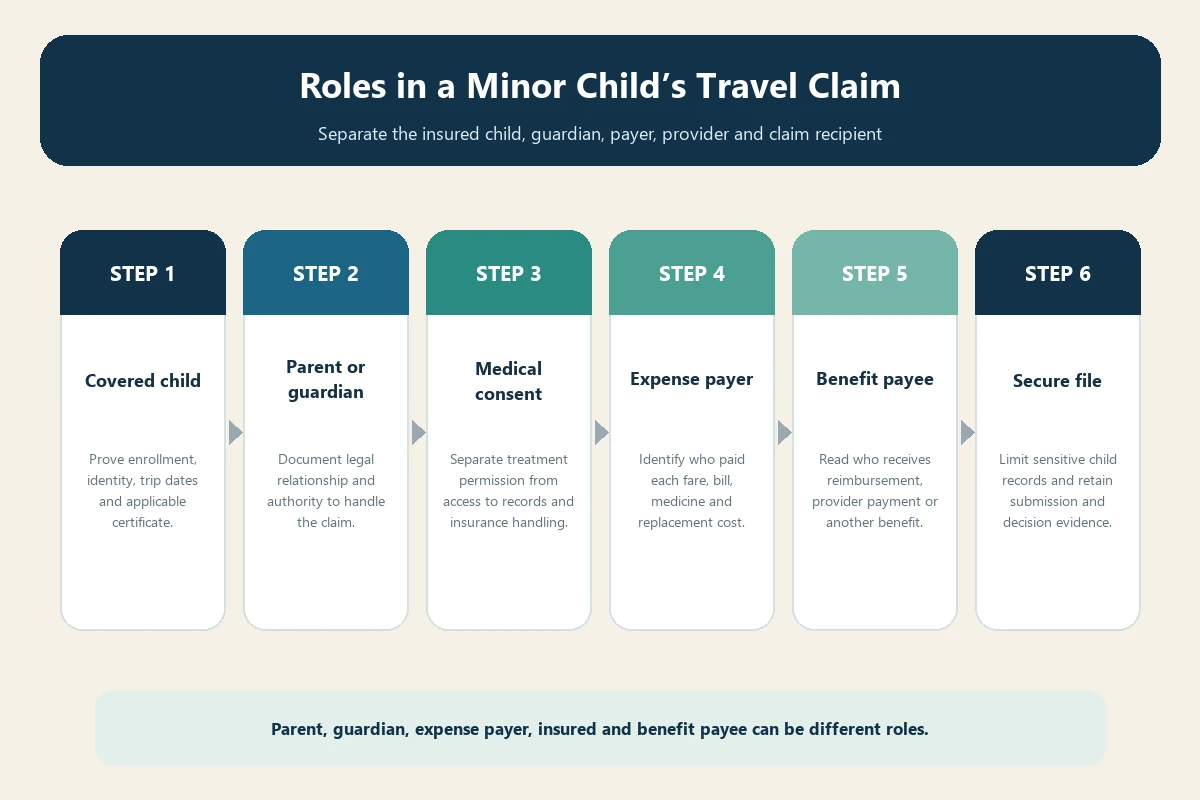
A travel insurance claim for a minor child must connect the child’s coverage with an authorized parent or guardian, the person who paid, and the evidence for the benefit. These roles can be different. A grandparent can buy the trip, a parent can sign the claim, a hospital can hold the records, and the insurer can issue payment under its policy and state requirements.
Confirm the child was enrolled, the age and dependent definitions, who may submit and sign, which authority document is required, and who receives payment. Do not assume that traveling with a child or paying an expense automatically grants every medical, privacy, settlement, or claim right.
Key takeaways
- Verify the child is an insured person, not merely listed on the itinerary.
- Ask who can sign and what proves parent or guardian authority.
- Separate the child’s expenses from shared family costs.
- Medical consent, record release, claim authority, and payment are distinct.
- Use secure channels for birth, custody, passport, and medical records.
Confirm the child’s coverage
Locate the declarations, certificate, traveler list, dates of birth, premium or included-dependent terms, trip dates, destination, and benefit schedule. A product can include eligible children with an insured adult, require separate enrollment, or apply age, residence, relationship, or travel-together conditions.
Verify the child’s name and birth date match the passport and booking. Correct clerical errors before they appear across medical and carrier records.
Parent is not the same as policyholder
The policy purchaser can be a parent, grandparent, school, tour organizer, employer, or another adult. The insured child can have no direct payment role. The claimant or signer must still satisfy insurer and legal requirements.
Ask the carrier to identify the policyholder, insured, claimant, signer, authorized representative, and payee for the exact benefit. Put the answer in the claim file.
Parent, guardian, and personal representative
A parent often acts for a minor, but custody orders, guardianship, emancipation, age of majority, state law, and the type of decision can change authority. A nonparent companion may need written authorization or formal guardianship proof.
HHS guidance explains that parents commonly act as a minor’s personal representative under HIPAA, with exceptions. Foreign providers follow local law and their own processes. Do not assume a U.S. travel consent letter controls medical records abroad.
Which authority records may be requested
- child’s birth certificate or other relationship record;
- parent or guardian identification;
- custody or guardianship order;
- travel consent from a nontraveling parent;
- medical consent or provider release;
- school, group, or tour authorization;
- power of attorney or other limited authority when recognized; and
- insurer-specific representative form.
Ask for the minimum necessary document and secure channel. Do not upload an entire custody case when a specific order page and certification will suffice.
Who signs the claim form?
The insurer can require a parent or legal guardian to sign for a child under a specified age. Older minors may also need to sign an authorization or factual statement. Read every signature block and identify the capacity, such as “parent of minor insured” or “court-appointed guardian.”
Never sign the child’s name as though the child signed. Use the carrier’s instructed representative format.
Medical consent versus claim consent
Medical consent authorizes treatment. A HIPAA or local release authorizes records. A claim form requests benefits. An assignment of benefits can direct payment. A travel consent letter addresses travel. One document does not automatically perform all functions.
Review our medical records authorization guide and ask the provider and insurer which forms they require.
Medical claim packet
For illness or injury, obtain the patient name, provider, dates, diagnosis or reason for treatment, itemized charges, clinical records, prescriptions, payment evidence, and any health-plan EOB. Keep the child’s bills separate from a parent’s or sibling’s.
If treatment occurred abroad, use our foreign medical bill guide. The original, translation, clinical record, receipt, and EOB are distinct.
Who paid the expense?
A parent, grandparent, school, tour operator, host family, or assistance company may pay. Identify the payer on each line and include the relationship or authority. A card statement in a parent’s name can support payment but does not by itself prove the child received the service.
Ask whether reimbursement is payable to the payer, policyholder, legal representative, provider, or another party. Do not assume the child’s account is used.
Shared family costs
A hotel room, rental car, cruise cabin, or package may be shared. Separate child-specific expenses from household costs and explain allocation. Do not divide equally if the invoice uses child pricing, occupancy, or a free-dependent term.
Use our travel insurance claim filing guide to organize the line items, proof, and submission sequence.
Emergency contacts are not legal representatives
An emergency contact can receive a call and help locate family, but that designation does not automatically authorize medical consent, record release, claim settlement, or payment. Ask the insurer and provider what authority is needed for each task.
Before group or independent travel, parents should give the responsible adult accurate contacts and the documents recognized for the destination and circumstances. Keep the child’s insurer and assistance details accessible without posting sensitive identifiers publicly.
Age changes during the claim
A traveler can be a minor on the event date and reach the age of majority while the claim is pending. Ask whose signature, authorization, privacy consent, and payment information are required at each stage. Do not assume the parent retains the same authority after the legal threshold.
Record the child’s birth date, coverage measurement date, event date, claim date, and majority date. If the insurer requests a new authorization, submit it without altering the original claim chronology.
Settlement and release language
A partial payment, disputed claim, or liability-related benefit can include a release or settlement document. A parent may not have unlimited authority to settle a minor’s rights, and some jurisdictions can require court approval or protected handling of funds. Travel insurance expense reimbursement is different from a personal-injury settlement, but broad language deserves review.
Ask which benefit and rights the document covers, who must sign, whether payment is final, and how funds will be issued. Obtain qualified legal advice for a material release, contested guardianship, or long-term rights.
When the child paid
An older minor may use a debit card, cash, or travel wallet. Preserve the child’s statement or receipt and explain the source of funds. Do not move the expense to a parent’s reconciliation simply because the parent files the claim.
The insurer can still require adult authority or a protected payment method. Verify the payee before providing account details.
Trip cancellation for a child
Prove the child was insured, the event fits a covered reason, and the prepaid child-specific cost is nonrefundable under the policy. Include booking, payment, cancellation date, supplier terms, refund statement, and medical or other event evidence.
If the whole family cancels because of one child’s condition, each insured adult’s coverage can depend on definitions such as family member, traveling companion, and covered reason. Do not assume one child’s approval determines every traveler’s claim.
Trip interruption and return arrangements
If a child becomes ill during travel, claims can involve unused cost, new adult-and-child transportation, lodging, companion expenses, and medical care. Label which person used each ticket and why an adult needed to accompany the child.
Follow our trip interruption guide. The child’s medical bill and the family’s changed travel costs belong in separate benefit lanes.
Return of minor children benefit
Some plans can include return of minor children when an insured adult is hospitalized, evacuated, or otherwise unable to supervise, subject to definitions, limits, assistance coordination, and suitable escort requirements. Verify the exact policy; the benefit is not universal.
Our dependent children evacuation guide explains the operational questions. Do not self-book an escort or international ticket without assistance approval when coordination is reasonably possible.
Baggage claims for children
Identify who owned the item, who bought it, age, condition, original value, and which baggage report covers it. A parent’s card can show purchase while photos show the child used the item. Item limits and depreciation can apply separately.
For missing receipts, use our alternative evidence guide. Do not list the same family item under multiple travelers.
Schools, camps, and group travel
The school or tour leader can hold bookings, payments, incident records, and group insurance. Ask whether the child is insured under a group policy, individual plan, or both. Obtain the master certificate and child-specific enrollment or roster evidence.
Clarify whether the organizer can submit only operational records or also act as claim representative. Parent and guardian signatures may still be required.
Separated or divorced parents
Do not assume either parent can control every record or payment. The insurer can require custody or legal authority documents, especially when parents disagree or the child lives in another state. Keep the claim focused and transmit family court records securely.
For a disputed settlement, beneficiary, or substantial payment, obtain qualified legal advice.
Privacy and portal access
Do not share one family portal password. Use authorized representative access when offered. Limit birth certificate, passport, Social Security, custody, and medical files to verified recipients.
Follow our claim payment scam guide for identity and payee changes.
Claim checklist
- Child’s coverage, name, birth date, and benefit.
- Signer and proof of parent or guardian authority.
- Trip, event, and child-specific chronology.
- Medical, carrier, supplier, or baggage evidence.
- Expense payer and proof of payment.
- Shared-cost allocation and other insured travelers.
- Refunds, credits, other insurance, and net loss.
- Secure payment and communication instructions.
FAQ
Can a grandparent file the child’s claim?
Possibly, but travel, payment, and legal relationship alone may not establish authority. Ask what representation documents are required.
Does the child need to sign?
Age, form, benefit, and law matter. Follow the insurer’s signature instructions for minor and representative.
Who receives the payment?
The payer, provider, policyholder, parent, guardian, or another recipient can apply depending on the benefit, contract, and law.
Is a birth certificate always required?
No universal rule applies. Provide the specific relationship or authority proof requested through a secure channel.
Bottom line
A child’s travel claim succeeds when coverage, authority, evidence, expenses, and payee are mapped separately. Verify the child’s enrollment, use the correct parent or guardian signature, secure sensitive records, allocate shared costs accurately, and ask who may receive each benefit before submitting payment details.
Sources
- U.S. Department of State — Traveling With Children
- HHS — Personal Representatives
- TSA — Identification
- CBP — Know Before You Go
- NAIC — What to Know About Travel Insurance
- CDC — Travel Insurance
Reviewed August 17, 2026. This article is general educational information, not legal, custody, medical, privacy, or coverage advice.
