
Travel insurance complaint status codes help state insurance departments classify intake, handling, and closure, but a code is not the whole decision. Read the exact label and number with the closure letter, insurer response, department explanation, remedy, and jurisdiction-specific definition.
“Open,” “closed,” “confirmed,” “justified,” “company position upheld,” “claim reopened,” and “complaint withdrawn” describe different concepts. Treating them as synonyms can lead to a wrong conclusion about coverage, payment, fault, or appeal rights. This guide is general information, not legal advice.
Start by saving the complete status record
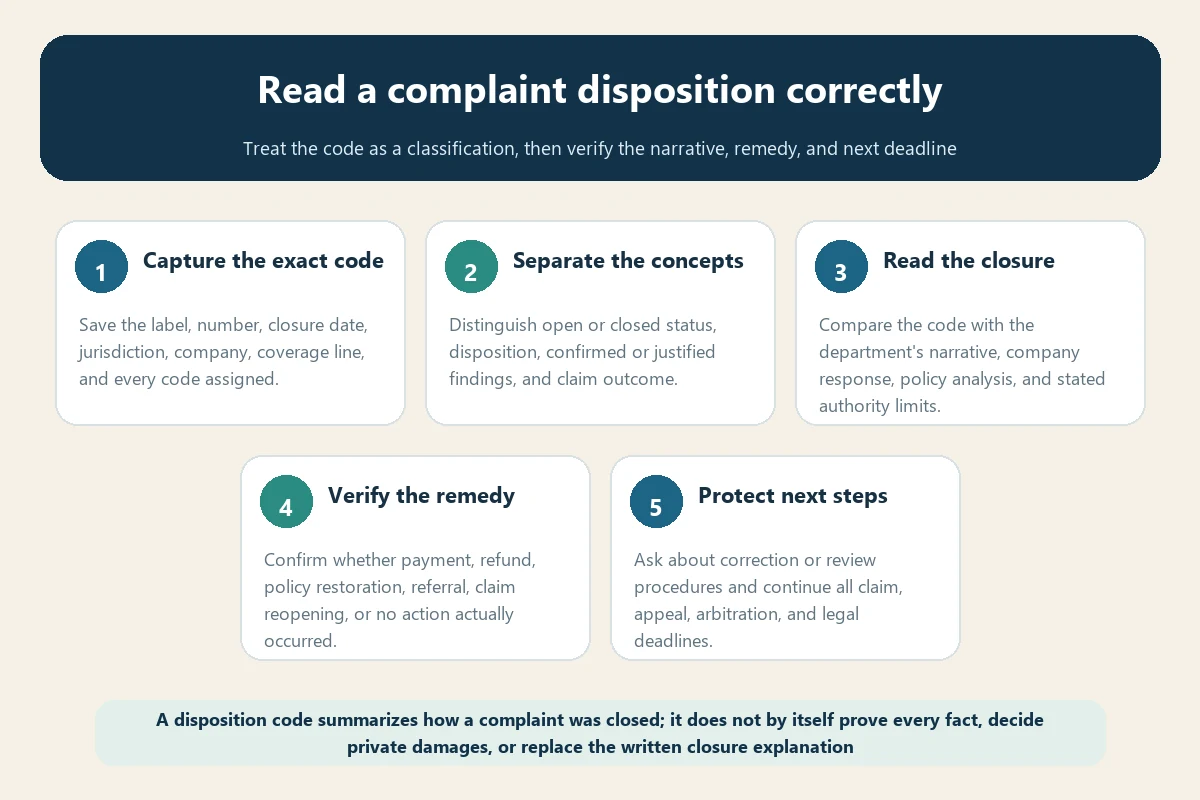
Capture the complaint number, regulator, insurer, coverage line, date received, date closed, portal status, every disposition label and code, closure notice, company response, and any later correction. A screenshot without the case number or date may be hard to authenticate later.
Ask whether the consumer-facing portal displays all assigned codes or only a simplified status. Some coding systems permit more than one disposition because a complaint can produce multiple outcomes.
Status and disposition are not the same
A status often describes where the case is in the workflow: received, pending, assigned, sent to company, under review, closed, or reopened. A disposition describes how the complaint was resolved or classified at closure.
A closed complaint can have a disposition such as no jurisdiction, company position upheld, claim settled, or complaint withdrawn. If a department later reopens the complaint, its workflow status may change while the historical closure and coding remain part of the record.
Claim reopened is not complaint reopened
“Claim reopened” generally indicates that the insurer reopened the underlying claim as an outcome of complaint handling. “Complaint reopened” means the regulator resumed work on the consumer complaint. Either may occur without the other.
If the portal says “claim reopened,” ask whether the insurer will conduct a new adjustment, request evidence, issue a fresh decision, or merely restore the claim to an active system status. The reopen travel insurance complaint guide addresses the separate regulator-case process.
Understand the NAIC disposition framework
The National Association of Insurance Commissioners compiles complaint information submitted by state insurance departments. Its historical aggregate disposition report lists codes including compromised settlement or resolution, claim reopened, claim settled, no action requested or required, referred to another department, referred to the proper agency, fine, disciplinary referral, contract or legal issue, company position upheld, no jurisdiction, insufficient information, state specific, company position overturned, and complaint withdrawn.
The report concerns closed confirmed consumer complaints in its stated data set and period. It is not a live dictionary for every current state portal. States may use additional codes, change labels, or present simplified categories.
Review the official NAIC closed confirmed complaint disposition report and the current NAIC complaint disposition page with their scope and limitations in mind.
Confirmed or justified is a separate finding
The NAIC report describes a confirmed complaint as one where the state department determines that the regulated entity violated an applicable requirement within its authority or the complaint and company response together indicate the entity was in error. That confirmed indicator is not itself a disposition such as payment or referral.
California separately publishes consumer complaint study definitions. It groups dispositions into categories such as positive outcome, without merit, and other outcome, while defining “justified complaint” through its own cited state regulations. The official California complaint study definitions show why category, disposition, and justified status must be read separately.
How to read common disposition labels
Company position upheld
This generally signals that the department did not require the company to change the position based on the reviewed record and authority. It is not automatically a court judgment on every contract issue, fact, or private remedy.
Company position overturned
This generally signals that complaint review caused the company position to change or the regulator determined correction was appropriate. Confirm the actual remedy: payment, reconsideration, policy action, explanation, or another result.
No jurisdiction
The department concluded it lacked authority over the entity, policy, issue, plan, or transaction. Ask whether it made a referral and whether a new filing is required. Do not treat no jurisdiction as a decision that the insurer acted correctly.
Insufficient information
The record did not contain enough information for the department’s review or classification. Ask what was missing and whether supplementation or reopening is possible. This does not necessarily mean the claim lacks merit.
Contract provision or legal issue
The dispute may turn on contract interpretation, disputed facts, damages, or another issue beyond the complaint unit’s resolution authority. Read the closure for the exact limitation and available alternatives.
Complaint withdrawn
The complainant asked to withdraw or the matter was coded as withdrawn under the department’s process. Withdrawal does not necessarily delete records, undo prior sharing, or waive separate rights. See the travel insurance complaint withdrawal guide.
No action requested or required
The department may determine that no further regulatory action was requested or necessary. Confirm whether the dispute was already resolved, no remedy was sought, or the record supported another explanation.
Referred to another department or proper agency
The matter was directed to another office with relevant authority. A referral is not proof that the receiving agency opened a case. Obtain its name, referral date, tracking number, and any filing instruction.
Claim settled or compromised resolution
The parties reached a payment or other resolution, but the label alone may not show amount, release scope, admissions, or performance. Preserve the actual agreement and verify completion.
Read state-specific codes through state sources
Illinois administrative rules provide examples of complaint dispositions in insurer records. Corrective-action examples include cancellation withdrawn, policy restored, premium refunded, additional money paid, coverage extended, claim reopened, and claim settled. No-action examples include contract provisions, questions of fact, policy not in force, cancellation upheld, and insufficient information.
The official Illinois Administrative Code complaint record section is useful for understanding that a disposition can summarize a concrete action or reason no action was deemed necessary. It is Illinois authority, not a universal consumer definition.
Do not infer more than the code states
A positive outcome does not automatically mean the full claim was paid. A company position upheld code does not necessarily decide tort liability or interpret ambiguous policy language for a court. A fine does not identify the consumer’s private recovery. A referral does not guarantee acceptance by another agency.
List what the code proves, what the closure says, and what remains unknown. Avoid filling gaps with assumptions.
Compare the code with the written closure
Read the department’s narrative for the issues investigated, policy terms considered, law or regulation referenced, company explanation, factual disputes, authority limits, corrective action, and next steps. If the narrative and code appear inconsistent, ask for clarification in writing.
The closed-no-violation complaint guide helps evaluate a closure without treating it as a judicial decision.
Verify that the coded remedy happened
If the code indicates payment, refund, policy restoration, claim reopening, correction, or settlement, confirm performance:
- Payment amount, payee, method, issue date, and clearance.
- Reopened claim number, adjuster, requested evidence, and new decision date.
- Policy status, effective dates, coverage, and updated declarations.
- Refund calculation and account posting.
- Settlement terms, releases, and completed obligations.
If the promised outcome failed, notify the examiner and ask whether the complaint should be reopened or supplemented.
Ask for the exact recorded codes
Re: Complaint [number]. Please confirm the complaint’s current status, closure date, each disposition code and label assigned, whether it was recorded as confirmed or justified under the department’s definitions, and the specific remedy or referral associated with each code. Please also identify any procedure for correcting a factual or coding error.
Use the case portal or assigned examiner. If records are not accessible, the complaint file request guide explains participant-access and public-record considerations.
Can a closing code be corrected or disputed?
Procedures vary. Illinois publishes a respondent FAQ stating that, after closure, a respondent can view NAIC codes attributed by the analyst and has a time-limited process to reconcile or dispute closing codes; the analyst decides whether to accept suggestions. That company-facing process does not establish an identical consumer right.
Use the official Illinois respondent FAQ only as an example that coding may have a distinct reconciliation workflow. Consumers should ask their department what correction or review process applies.
Use complaint data carefully when comparing insurers
Complaint counts can be affected by business volume, coverage line, state, coding, reporting practices, and time period. Texas explains that its data sets can contain multiple rows per complaint when several people or organizations are named, while a separate data set provides one record per complaint.
The official Texas complaint data resources also points consumers to complaint indexes and NAIC reports. Do not compare raw counts without premiums, policies, market share, coverage, and methodology.
Protect deadlines regardless of the code
A status or disposition may not pause insurer appeals, proof-of-loss duties, cancellation review, arbitration, contractual limitations, statutes of limitation, or court deadlines. Calendar each separately.
If the closure creates a formal review right, follow the governing notice. The state complaint decision appeal guide explains why ordinary closure letters and appealable orders must be distinguished.
Frequently asked questions
Does “closed” mean the insurer won?
No. Closed is a workflow status. The disposition and closure narrative explain how the matter ended.
Does “confirmed” mean I get paid?
Not automatically. Confirmed concerns the regulator’s complaint finding under its definition. Payment depends on the remedy, policy, facts, and actual action taken.
Can a complaint have several disposition codes?
Potentially, depending on the reporting system and outcomes. Ask the department to list every code and its relationship to the case.
Why does my portal label differ from the NAIC report?
The portal may use a state-specific or simplified label, while NAIC reports aggregate standardized data. The agency’s current definition controls its own record.
Is a code enough to appeal?
Usually you need the written closure or formal decision, governing authority, deadline, and record. A code by itself may not establish an appeal right.
Read complaint codes as structured metadata, not verdicts. Capture every label, separate workflow status from disposition and confirmed findings, read the closure narrative, verify the remedy, ask about correction procedures, and keep every claim and legal deadline moving.
