
To request your travel insurance complaint file, identify the state insurance department, original complaint number, exact documents needed, preferred format, and reason the records must be located. Start with the assigned examiner or consumer portal when you are asking for your own case materials, then use the agency’s public-records process if directed.
Do not assume every item in a regulator’s file is public or releasable to every requester. State confidentiality laws, personal-information protections, investigative exemptions, privileges, insurer submissions, and agency retention practices differ. The department may provide some records, redact others, deny certain categories, or explain that it does not possess what you described. This guide is general information, not legal advice.
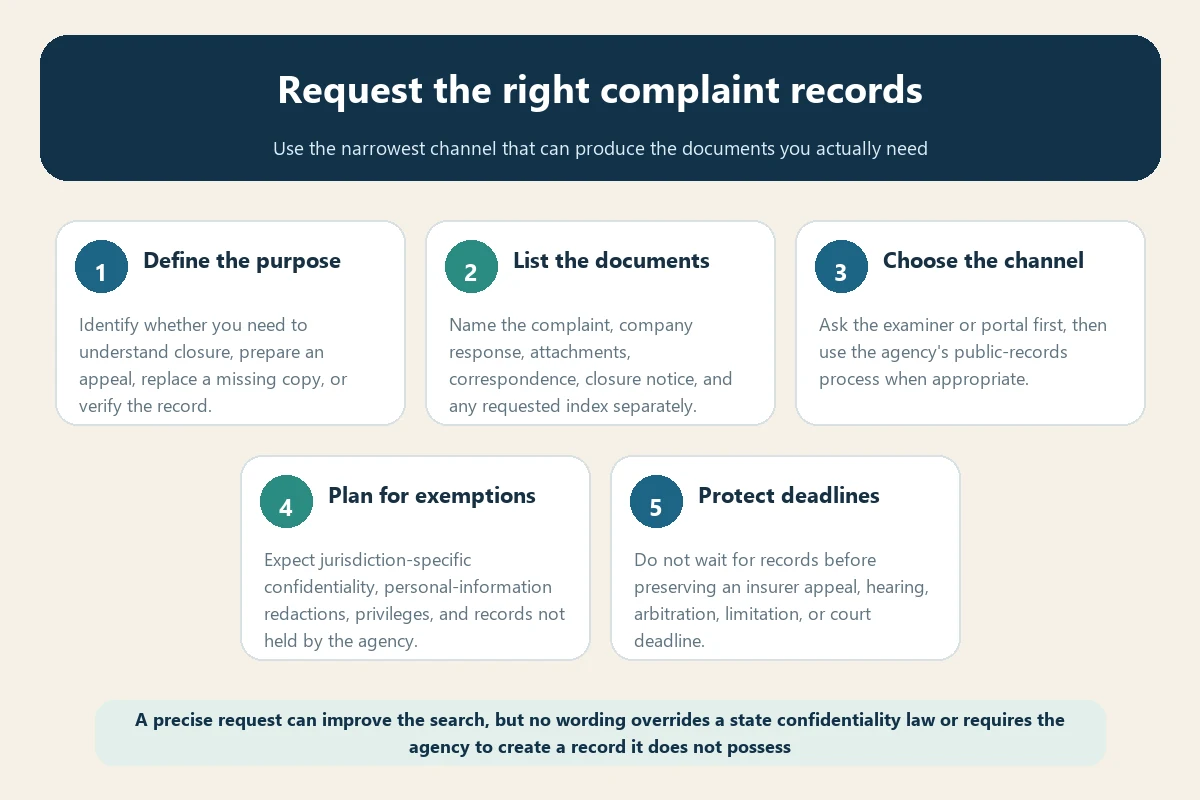
Define why you need the file
A clear purpose helps you request the right records without demanding every document the agency has ever created. You may need to understand a no-violation closure, compare the company response with your evidence, prepare an insurer appeal, evaluate a formal review right, replace a lost submission, or verify that attachments reached the examiner.
The purpose does not necessarily change whether a record is legally disclosable, but it improves scope. It also helps distinguish records already available to you as a complaint participant from records that require a formal public-disclosure request.
Create a document inventory before filing
List each category separately and mark what you already possess:
- Your submitted complaint and confirmation.
- Each attachment and portal comment you provided.
- The insurer’s response and attachments released to you.
- Department correspondence, questions, and status notices.
- Your replies and supplemental evidence.
- The closure notice, disposition, or formal decision.
- A record index, correspondence log, or document list if one exists and is releasable.
- Any audio recording or transcript that you know was created.
Do not request “all records about me anywhere” when the actual need is the company’s response to complaint 12345. Narrow scope improves identification and can reduce delay, cost, privacy exposure, and disputes about ambiguity.
Ask through the complaint channel first
Log in to the consumer portal or contact the assigned examiner using the original case number. Ask which case documents are already downloadable, which can be sent directly to a complainant, and whether a separate records request is necessary. Preserve the answer.
Direct case access and public-records disclosure are different mechanisms. The complaint unit may provide documents routinely shared with the parties, while the public-records officer applies state disclosure law to agency records. Do not submit duplicate requests to multiple units unless instructed.
If you no longer have the acknowledgment or cannot identify the regulator, retrace the insurer, policy jurisdiction, submission method, and confirmation details using the state travel insurance complaint filing guide.
Use the agency’s official public-records process
If the department directs you to its records office, use the current form, portal, email, or address on its official website. Include your name and contact method, the insurance department division, complaint number, insurer, approximate date range, named record categories, and preferred electronic format.
Washington’s Office of the Insurance Commissioner provides an official public-records request form. It tells requesters that greater document detail improves the search and warns them not to put health information, Social Security numbers, or other confidential data into the request form.
California’s Department of Insurance publishes guidelines for accessing public records. The guidance recommends a written request that describes records with enough specificity for staff to locate them and identifies the office or division responsible when known. These are state examples, not nationwide rules.
Write a precise request
I request accessible agency records associated with complaint [number], involving [insurer], received approximately [date range]. Specifically, I seek: (1) my complaint and submitted attachments; (2) the company response and releasable attachments; (3) correspondence sent between the department, company, and me; and (4) the closure notice or recorded disposition. I prefer searchable electronic copies. If any portion is withheld or redacted, please identify the applicable legal basis and release reasonably segregable nonexempt material where required by governing law. Please contact me before expanding the scope or incurring charge above [amount].
Adapt the wording to the state’s law and form. Do not demand a legal conclusion, require staff to answer questions, or ask the agency to create a new summary unless its rules provide for that service. A records request ordinarily seeks existing records.
Do not include sensitive evidence in the request form
The records office usually needs identifiers sufficient to locate the file—not a second copy of medical records, passport images, account statements, or the complete claim. Use the case number, insurer, date range, and document names. If identity verification is required, follow the department’s secure instructions.
Never email unrequested sensitive documents to a general public-records address. The travel insurance complaint privacy guide explains public-record notices, insurer sharing, redaction, and secure submission practices.
Expect state-specific confidentiality rules
Disclosure can differ dramatically. Washington’s complaint-process page says a complaint and submitted documents become public records that may be disclosed under state law, while identifying categories of personal information that state law protects. It also notes that some ordinary contact information may not be protected in most cases.
Missouri takes a different approach in a specific insurance statute. Section 374.071 states that documents and materials in consumer complaint files—including listed categories such as medical records, adjuster notes, policy provisions, and claim-related records—are not public records and are unavailable for public examination, subject to the statute’s terms.
Read the official Washington complaint confidentiality statement and Missouri Revised Statutes section 374.071 as evidence that one state’s answer cannot be projected onto another.
Being the complainant may matter—but does not guarantee everything
A state may distinguish a member of the public from the policyholder, complainant, authorized representative, insurer, or party to a proceeding. Ask whether the department has a participant-access procedure and what authorization or identity proof it requires.
Illinois’s workers’ compensation insurance complaint form, for example, states that complaints filed with the department are confidential and not released to third parties except specified parties such as the policy owner, authorized representative, or party complained against. That form concerns a particular Illinois complaint type and should not be treated as a general national rule.
Understand common withholding categories
Depending on state law, an agency may withhold or redact:
- Social Security, driver-license, passport, financial-account, and protected health information.
- Information about other people.
- Confidential insurer or producer submissions.
- Investigative, examination, enforcement, or market-conduct materials protected by statute.
- Attorney-client, attorney-work-product, deliberative, or other privileged material where applicable.
- Records the agency does not possess or no longer retains under an authorized schedule.
A redaction does not automatically prove wrongdoing or an incomplete search. Read the cited exemption and compare it with the record description.
Ask for an index or explanation when allowed
If the production appears incomplete, ask whether the department can identify withheld categories, exemption citations, date ranges searched, offices searched, and whether nonexempt portions were separated. Use the state’s language for a denial explanation, exemption log, or review request.
Do not assume every jurisdiction must create a detailed privilege log for a public-records request. Ask what its law requires. If the response says no records were found, confirm identifiers and custodian rather than immediately alleging destruction.
Track acknowledgment, estimates, installments, and fees
Record the submission date, request number, acknowledgment, estimated completion date, clarification requests, fee estimate, installment schedule, download expiration, and final-response date. Reply promptly to clarification questions so the request is not closed as abandoned.
Washington’s official public-records process guidance says its records team responds within five business days, may provide installments or seek clarification, and may adjust estimates based on volume, quantity, staffing, and complexity. It also describes an appeal to the public-records officer for a denied request. Those timelines and remedies apply to Washington’s process, not every state.
Review the production systematically
Save the transmittal, files, filenames, metadata where available, and any exemption explanation. Create a comparison table showing the records requested, produced, redacted, withheld, not found, or pending. Check whether the company response matches the version you previously received.
Look for the exact policy version, chronology, disputed claim facts, attachments referenced but missing, examiner questions, company promises, and closure rationale. The insurer complaint response review guide provides a structured comparison method.
Challenge a denial through the stated records process
If you believe records were wrongly withheld, use the reconsideration, administrative review, public-records officer appeal, ombudsman, attorney general, or court procedure actually provided by that state. Identify the denied record, cited exemption, and reason the exemption may not apply or why a segregable portion should be released.
Do not confuse a public-records appeal with an appeal of the insurance complaint outcome. One concerns access to agency records; the other concerns review of a complaint decision, if such review exists. The state complaint decision appeal guide explains that separate classification.
Do not let the records request consume another deadline
A pending records request usually does not pause an insurer appeal, proof-of-loss requirement, administrative hearing deadline, contractual limitation, statute of limitation, arbitration period, or court filing. Calendar each track independently.
If a deadline is close, file the best supported protective submission permitted by the governing process and explain that a records request is pending. Seek qualified legal advice where needed. Do not promise to supplement later unless the forum allows it.
What if you only need the insurer’s response?
Ask the complaint examiner or portal first. The response may already be available in the case workspace or closure communication. Specify whether you need the response letter, its attachments, or both. Do not broaden the request to the entire agency file unnecessarily.
If the department closed the complaint without finding a violation, use the no-violation closure review guide to identify which records could materially explain the outcome.
Frequently asked questions
Am I entitled to the complete complaint file because I filed it?
Not automatically. Participant access, public disclosure, exemptions, and confidentiality statutes vary. Ask the department what can be released to you and under which procedure.
Can the regulator charge for copies?
Some agencies charge for paper copies, media, postage, or unusually configured electronic work under state rules. Request an estimate and a cost ceiling before processing.
Can I request internal emails and notes?
You can describe existing records, but the agency may apply exemptions or say it has no responsive records. Use a reasonable date range, staff unit, complaint number, and subject.
Will a public-records request reopen my complaint?
No. Records access and complaint handling are separate. If new evidence appears, make a distinct request under the department’s complaint procedure.
What if the agency says the file is confidential?
Ask for the statutory basis, whether any portion can be released to the complainant or authorized representative, and what review procedure applies to the denial. Do not assume a public-records request overrides an insurance-specific confidentiality law.
A useful complaint-file request is specific, secure, and procedurally correct. Define the purpose, list the exact records, begin with the case channel, use the official disclosure process when needed, understand exemptions, preserve the production, and keep every separate insurance or legal deadline moving.
