
Travel insurance fog flight cancellation coverage depends on the booked flight’s operational outcome, not simply on fog near an airport. Dense fog can reduce runway visibility, slow traffic, divert an arrival, or cancel certain flights while properly equipped aircraft continue operating. Coverage then depends on policy language, purchase timing, waiting periods, airline remedies, and documented net loss.
This U.S. guide explains how to connect a public weather warning to measured airport conditions and the airline’s flight-specific action. It also separates trip cancellation from delay, missed connection, diversion, and interruption. It is educational, not meteorological, aviation, safety, legal, medical, or insurance advice.
Fog flight cancellation coverage at a glance
- Preserve the NWS advisory, affected area, visibility, and exact time window.
- Record airport observations, runway visual range, and traffic restrictions.
- Ask the airline why this flight could not operate and save every remedy.
- Compare the first forecast with policy purchase and effective times.
- Apply the correct benefit and waiting period to the actual sequence.
- Subtract airline and supplier refunds before claiming the remaining expense.
Reviewed August 17, 2026.
Dense fog affects flights through visibility
The National Weather Service’s fog safety overview explains that restricted visibility can affect takeoff and landing procedures and cause aviation delays. Fog is the hazard; the relevant insurance fact is what that hazard did to the insured itinerary.
A fog bank may cover one part of a region while the airport remains clear. It may lower visibility at the destination but not the origin. It may lift before departure, return during the connection, or affect only the alternate airport. Preserve place and time rather than relying on a general news report.
What a Dense Fog Advisory proves
NWS fog advisory guidance says local offices issue a Dense Fog Advisory when widespread dense fog develops, frequently reducing visibility to one-quarter mile or less. A Freezing Fog Advisory adds a surface-icing hazard when temperatures are at or below freezing.
The advisory proves an official public hazard within a defined area and period. It does not prove that the airport closed, that all runways were below operating minimums, or that the booked carrier canceled. Save the full bulletin with issuing office, product, location, visibility, onset, expiration, timezone, and updates.
Airport visibility is more specific than regional visibility
Airports use surface observations, ceiling, prevailing visibility, and runway visual range. Conditions can differ by runway and change quickly. Record the airport’s observation close to the scheduled departure or arrival, plus later improvement or deterioration.
Runway visual range is especially useful because it describes visibility along a runway. Do not translate a highway visibility report into airport RVR. If the source uses coded aviation observations, preserve the original and an authoritative decoded view rather than guessing at abbreviations.
Low visibility does not affect every flight equally
Whether a flight can operate can depend on the runway and approach, airport low-visibility procedures, aircraft equipment, crew authorization, destination and alternate weather, and carrier rules. The FAA’s active low-visibility operations guidance describes airport planning for surface movement when visibility is very low.
This explains why one flight may land while another diverts, or why arrivals resume before a specific aircraft is available. Do not infer unfair treatment or insurance coverage solely from another carrier operating. Ask for the booked flight’s reason and preserve the answer.
Document the operational response
Look for a ground stop, ground delay program, arrival-rate reduction, runway or approach restriction, diversion pattern, or temporary closure. Save the facility, impacting condition, start and end time, expected delay, revisions, and recovery notice. Then show the overlap with the scheduled flight.
Our air traffic control delay coverage guide explains FAA traffic-management records. A ground stop is not necessarily an airport closure, and the stated cause may be low ceilings, fog, equipment, or a combination.
Get the carrier’s flight-specific explanation
Keep the original itinerary, confirmation, ticket number, flight number, scheduled times, boarding pass, app alerts, email, text messages, and airport display. Ask whether the cause was fog, low ceiling, runway visibility, airport restrictions, destination conditions, diversion recovery, aircraft positioning, or crew displacement.
The cause can evolve. A flight held for fog may later cancel because its inbound aircraft diverted. Preserve both the initial and final reason. Record every option offered: same-day reroute, later flight, alternate airport, waiver, voucher, cash refund, hotel, meals, and ground transportation.
Use the airline’s refund or rebooking path first
Under the U.S. Department of Transportation’s current airline refund guidance, a passenger is entitled to a refund when the airline cancels the flight and the passenger does not accept alternative transportation or other compensation. Weather does not remove that refund right.
If the traveler accepts rebooking, the ticket generally remains used rather than becoming a refunded loss. Insurance may instead address eligible meals, lodging, transport, a missed connection, or unused land arrangements, subject to the policy. Save the decision and its timestamp.
Build the known-event timeline
List the trip deposit, later nonrefundable payments, policy purchase, coverage effective time, first relevant fog forecast, NWS advisory, airport observation, traffic restriction, airline notice, and actual outcome. Normalize the timezones in a separate column without altering the source records.
A policy bought after dense fog was already forecast or disrupting the airport may not cover that event. “Unforeseen” and “known event” are contract questions, not a universal number of forecast hours. Our travel insurance purchase timing guide explains the evidence to keep.
Read the weather trigger and thresholds
Search the certificate for weather, inclement weather, common carrier, airport closure, cessation of service, air traffic control, delay, missed connection, destination inaccessible, and natural disaster. Read the definitions, exclusions, duties, waiting periods, per-day limits, and maximum benefit.
Answer these questions before filing:
- Must the common carrier cancel, or can a qualifying delay trigger benefits?
- How many consecutive hours must the delay last?
- Does trip cancellation require service to stop for a stated period?
- Does an airport need to close completely?
- Is a missed connection benefit limited to named causes or tours and cruises?
- Which expenses need advance approval or itemized receipts?
Use the broader weather delay insurance guide for general rules; use this page for the fog-specific visibility and capability evidence.
Choose cancellation, delay, connection, or interruption
Trip cancellation generally concerns abandoning the trip before departure for a covered reason. Trip delay can reimburse limited necessary expenses during a qualifying wait. Missed connection addresses a late arrival that breaks an onward segment. Trip interruption may apply after departure when a covered event changes or ends the trip.
A two-hour fog hold does not automatically create trip cancellation. A flight that lands elsewhere is a diversion. A traveler who reaches the destination a day late may have delay costs and unused hotel nights. The benefit comparison guide helps match the sequence.
Handle a missed connection or diversion
For a missed connection, keep actual gate-departure and arrival times, the original connection, the missed flight, rebooking, and final arrival. Test the policy’s minimum delay and eligible connection type. See our missed connection insurance guide.
For a diversion, save the diversion airport, reason, landing time, deplaning instructions, baggage status, ground transport, and onward plan. A diversion may later become a cancellation, but the records should preserve each stage. The flight diversion coverage guide explains that evidence chain.
Freezing fog creates a second hazard
When temperatures are at or below freezing, droplets can freeze on surfaces. The operational record may then include deicing, runway treatment, aircraft inspection, or surface restrictions in addition to low visibility. Preserve the exact carrier reason instead of simplifying every event to “fog.”
Freezing fog can also make road access hazardous. Follow official transportation and emergency guidance. Do not drive to an alternate airport on icy, low-visibility roads merely to reduce a claim. Safety decisions and insurance decisions should be documented separately.
Evaluate rerouting safely
An alternate airport can be reasonable if its visibility, approaches, road access, and onward transport are suitable. Confirm the airline will honor the change, baggage can follow, and the replacement plan preserves the trip. Fog may be widespread, so a nearby airport is not automatically better.
When time and safety allow, contact the insurer’s assistance line before purchasing an expensive replacement. Keep the representative’s name, time, case number, advice, and authorization. If immediate action is required, record why the choice was reasonable and retain contemporaneous conditions.
Create a layered claim file
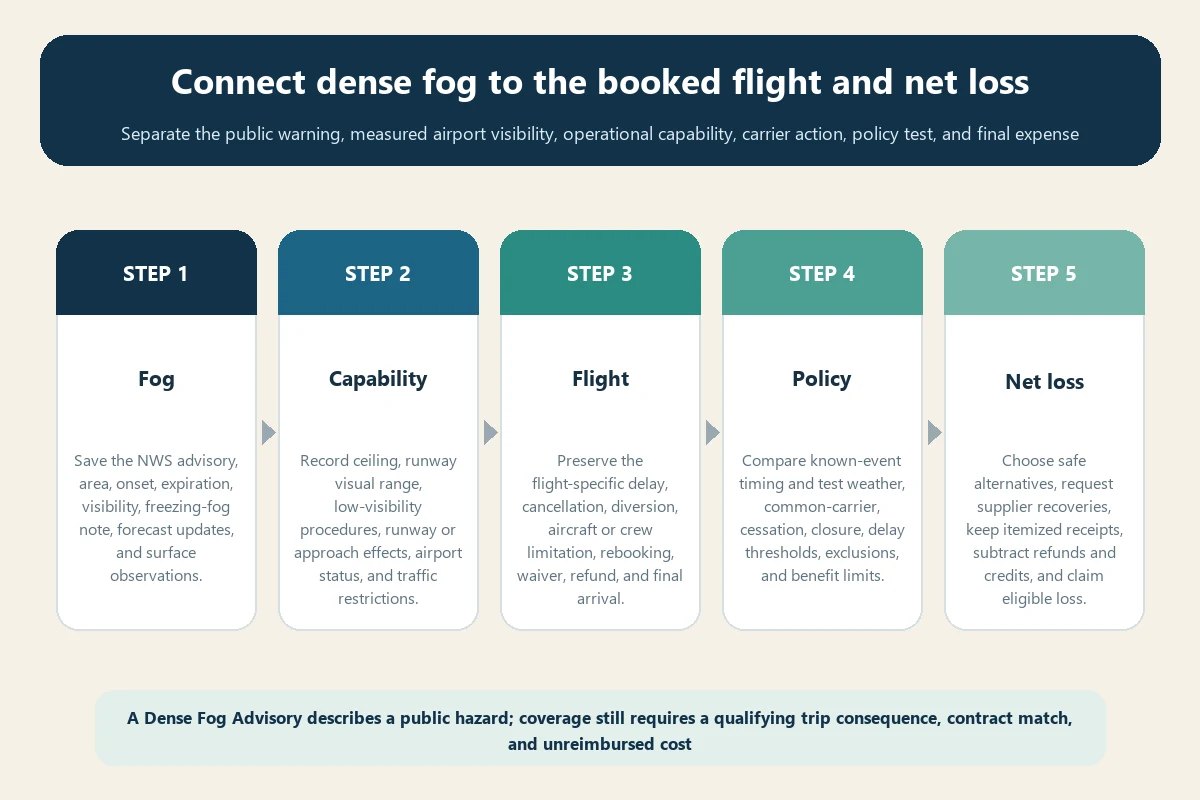
- Public hazard: NWS advisory, area, visibility, onset, expiration, and updates.
- Airport conditions: observations, ceiling, RVR, low-visibility procedures, and traffic action.
- Booked flight: itinerary, carrier reason, cancellation or delay, reroute, and final arrival.
- Contract: policy, schedule, purchase time, covered reason, threshold, exclusion, and duty.
- Money: supplier terms, refund requests, responses, receipts, credits, and remaining loss.
Write a concise chronology that points to each exhibit. Explain how the observed conditions affected airport capability, how that affected the flight, which safe remedy was used, and what cost remained.
Calculate only eligible net loss
Use a ledger with supplier, original charge, service date, amount, currency, refund eligibility, refund received, voucher or credit, replacement expense, and amount claimed. Keep airfare, lodging, meals, local transport, and unused prepaid activities on separate rows.
Airline refunds and supplier recoveries reduce the same loss. Do not claim the full ticket after accepting a refund. The guide to supplier refunds and insurance recovery explains coordination and later credits.
Common fog claim mistakes
- Submitting a fog photograph without the location, time, or official observation.
- Treating a regional advisory as proof the airport closed.
- Ignoring differences in runway, aircraft, crew, and approach capability.
- Canceling voluntarily before confirming the airline’s plan.
- Using the wrong benefit or ignoring its waiting period.
- Failing to document the final carrier reason after the cause changed.
- Claiming airfare, lodging, or meals already refunded or provided.
- Taking an unsafe road transfer during dense or freezing fog.
File and follow the claim
Notify the insurer within the required time and use the benefit form that matches the sequence. Attach the policy, purchase proof, timeline, itinerary, NWS record, airport and FAA evidence, carrier explanation, supplier correspondence, receipts, and net-loss ledger. Keep a complete copy and claim number.
If more information is requested, answer the exact question. If the claim is denied, request the policy clause and factual basis, then compare them with the visibility, capability, and flight records. Our claim filing guide can organize the submission.
Bottom line
Fog can support travel insurance benefits when it causes the qualifying trip consequence described by the policy. The strongest case connects an official advisory to airport visibility, establishes why the booked flight could not operate, applies the correct timing and benefit rules, uses airline remedies, and claims only documented unrecovered expense.
Freezing rain adds aircraft contamination, deicing capacity, and runway-surface evidence to the weather claim. Use this freezing rain flight cancellation travel insurance guide to trace the ice event, preserve carrier remedies, test timing and thresholds, and claim net loss.
