

A travel insurance family member pre existing condition may affect trip cancellation or interruption even when the relative is not traveling. Coverage depends on the policy’s family definition, pre-existing-condition language, covered reason, waiver scope, and required proof.
This U.S. guide addresses a non-traveling relative whose illness may cause the insured traveler to cancel or return early. It is educational information, not medical, legal, or coverage advice.
Key takeaways
- Confirm that the person meets the certificate’s defined term Family Member.
- Read the family-member cancellation reason separately from the pre-existing exclusion.
- Check whether the condition existed inside the stated look-back period.
- Verify that any waiver extends to the family member and affected benefit.
- Match physician proof to the exact trigger, such as life-threatening illness or immediate care.
Reviewed August 16, 2026. Family definitions and benefit triggers vary by plan and state. The issued certificate controls.
Separate the relative from the insured traveler
The person who becomes ill and the person who loses money may be different. The relative may remain at home while the insured traveler cancels a prepaid trip. That means the claim is usually about the traveler’s trip-cancellation benefit, not medical reimbursement for the relative’s treatment.
Draw two boxes. In the first, list the relative, relationship, medical event, and treating physician. In the second, list the insured traveler, trip dates, payments, cancellation date, and unrecovered amount. This prevents medical records and financial records from being mixed.
The trip cancellation coverage guide explains why prepaid loss is reimbursed only after a listed reason and all conditions are satisfied.
Run the claim through five gates
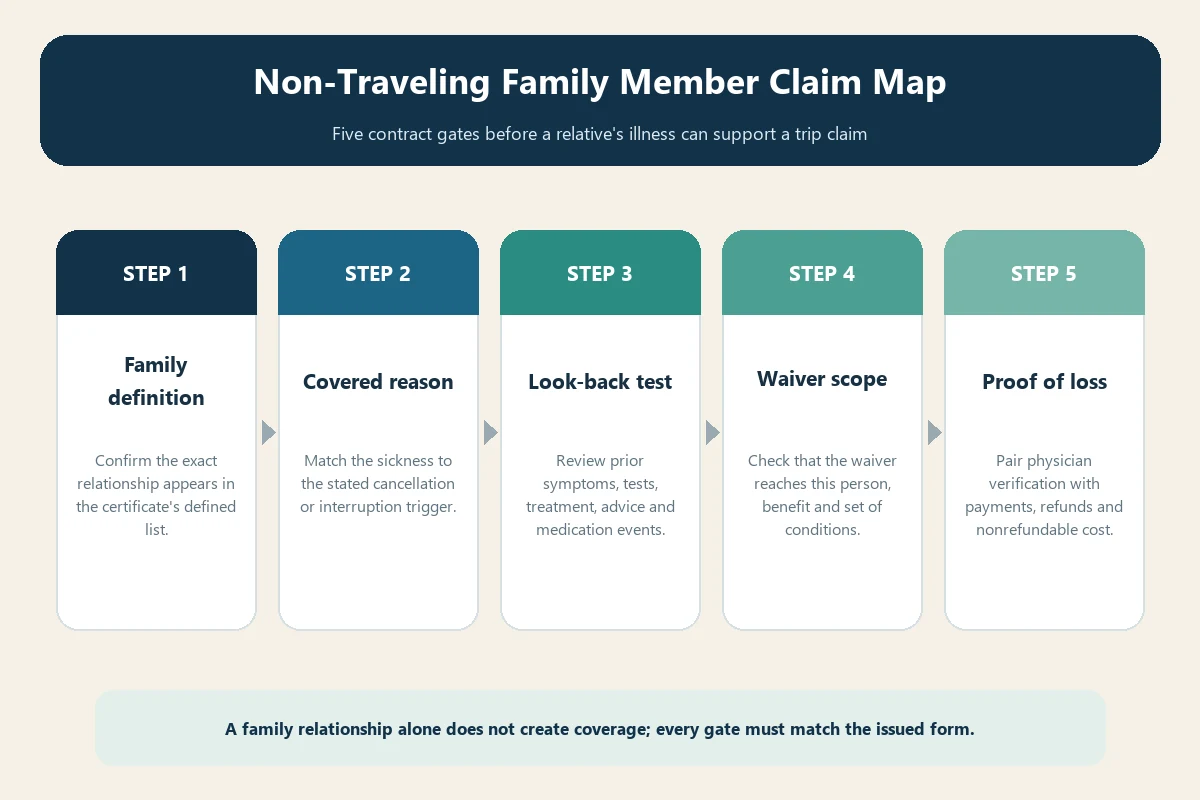
Gate one: is the person a defined family member?
Everyday family language is not enough. A certificate may include a spouse, child, parent, sibling, grandparent, in-law, domestic partner, aunt, uncle, niece, nephew, or another named relationship. Another form can use a shorter or different list.
Find the capitalized term in the definitions section. If the relationship is not listed, do not assume a close emotional or caregiving relationship qualifies. Ask the insurer in writing before purchase when the answer could affect plan selection.
Gate two: does the medical event match a covered reason?
A policy may cover sickness or injury of a family member only under stated conditions. Some wording requires a physician to verify that the condition is life-threatening or that the relative requires the insured’s immediate care. Other wording may use a different threshold.
“My parent needed help” does not automatically satisfy a defined trigger. The physician record should address medical facts and timing, while the claim should show why cancellation became necessary under the certificate.
Gate three: does the pre-existing definition apply?
Some forms expressly include a family member within the pre-existing-condition definition. Review the look-back period for symptoms, worsening, care, testing, treatment, advice, or medication events. A new emergency can still relate to an earlier condition.
Use the look-back guide to calculate dates from the correct policy anchor rather than from departure by assumption.
Gate four: does a waiver reach this person and benefit?
A waiver can remove a named pre-existing-condition exclusion only where the contract says it applies. Confirm that the family member is within its scope and that all purchase, trip-cost, and medical-ability requirements are met.
The waiver eligibility checklist helps document each gate. The older waiver timing guide explains why a deadline is only one condition, not the complete test.
Gate five: can the insured prove the loss?
Coverage does not create a financial loss. Keep supplier cancellation confirmations, refund or credit records, payment receipts, and the policy’s insured trip cost. Reimbursement is generally limited to eligible nonrefundable amounts under the selected benefit.
A current sample policy illustrates the sequence
A current Travel Guard Pennsylvania sample policy separately defines Family Member and Pre-Existing Medical Condition. Its trip-cancellation wording includes sickness or injury of a family member when a physician verifies a specified level of need, and its exclusion and waiver sections must then be read together.
This sample is useful because it exposes the contract sequence. It is not the reader’s plan and cannot establish coverage in another state. Obtain the complete certificate actually offered, including endorsements and schedule.
Do not confuse family-member coverage with their medical bills
If a non-traveling parent is hospitalized at home, the travel policy normally does not become their health insurer. The traveler’s claim may concern forfeited trip costs or early-return expenses if the event meets a cancellation or interruption reason.
The trip interruption guide distinguishes cancellation before departure from an interruption after the trip begins. Use the event date and benefit effective dates to select the correct path.
Foreseeability and prior advice need careful records
A relative can have a chronic diagnosis for years without an imminent trip-disrupting event. The relevant question is not merely whether the diagnosis existed. Review the policy’s stated look-back events and known-loss language, then build a timeline of symptoms, escalation, testing, physician advice, and the final event.
Do not characterize a predictable event as sudden. If a physician had already recommended surgery during the travel dates or told the insured that immediate care would likely be needed, preserve that advice and ask the insurer how the certificate applies.
The National Association of Insurance Commissioners’ travel insurance overview encourages consumers to compare covered events, exclusions, and policy limits. It supports a certificate-first review rather than a broad promise.
Check which relative’s condition the waiver reviews
Some plans may test medical ability to travel for the insured traveler while defining pre-existing conditions for several people. Do not assume the relative at home must pass the same purchase test, or that they are automatically outside it. Copy the exact people named in each clause.
Allianz’s pre-existing-condition explanation describes plan-specific waiver requirements. Use it to understand the concept, then confirm the selected certificate’s scope.
Build the physician-verification packet
Ask the relative’s treating physician for factual records: diagnosis, symptom onset, examination date, treatment, functional limits, and the reason immediate care or the insured’s presence was medically necessary if the benefit requires that fact. A generic note saying “family emergency” may not answer the certificate.
Respect the relative’s privacy and authorization requirements. The insurer may require a signed medical release. The insured should not alter records or ask the physician to make a coverage judgment.
CDC guidance on travel health insurance explains that ordinary health coverage and travel-specific benefits can differ. That distinction helps families keep the relative’s treatment records separate from the traveler’s reimbursement claim.
Prove the relationship and caregiving need
The claim form may ask for the relationship to the relative. Depending on the circumstances, a birth certificate, marriage record, domestic-partner evidence, or other document may be requested. Submit only what the insurer requires through its secure process.
If the reason depends on the insured providing immediate care, document why another person could not reasonably provide it and when that need arose. Keep travel changes, hospital communications, and physician instructions in date order.
Map refunds before claiming the balance
Contact airlines, hotels, cruise lines, and tour operators promptly. Record cash refunds, credits, vouchers, fees, and denied refund requests. Do not claim a cost twice or omit a usable credit when the form requires disclosure.
The claim documentation guide provides a ledger for proof of payment and refunds. The claim-denial guide explains common gaps such as missing physician support, an unlisted reason, or an excluded condition.
Work through three family scenarios
Parent hospitalized before departure
A parent with a long-managed condition experiences a new acute event. The insured cancels to provide immediate care. Review the parent definition, physician-verification wording, look-back facts, waiver scope, and remaining nonrefundable loss. No single fact decides all five gates.
Relative’s scheduled procedure moves
A known procedure is rescheduled into the trip dates. The change may feel unexpected, but the contract still requires a listed reason and review of known treatment, advice, and pre-existing language. A new schedule is not automatically a new illness.
Close friend needs help
The insured considers the person family, but the certificate’s definition does not list that relationship. Emotional closeness cannot expand a defined term. Another covered reason or optional benefit would need its own analysis.
Ask eight questions before buying
Ask who qualifies as a family member; whether a non-traveling relative is included; what medical threshold triggers cancellation or interruption; which look-back period applies; whether the exclusion includes that relative; whether a waiver extends to them; what physician proof is required; and how refunds or credits reduce the claim.
Provide the plan name, state, purchase date, first trip-payment date, departure date, and relationship. Request written answers and the complete form. Do not send private medical details through an insecure sales chat.
Bottom line
A family member’s pre-existing condition does not produce an automatic approval or denial. The strongest review follows the contract in order: defined relationship, listed medical reason, look-back facts, waiver scope, physician proof, and actual nonrefundable loss.
That sequence gives a traveler a realistic purchase decision and a cleaner claim file while respecting the relative’s medical privacy.
