

A travel insurance undiagnosed condition can require review even when no clinician has named the illness. Some U.S. certificates look to symptoms, medical advice, treatment, tests, or medication events during a stated period. Other forms use narrower wording. The absence of a diagnosis is a fact, not a universal coverage answer.
This guide provides a certificate-first method for U.S. travelers with symptoms or pending evaluation before plan purchase. It is insurance education, not medical, legal, diagnostic, or coverage advice. Seek necessary medical care promptly and never delay testing to influence an insurance timeline.
Key takeaways
- Read the event list in the pre-existing-condition definition, not only the word diagnosis.
- Separate symptoms, advice, testing, treatment, medication, and the later diagnosis.
- Pending tests can be relevant under some forms but are not universally disqualifying.
- Do not infer that a later illness caused earlier symptoms without medical evidence.
- Test the waiver, covered benefit, exclusions, and claim proof after applying the definition.
Reviewed August 16, 2026. U.S. state forms and plan definitions differ. The issued certificate, schedule, and endorsements control.
Why a diagnosis-only test can fail
A traveler may be waiting for imaging, laboratory results, a specialist appointment, or a follow-up after unexplained symptoms. Search results often frame the problem as whether the traveler must “declare” an undiagnosed condition. Many U.S. travel policies instead apply a written definition to medical facts and records.
Start by copying the entire pre-existing-condition definition. Identify the covered people, anchor date, number of look-back days, listed medical events, and exceptions. The look-back period guide explains why a remembered diagnosis date may not be the contract’s decisive date.
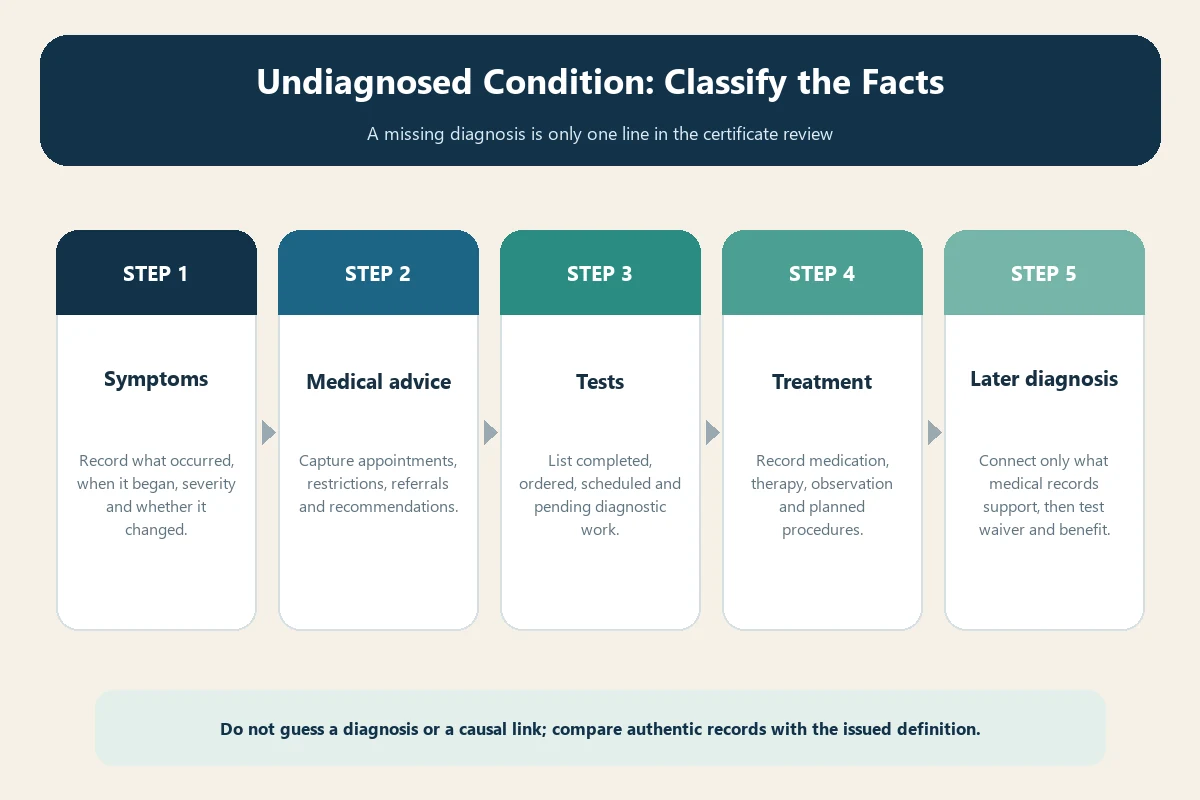
Use five columns instead of guessing
Column one is symptoms: onset, duration, severity, recurrence, and change. Column two is medical advice: appointments, restrictions, referrals, and recommended follow-up. Column three is testing: completed, ordered, scheduled, or pending. Column four is treatment and medication. Column five is the later diagnosis, if one exists.
Attach a source record to each row. Use clinical notes, referral orders, test orders, after-visit summaries, and pharmacy records. Do not write a diagnosis that the clinician did not make. Do not erase an earlier description when a later diagnosis becomes available.
Symptoms do not produce a universal result
Some forms ask whether symptoms existed during the look-back period or were severe enough that a reasonable person would seek care. Other forms do not list symptoms and instead focus on advice or treatment. The exact words determine which facts require analysis.
A current Travel Guard Pennsylvania sample policy illustrates a broad pattern that includes manifestation or worsening, symptoms that would prompt reasonable care, care or testing given or recommended, and prescribed-medication changes. A current Vermont sample uses a different definition. Neither sample is the reader’s policy.
The look-back examples help compare wording without treating one specimen as a market-wide rule.
Medical advice can matter before treatment begins
A clinician may recommend imaging, a specialist consultation, monitoring, or a procedure without starting treatment. If the certificate lists recommended medical advice, testing, or treatment, preserve the order and the date it was communicated.
A current Travel Guard Vermont sample policy defines a pre-existing condition through medical advice or treatment recommended or received during its stated 180-day period. It demonstrates why “nothing was treated yet” may not complete the review under every form.
Pending tests require a status map
Write whether a test was merely discussed, formally ordered, scheduled, completed, or awaiting results. Record who ordered it and why. A routine screening test and a diagnostic test prompted by symptoms are different facts, although the form decides whether either is relevant.
Do not cancel medically appropriate testing or hide a pending result. Insurance applications and claims should be accurate. If a purchase question is unclear, request a written explanation tied to the exact form and state.
Medication events need context
A clinician might prescribe symptom relief while the diagnosis remains unknown. Record the drug, dose, purpose, start date, and whether it replaced or changed another prescription. A routine refill, generic substitution, and new therapeutic trial are not interchangeable.
Use the medication-change guide to classify the record. It does not decide the claim; it prevents a pharmacy transaction from being described inaccurately.
Unknown diagnosis and new condition are different claims
A condition can be undiagnosed before purchase yet later linked to earlier symptoms. A genuinely new condition can also begin after coverage starts. The distinction is medical and factual, not a label the traveler should choose for a claim.
Allianz’s current existing-condition explanation illustrates plan wording that refers to an illness or injury exhibiting symptoms or receiving treatment during a stated period. That pattern can capture facts before the final diagnosis. Another form may use a different test.
Do not infer causation from timing alone
Earlier fatigue and a later diagnosis do not automatically prove they were related. Likewise, a normal test does not necessarily prove that an earlier symptom was unrelated. Use clinical records and appropriate professional conclusions. Submit the complete timeline without offering an unsupported causal opinion.
The controlled-condition guide provides the same discipline for vague labels. Replace assumptions with dated, sourced facts.
Apply the waiver after the definition
If the symptom, advice, test, treatment, or medication event meets the issued definition, review the pre-existing-condition exclusion waiver. Conditions may include purchase during a time-sensitive period, medical ability to travel, insuring required trip costs, and updating later expenses.
The waiver checklist separates those requirements. A waiver can remove the specified exclusion only when every condition is met. It does not guarantee that the later event is a covered reason or eliminate another exclusion.
Medical ability to travel is a separate date
Some waiver language requires the insured to be medically able to travel when the plan is purchased. A pending evaluation does not automatically answer that question. Follow the treating professional’s guidance based on the symptoms and itinerary.
A fitness letter records a clinician’s assessment. It does not amend the policy. If the condition changes after purchase, obtain appropriate care and preserve the new advice rather than relying on the earlier letter.
Test cancellation and medical benefits separately
For trip cancellation, identify a listed covered reason, physician requirements, affected person, cancellation timing, and nonrefundable loss. For emergency medical expense, identify eligible treatment, medical necessity, limits, provider rules, authorization, and exclusions.
A pending test before departure may be relevant to the pre-existing analysis but does not itself prove a covered cancellation reason. A new emergency during travel may be medically necessary yet still require analysis under definitions and exclusions. Use the medical benefits guide to keep each section separate.
Check known plans and travel-for-treatment exclusions
Travel insurance generally addresses unforeseen covered events, not a journey arranged to obtain planned care. Read exclusions for travel for medical treatment, scheduled procedures, routine care, foreseeable events, and travel against medical advice.
The five-layer exclusions guide covers general exclusions, benefit exclusions, definitions, conditions, and endorsements. A pre-existing waiver does not automatically remove a planned-treatment exclusion.
Work through four limited examples
Minor symptom with no care
A brief symptom occurred before purchase and no advice, test, or treatment followed. Do not assume the result. Check whether the form lists symptoms, what threshold it uses, and whether the later event is medically related.
Specialist referral is pending
A clinician recommended specialist review inside the look-back period. Preserve the referral reason and date. Apply advice, testing, and treatment wording even though the specialist has not diagnosed anything.
Test was normal before purchase
Keep both the symptom record and the normal result. A normal test can be important evidence but does not rewrite why care occurred. Compare all facts with the issued definition.
New diagnosis after purchase
The diagnosis arrives after purchase. Determine whether records connect it to earlier symptoms or advice, then test effective dates, the waiver, the covered benefit, and exclusions. Do not make that medical connection yourself.
Build a transparent claim file
Include the first symptom note, referrals, test orders and results, medication records, later diagnosis, physician restrictions, itemized bills, payment proof, cancellation records, supplier refunds, and assistance-center communications. Retain plan documents as issued.
The claim documentation guide provides a ledger. Submit records through secure channels, preserve originals, and answer requests accurately. An incomplete history can slow review or damage credibility.
Ask precise questions before relying on a plan
Give the insurer the state, plan, form number, purchase and trip dates, and a limited hypothetical. Ask whether the definition uses symptoms, advice, tests, treatment, or medication events; how pending evaluation is handled; which waiver requirements apply; and what records are required.
NAIC’s current travel-insurance examination standard calls for clear pre-purchase disclosure of pre-existing exclusions, waiver circumstances, and policy definitions. Obtain the full fulfillment materials and keep written answers with the form.
Bottom line
An undiagnosed condition is not automatically covered or excluded. Classify symptoms, medical advice, tests, treatment, medication, and any later diagnosis. Then apply the issued definition, waiver, benefit, exclusions, and evidence requirements—without delaying care or inventing a diagnosis.
