

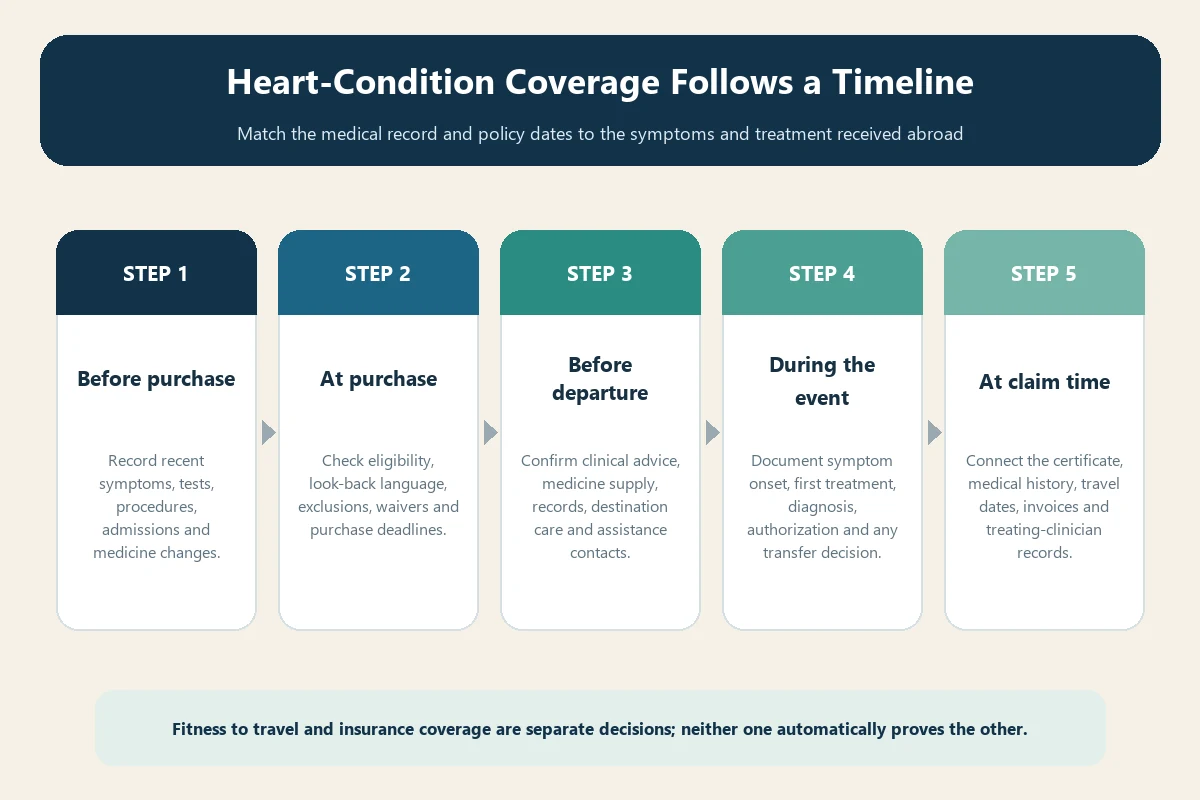
Travel medical insurance for heart conditions depends on two separate decisions: whether the traveler is medically fit for the itinerary and whether the issued certificate covers the event. A cardiologist can address fitness and risk. Only the policy wording can address benefits, exclusions, limits and claims.
This guide helps U.S. travelers organize cardiac history and compare insurance. It does not decide when someone can fly after a heart attack, procedure or symptom change. That decision belongs to the treating cardiologist, airline or transport medical service as applicable.
Key takeaways
- Create a dated record of symptoms, tests, procedures, hospitalizations and medication changes.
- Do not treat medical clearance as proof of insurance eligibility or vice versa.
- Test a cardiac emergency under the pre-existing-condition rule, then evaluate each service separately.
- Confirm implanted-device, oxygen and medical-evacuation requirements before travel.
- Carry a current medical summary, generic medicine list and accessible electrocardiogram when the clinician recommends it.
Reviewed August 16, 2026. Cardiac fitness and insurance terms can change; obtain individualized medical advice and verify the current certificate.
Build a cardiac event calendar
List angina, heart failure episodes, arrhythmias, heart attack, angiography, stent, ablation, bypass surgery, valve procedure, pacemaker or defibrillator placement and emergency visits. Add dates for follow-up tests and medication changes.
The pre-existing-condition look-back guide helps compare that calendar with the certificate. Include recommended care even if it was not completed.
Separate fitness to travel from coverage
A traveler may be medically cleared yet face a contract exclusion. A certificate may appear favorable while a cardiologist advises delaying the trip. Both decisions must be affirmative; neither replaces the other.
Ask for a clinical fitness letter only when appropriate and truthful. Give the insurer the facts its application requests rather than asking the clinician to promise coverage.
Check recent-event guidance with the specialist
CDC’s current chronic-illness guidance lists recent acute heart failure, unstable angina, angiography, ablation, bypass surgery, stenting, device implantation and myocardial infarction as events requiring condition-specific clearance and any delay recommended by the treating cardiologist.
Use the current CDC Yellow Book chronic illness chapter to prepare the clinical discussion. Do not convert its medical guidance into a universal insurance waiting period.
Find the certificate’s stability test
Search for pre-existing condition, stable, treatment, symptoms, advice, medication change, acute onset and medically able to travel. Some forms use a look-back definition without the word “stable.” Others condition a waiver on fitness when the policy is purchased.
There is no single insurance rule for every heart diagnosis or procedure. Copy the actual clause and place the dated facts beside it.
Evaluate a waiver and its purchase deadline
A time-sensitive waiver may remove the general pre-existing-condition exclusion when the policy is purchased within a specified period, the traveler is medically able to travel and required trip costs are insured. Later cost additions may need prompt updates.
The waiver eligibility guide provides a purchase file. Confirm whether separate cardiac, device or travel-against-medical-advice exclusions remain.
Review medication changes accurately
List new, stopped, increased or decreased medicines, including anticoagulants, rhythm medicines and rescue therapy, without interpreting their meaning beyond the records. A change can affect both medical planning and the insurance timeline.
The chronic medication guide separates routine supply, a new prescription, loss and a flare-up. Never delay a clinically necessary adjustment to create an appearance of stability.
Prepare medicine and records for the route
Carry enough permitted medicine plus a delay buffer, original packaging, generic names, prescriptions, allergies and the clinician’s contact information. Discuss time-zone dosing with the prescriber. Store copies securely in paper and accessible electronic form.
The U.S. Department of State medicine guidance advises checking destination restrictions and carrying a doctor letter. It also reminds travelers that foreign facilities can require deposits or payment before care.
Plan for pacemakers and implanted defibrillators
Ask the cardiologist whether settings or recent checks matter for long-haul travel. Carry the device identification card and notify security personnel as appropriate. Confirm manufacturer and airline guidance rather than relying on a generic screening assumption.
Insurance questions are different: determine whether device malfunction, replacement, interrogation and related emergency care are covered expenses or subject to equipment exclusions.
Confirm oxygen and airline arrangements
If supplemental oxygen may be needed, contact the airline early and follow medical approval procedures. Personal oxygen equipment, carrier-supplied oxygen and medical oxygen during an emergency can fall under different payment rules.
Ask the insurer whether planned oxygen is excluded as ongoing care and whether emergency oxygen is part of an eligible medical event.
Define an acute cardiac scenario
Describe onset, symptoms, first request for help, ambulance, emergency testing, diagnosis, treatment and admission. Avoid asking only whether “heart attacks are covered.” The pre-trip history and actual service list determine how the certificate is applied.
The travel medical benefits guide helps connect the episode to definitions and exclusions. Keep every cost tied to the same incident.
Test physician, hospital and medicine charges
Separate professional fees, electrocardiogram, imaging, laboratory work, medicine, procedure, intensive care and follow-up. Apply deductible, coinsurance, service caps and the overall medical maximum.
The policy limits guide provides a cost stack. A large headline maximum does not prove every procedure is eligible.
Contact assistance as soon as practical
Seek necessary emergency care first. Then follow notice rules, record the assistance-center reference and ask about direct billing, medical monitoring and transfer. For non-emergency follow-up, obtain any required preauthorization.
Assistance coordination is not final claim approval. Preserve both assistance and claims communications.
Evaluate medical evacuation beyond the maximum
Cardiac transport can require a suitable receiving facility, medical escort, oxygen or specialized aircraft. Confirm whether the event is eligible after the pre-existing-condition analysis, who chooses the destination and whether the policy covers the nearest adequate hospital or later transport home.
The evacuation coverage guide explains why insurer authorization and clinical necessity often decide more than the displayed dollar limit.
Check whether the traveler is fit to be evacuated
“Evacuation” is not an automatic flight home. The assistance team and treating clinicians may decide stabilization is required before transport. Ordinary return travel, medical transfer and repatriation are different pathways.
Ask who pays for additional lodging or a companion if transport must wait. These costs may sit outside the medical benefit.
Research destination cardiac capability
Identify hospitals with appropriate cardiology and intervention services along the itinerary. Check remote segments, islands, cruises and altitude routes. Save provider and assistance contacts offline.
The CDC Yellow Book’s travel insurance guidance recommends planning destination care and considering evacuation when definitive care may not be locally available.
Account for altitude, heat and air quality
Destination conditions can change the clinical suitability of an otherwise ordinary itinerary. Ask the cardiologist about altitude, extreme heat, air pollution, long transfers and exertion. Build rest, hydration access and a lower-exertion alternative into the route. Then confirm that the assistance network can reach each planned region.
Trip cancellation or interruption for a known destination condition is a different insurance question from emergency medical care. Check covered-reason wording rather than assuming a medically unsuitable route can always be canceled for reimbursement.
Coordinate domestic and travel insurance
Ask the domestic plan what emergency care it covers overseas and whether the travel certificate is primary or secondary. A secondary plan may require another insurer’s explanation of benefits before processing the remainder.
The health insurance abroad guide provides a payer worksheet. Include medical evacuation, which many domestic plans do not pay.
Preserve a claim-ready clinical record
Keep the cardiac history requested by the insurer, fitness letter when relevant, overseas clinician notes, diagnostic reports, procedure records, itemized bills, prescriptions, payment proof and authorization references. Retain original-language records and translations.
The claim documentation guide helps track deadlines and supplemental requests. Answer history questions accurately.
Use consumer guidance instead of product rankings
NAIC’s current travel insurance consumer guide says each policy sets its own covered situations, limits and exclusions. It advises asking about approval requirements and pre-existing conditions.
A “best for heart conditions” badge cannot replace the certificate available for the traveler’s state, dates, age, destination and medical facts.
Run a stent-and-chest-pain scenario
Imagine a traveler had a stent several months before departure, changed medicine afterward and later received medical clearance. Chest pain abroad leads to an ambulance, testing, observation and a changed prescription. Test the look-back definition, waiver conditions, medical clearance date, each service and follow-up.
This scenario exposes the boundary between fitness, pre-existing-condition eligibility, emergency treatment and routine continuation.
Ask these questions before buying
- Which cardiac events, symptoms, tests and medication changes fall inside the look-back definition?
- Is a waiver or acute-onset benefit available, and what are its conditions?
- Does medical clearance need to exist on the purchase or departure date?
- How are implanted-device malfunction, oxygen and follow-up handled?
- Are ambulance, emergency testing, hospitalization and procedures eligible?
- Who authorizes evacuation and chooses the receiving facility?
- Is the plan primary or secondary, and can providers require up-front payment?
- Which cardiac records and claim documents are required?
Make the final heart-condition decision
Choose only when the cardiologist’s fitness decision and the certificate’s eligibility decision both support the planned trip. Apply the exact facts to the pre-existing-condition, waiver, service, evacuation and evidence clauses.
Build a backup for gaps: medicine supply, records, destination care, payment, companion logistics and a safe route. Insurance works best when those clinical and operational layers are already in place.
A past stroke or TIA does not answer whether a trip is medically ready or insurance-eligible. Use this senior post-stroke travel insurance timeline to review stability, recent care, medication, mobility, recurrence, cancellation, evacuation, and claims.
