

Travel insurance for Luxembourg from USA trips should be built as multi-country protection, even when the hotel never changes. A traveler can sleep in Luxembourg City and cross into Belgium, France or Germany during an ordinary day. Medical care, rail fares, carrier remedies and policy territory can therefore span several jurisdictions.
Key takeaways
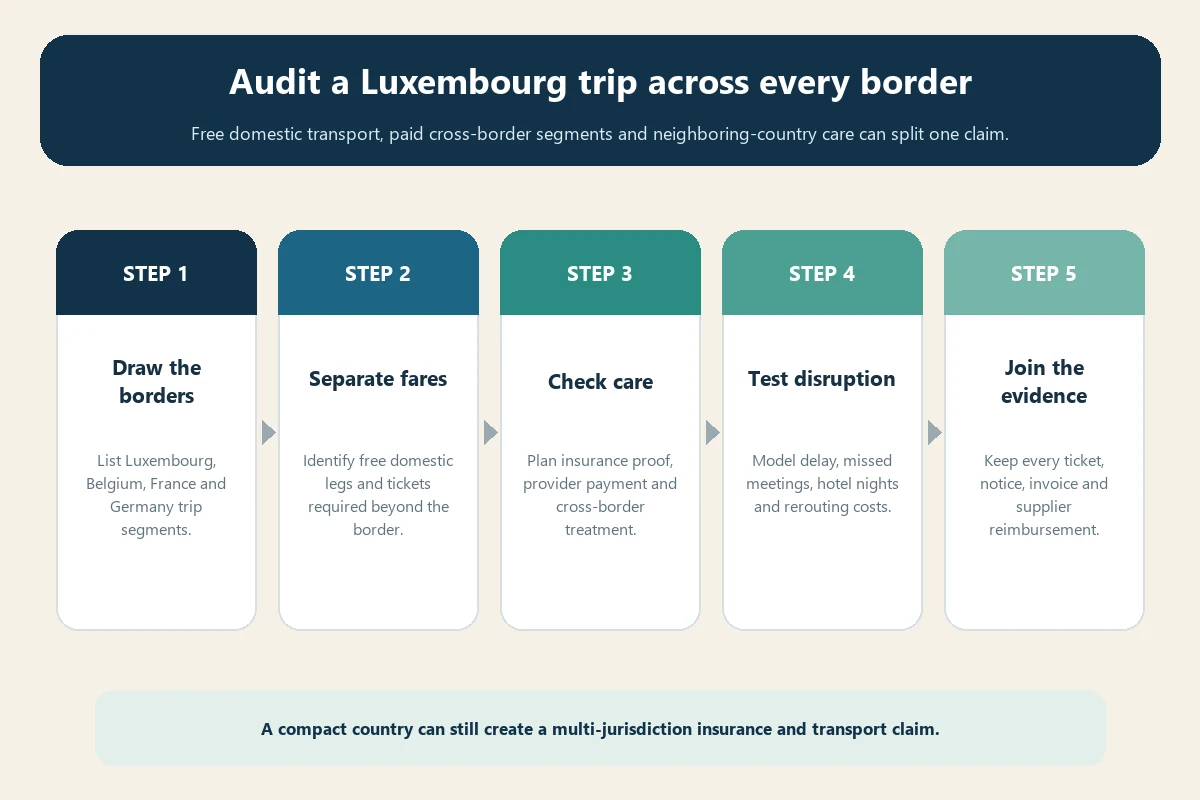
- List every neighboring country, transit airport and cross-border day trip before purchase.
- Prepare for hospitals to request insurance proof or payment before discharge.
- Separate free Luxembourg transport from paid first-class and cross-border segments.
- Identify through tickets and self-made rail connections before testing missed-connection cover.
- Join medical, transport, supplier and payment records into one chronological claim file.
Planning information reviewed August 16, 2026. Fares, schedules, border procedures, provider practices and insurance terms can change. Verify current details for the actual journey.
Draw the trip by country, not by hotel
Create a day-by-day map from the U.S. departure through every connection. Mark Luxembourg stays plus visits to Trier, Metz, Brussels, the Ardennes or other neighboring areas. Add the country crossed during airport transfers. The policy’s geographic definition must include all of them.
Next to each segment, record its operator and booking contract. A cross-border commuter train, international high-speed train, regional bus and rental car create different duties after disruption. The traveler needs to know which supplier responds first and which eligible loss may remain for insurance.
Use the multi-country Europe insurance guide to audit transit countries, side trips and date boundaries.
Confirm entry status without confusing it with coverage
Many U.S. citizens visit Luxembourg and other Schengen countries for short tourism without a traditional visa under current arrangements. That does not determine every traveler’s case. Passport, residence, trip purpose, duration and prior Schengen days can change the process.
When an applicant must show an insurance certificate, the document addresses an entry requirement. It does not guarantee cancellation, business equipment, private hospital payment or cross-border missed connections. The full issued policy controls. Review the Schengen insurance requirements guide when formal proof is needed.
Prepare for hospital payment in Luxembourg
The U.S. Department of State’s official Luxembourg travel information says hospitals may require proof of insurance or payment and can request payment before discharge. It notes that credit cards or bank transfers may be accepted and recommends medical-evacuation coverage.
Ask the existing U.S. health plan about emergency care abroad, out-of-network reimbursement and claim order. Ask the travel insurer whether its medical benefit is primary or secondary, how assistance chooses a provider and whether it can arrange a guarantee of payment.
Carry the policy number and assistance details offline. Keep a payment method that can handle an unexpected deposit. Before leaving a provider, obtain the diagnosis, medical report, itemized invoice, prescription and proof of payment. The primary medical coverage guide explains reimbursement sequencing.
Cross-border care creates two location questions
An incident in Luxembourg may lead to treatment there, while an incident during a day trip may begin in France, Belgium or Germany. Record both where the event occurred and where care was delivered. The policy can apply territorial, provider and authorization rules to each.
Luxembourg uses 112 for emergencies, as identified in the State Department information. Local ambulance service, hospital transfer, medical evacuation and repatriation are distinct. Ask who determines the nearest suitable facility and whether a border crossing for treatment needs assistance approval.
A preferred return to the United States is not automatically medically necessary repatriation. The evacuation and repatriation guide separates local care from an authorized return.
Understand where free public transport ends
Luxembourg’s official public-services portal explains that domestic public transport is free in second class. It also explains that first class and most cross-border travel require a valid ticket, with specified exceptions near the border.
A traveler should not treat “Luxembourg transport is free” as a complete fare rule. Record where the journey crosses a tariff boundary and retain the ticket for the paid portion. The official Mobiliteit portal publishes current fare information and conditions.
This distinction matters for claims. There may be no original fare to reimburse on a free domestic leg, but a disruption can still cause a paid taxi, hotel or replacement cross-border ticket. Eligibility depends on a policy trigger and evidence, not on the general fare policy.
Audit cross-border tickets before departure
Mobiliteit provides official guidance on cross-border tickets for neighboring networks. Save the specific fare, operator, validity and conditions used. A daily commuter product can differ from a reservation on an international train.
Determine whether the complete journey is issued on one ticket. If a regional train connects to an independently purchased high-speed service or flight, mark it as a self-transfer. Calculate the walking or transfer time, check-in deadline, next available service and replacement cost.
Insurance may require a common-carrier delay, minimum connection and specified waiting period. A traveler who planned an impossible connection can have difficulty showing that the loss was unavoidable.
The Europe train travel insurance guide explains through tickets, separate contracts and evidence.
Apply railway passenger rights first
The European Union’s official rail passenger-rights guidance describes reimbursement, rerouting, assistance and compensation for qualifying journeys. The actual service, delay and exceptions determine the remedy.
Ask the operator for written confirmation of the cause and expected delay. Record the original option, rerouting offered and actual arrival. Before buying another ticket, document whether the railway was given the opportunity to assist and whether self-rerouting was permitted.
Carrier compensation and insurance are not duplicate payments for the same loss. Disclose every refund, reimbursement and travel credit. Claim only eligible costs that remain after those recoveries.
Test a Luxembourg disruption across the whole day
| Scenario | First response | Possible remaining issue |
|---|---|---|
| Domestic train is late | Operator information and rerouting | Eligible added local cost after the policy threshold |
| Cross-border service is canceled | Rail reimbursement or alternative | Hotel, meals or onward ticket not recovered |
| Separate flight is missed | Airline fare terms | Whether missed-connection wording covers self-transfer |
| Medical event ends the trip | Assistance and provider | Unused bookings and authorized return transport |
| Business meeting is missed | Supplier cancellation terms | Whether business-related loss is insured at all |
One delay can create several consequences, but each expense must fit a benefit. The delay, interruption and cancellation guide helps place the loss on the correct timeline.
Do not assume business losses are included
Luxembourg trips often mix tourism with a conference, meeting or financial-sector visit. Standard leisure coverage may insure the traveler without covering lost professional fees, contractual penalties, samples or specialized equipment. Ask whether incidental business activity is allowed and which business property limits apply.
Keep personal and employer-paid costs separate. Record who bought each flight, hotel, rail ticket and device. Only the party that suffered the loss should seek reimbursement, subject to policy terms. If an employer can refund the expense, disclose that recovery.
Rental cars create border and liability questions
A short drive can enter France, Belgium or Germany. Obtain written cross-border permission from the rental company and confirm the authorized drivers, countries and roadside number. Check collision damage, third-party liability, tires, glass, undercarriage and administrative fees separately.
Travel medical insurance does not normally replace automobile liability. A credit-card collision benefit may cover the rental vehicle but not harm to other people or property. Photograph the car at pickup and return, and keep the final rental statement after any incident.
Calculate trip cost without double counting
Include prepaid, nonrefundable flights, lodging, tours, conference fees and paid transport. Do not declare free public transport as a purchased cost. For refundable fares, insure only the amount actually exposed under the cancellation rules.
Trip cancellation normally responds before departure to listed covered reasons. Trip interruption operates after departure. “Cancel for any reason,” when offered, has separate purchase deadlines, reimbursement percentages and cancellation timing. Never assume a standard plan covers a change of mind.
Compare plans with a Luxembourg border worksheet
- Luxembourg plus every French, Belgian, German and transit segment;
- medical maximum, deductible, benefit order and provider-payment support;
- ambulance, cross-border transfer, evacuation and repatriation;
- through tickets, separate connections and carrier remedies;
- delay thresholds, missed-connection causes and daily expense limits;
- business travel, employer-paid costs and equipment sublimits;
- rental-car territory, collision damage, liability and roadside help;
- claim notice, authorization, proof and appeal deadlines.
Compare complete policies issued for the purchaser’s U.S. state. The Europe policy comparison guide provides a neutral worksheet for limits and definitions.
Build one chronological claim across borders
Start with the event location, date and time. Add each provider or carrier contacted, the response given and the resulting expense. For medical care, keep clinical and payment records. For transport, retain every ticket, scheduled and actual time, written cause and alternative offered.
Request supplier refunds before finalizing the net loss. Link each receipt to the reason it was necessary. The travel insurance claim guide provides a document index and escalation sequence.
Finally, check exclusions for each country rather than relying on the word “Europe.” Government advisories, sanctions, war and civil-disorder clauses can operate independently. The country-exclusions guide explains that review.
Frequently asked questions
Is travel insurance mandatory for every U.S. tourist in Luxembourg?
There is no identical private-policy rule for every short U.S. tourist. Passport, visa status, trip purpose and duration determine formal documentation. Verify current official entry rules.
Is all public transport in Luxembourg free?
Domestic second-class public transport is generally free, but first class and most cross-border segments require a valid ticket. Check current official fare boundaries.
Will a Luxembourg hospital accept travel insurance instead of payment?
Do not assume it will. A hospital may require insurance proof or payment. Ask assistance about a guarantee and collect complete documents for reimbursement.
Does insurance cover a missed train connection in another country?
Only when the cause, ticket structure, connection time and expense meet the policy. The territory must also include the country where the loss occurs.
Can a business traveler insure a missed meeting?
Standard plans do not automatically cover lost professional income or business penalties. Review business-purpose and equipment wording and identify who bears each cost.
This article is educational and is not legal, medical or insurance advice. Official authorities, providers, carriers and the issued policy control.
