

Travel insurance for Malaysia from USA trips should match the exact route across Peninsular Malaysia, Borneo, islands and diving activities. Upfront hospital payment, rural access, marine transport and an activity exclusion can matter more than a generic countrywide medical limit.
Key takeaways
- Map Kuala Lumpur, Peninsular islands, Sabah and Sarawak separately.
- Prepare for upfront medical payment and patient-funded transfers.
- Verify every diving fact, including certification, depth and rescue.
- Use official weather information plus each supplier’s decision.
- Match eastern Sabah advisory geography to the actual marine route.
Planning information reviewed August 16, 2026. Entry rules, advisories, weather, medical access and policy terms can change. Recheck official and supplier information for the travel dates.
Build a Malaysia route before comparing plans
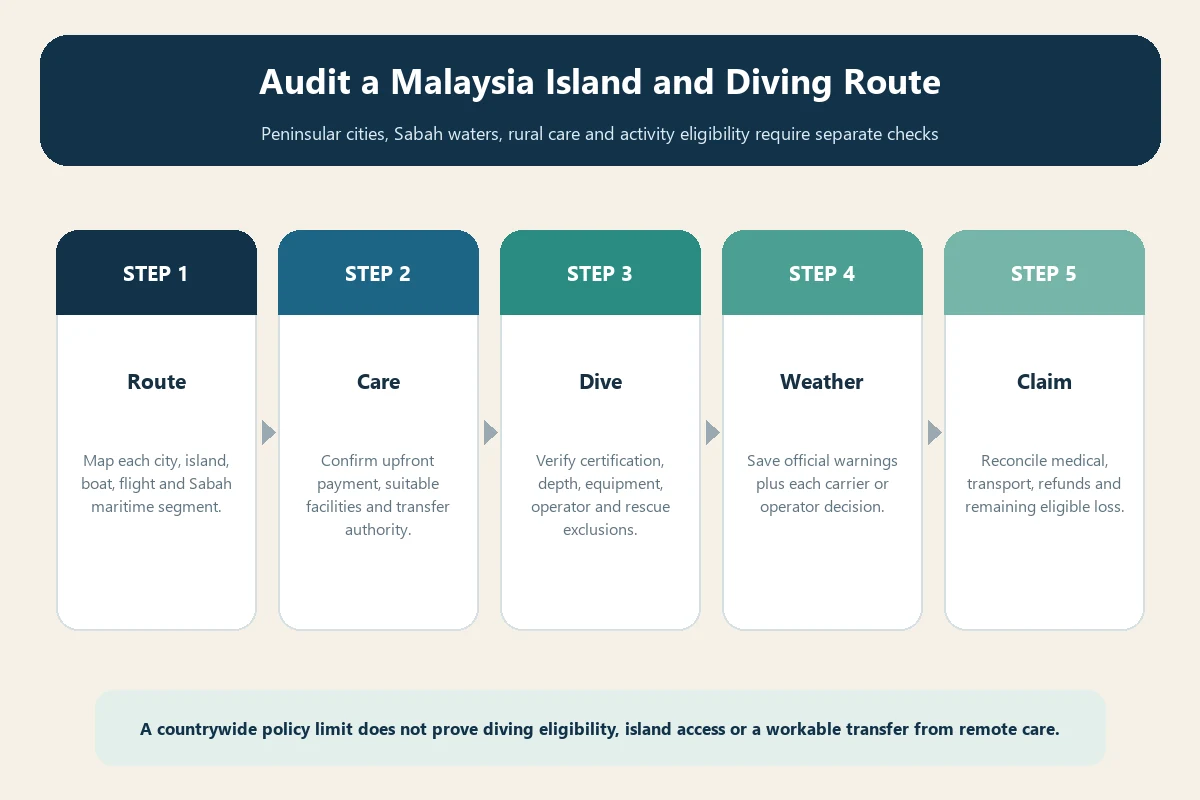
List Kuala Lumpur, Penang, Langkawi, east-coast islands, Kota Kinabalu, inland Borneo and every boat or domestic flight as separate segments. Add prepaid hotels, tours, dive packages, rental vehicles and the last workable connection each day. A city break and a remote Sabah itinerary do not create the same medical or interruption problem.
Mark which costs are refundable and which depend on another segment. Use the delay, interruption and cancellation guide to distinguish added lodging from an unused remainder of the trip. Do not insure a total that silently includes recoverable bookings.
Check current entry and regional guidance
The current State Department Malaysia travel guidance identifies the Malaysian Digital Arrival Card for many visitors and gives separate advice for islands and maritime areas off eastern Sabah. Recheck the named districts, exemptions and submission channel shortly before travel.
Insurance does not make an advised-against route safe or permitted. Ask the insurer how territorial and advisory exclusions are measured, including whether the relevant date is purchase, departure or event. Save the guidance that applied to the exact island, water area and booking date.
Prepare for upfront hospital payment
Official guidance says Malaysian hospitals require payment before treatment or admission and cards are not always accepted. Medical care is not free in public facilities. Ask assistance whether it can issue a payment guarantee to a named hospital and what evidence is needed to do so.
Keep secure payment capacity even when reimbursement is expected. Obtain an itemized bill, diagnosis, proof of payment and discharge instruction. The health insurance abroad guide structures the separate call to the U.S. plan.
Distinguish public dispatch from private care
State guidance says dialing 999 connects a caller to a government hospital selected by the dispatcher, while private-hospital emergency care may require contacting that hospital directly. Ask assistance how it coordinates each route without assuming that an ambulance will take the traveler to a preferred facility.
Record the emergency need first. Then document the facility, payment request and any transfer recommendation. A private hospital name in a directory does not prove current capacity, admission, direct billing or English-language support.
Map rural and island medical access
Official guidance says adequate care can be harder to find in rural Malaysia and that response may take longer far from a large city. For each island or inland stay, identify a plausible stabilization point, onward ground or marine transport and a higher-care facility without treating that plan as a guarantee.
Ask who decides medical necessity, destination and transport method. Patients may bear transfer costs, so clarify direct payment, reimbursement and approval rules. The medical evacuation guide separates local response, stabilization, hospital transfer and possible repatriation.
Audit diving eligibility in writing
Give the insurer the certification level, maximum depth, number of dives, night or wreck plans, boat operator, equipment source and whether a guide is present. Ask about search and rescue, recompression treatment, medical evacuation, equipment and missed dives separately.
The activity exclusions guide provides a comparison method. A policy that covers ordinary swimming may not cover scuba at the planned depth. A dive operator accepting the booking does not establish policy eligibility.
Verify the operator and emergency plan
Request certification checks, equipment inspection practices, oxygen, communications, weather limits, nearest recompression option and the method for reaching shore. Record the dive site and boat rather than relying on a general island description.
Ask what happens if the operator changes the site or substitutes a vessel. Preserve its cancellation, refund and alternate-dive terms. If the safety plan or insurance answer no longer fits, decline the activity rather than assuming the original approval transfers.
Use official Malaysian weather information
MET Malaysia publishes current weather forecasts and warnings for districts, heavy rain, wind and marine conditions. Save the affected place or sea area, issue time, validity and recommended action.
Then obtain the airline, ferry, hotel or tour decision. An official warning proves conditions; it does not prove that every supplier stopped. The weather-delay guide explains policy timing and carrier thresholds.
Treat haze as a health and operations question
Haze can affect outdoor activity, flight operations and a traveler’s health differently. Record official air-quality information, clinician advice for a known condition and the supplier’s actual decision. A poor reading alone may not trigger cancellation benefits.
Ask how the policy treats an acute illness compared with a traveler choosing to avoid outdoor plans. Preserve medical restrictions, airline changes and operator refunds. Do not describe a forecast as a covered event unless the certificate says so.
Review health guidance by region and activity
The CDC publishes current Malaysia traveler health guidance. Review it with a clinician using the exact state, season, trip length and activities rather than a country label alone.
Health advice is not a coverage promise. Ask about illness, preventive treatment, prescription replacement and pre-existing conditions. Carry lawful medicines in original packaging with supporting documentation.
Audit every island transport contract
List the boat operator, jetty, scheduled departure, baggage rule, island hotel and onward flight. Ask which services meet the policy’s common-carrier definition and what minimum delay applies. Small tour boats and public ferries may be treated differently.
Save cancellations, alternate sailings, refunds and replacement receipts. The ferry insurance guide offers a transport-stage method that can be applied after confirming the Malaysia policy wording.
Separate scooter liability from medical cover
If the route includes a scooter or motorcycle, verify the accepted license, vehicle class, helmet, road use and local-law requirements. Ask the insurer whether an accident remains eligible under those exact facts.
Travel medical benefits do not automatically pay damage to the vehicle, another person or property. The rental vehicle abroad guide explains liability and damage layers, but two-wheeled vehicles often require separate answers.
Create an island handoff table
For every remote stay, make columns for communication, first care, payment, transport, receiving facility and next scheduled connection. Add who controls each decision. This exposes where a boat, road or hospital acceptance is assumed but not verified.
Include companion lodging, unused tours and replacement flights on separate rows. They may fall under different policy sections from medical transport. A clear table prevents one headline evacuation limit from obscuring the stages that actually create cost.
Compare policies with one Malaysia scenario
Use identical ages, dates and insured trip costs. Include Kuala Lumpur, Sabah, an island boat, certified diving, a heavy-rain warning, an upfront hospital bill and a possible transfer.
- Which territories and advisories are excluded?
- What diving facts control eligibility?
- How is upfront care funded?
- Who selects and pays for transfer?
- What supplier action triggers delay benefits?
- Which refunds reduce the claim?
Read the certificate. Generic daily prices and fixed limits in search results do not answer route, activity or payment questions.
Use assistance without assuming approval
Store 999, the policy number and assistance line offline. Record representative names, times, instructions and case numbers. Give a companion allergies, medicines and consent information.
The assistance versus claims guide explains why coordination is not final adjudication. In an emergency, prioritize necessary care and notify the insurer as soon as reasonably possible.
Build the claim in chronological order
Keep the official warning, operator notice, emergency call, medical record, payment receipt, transfer recommendation, authorization, receiving record, refunds and new travel costs. Label each entry by person, date, location and reason.
The claim filing guide explains payer reconciliation. Record ringgit and actual card conversion. Show the original cost, every supplier recovery and the remaining amount requested.
Reconcile trip cost as the route grows
Record the first trip payment and every later nonrefundable hotel, dive, domestic flight or boat booking. Ask how the insurer handles increases after purchase and whether time-sensitive benefits depend on the initial-deposit date. Keep the confirmation showing when each cost became nonrefundable.
Use the same insured amount when comparing plans. A refundable city hotel, cash-paid island operator and changeable domestic ticket should not be treated as identical exposures. If a supplier later returns a credit, add it to the recovery ledger instead of leaving the original gross cost as the claimed loss.
Review the ledger after any route substitution. Moving from Peninsular Malaysia to Sabah can change territory, activities and transport even when the total price stays similar. Repeat the insurer questions before accepting the revised plan. Add the new operator’s cancellation terms, safety plan and contact details instead of carrying forward the old supplier’s answers. Confirm that the policy end date still covers the revised return and any required overnight connection.
Bottom line
A strong Malaysia plan distinguishes Peninsular cities, Borneo routes, islands and diving. Verify upfront payment, rural access, official warnings and activity eligibility, then preserve the evidence that connects an eligible event to the final unreimbursed loss.
