
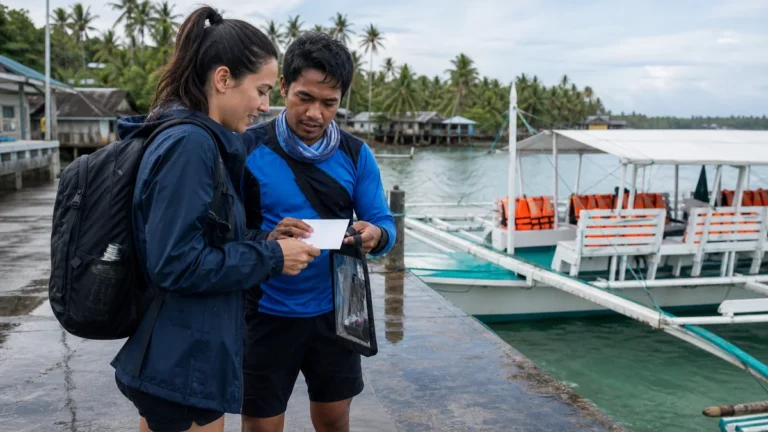
Travel insurance for Philippines from USA trips should be built around typhoon timing, island transport, cash medical care and a realistic transfer chain. A named storm does not automatically prove every loss; the affected island, policy purchase, carrier action and remaining cost must align.
Key takeaways
- Save official PAGASA bulletins by island, hazard and issue time.
- Document airline, ferry, hotel and dive-operator decisions separately.
- Prepare for cash payment and limited ambulance response.
- Map suitable care and transfers from smaller islands.
- Check diving, boating and scooter exclusions before departure.
Planning information reviewed August 16, 2026. Storms, advisories, entry rules, ferries, medical access and policy terms can change. Recheck official and supplier information for the travel dates.
Map the Philippines island by island
List Manila, Cebu, Palawan, Boracay, Siargao or every other planned island as a separate segment. Add domestic flights, ferries, boats, drivers, dives, tours and nonrefundable lodging. Record the last workable connection and a safe overnight option.
An airport delay and a canceled local boat can affect different bookings. Use the delay, interruption and cancellation guide to classify added lodging, missed connections and the unused remainder of the route.
Check the current advisory by region
The current State Department Philippines travel guidance identifies higher-risk areas and limits on U.S. government emergency response in some regions. Match the province and island to the itinerary.
Ask the insurer how territorial, security and government-advisory exclusions work. Save the guidance that applied at purchase, departure and event. Insurance cannot make an unsafe or prohibited route acceptable.
Use PAGASA bulletins for the fact they prove
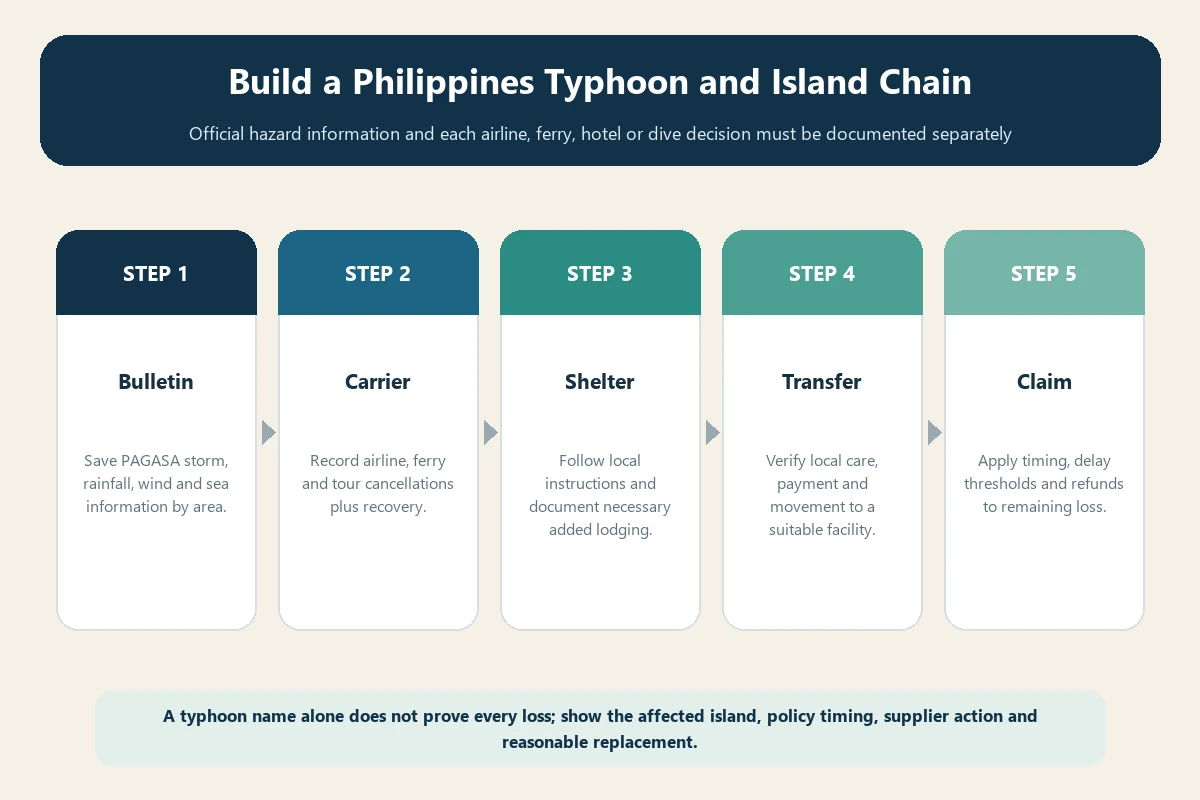
PAGASA publishes current tropical cyclone bulletins with affected areas, wind signals, rainfall and sea information. Save the bulletin number, issue time, island or province and instruction.
Then obtain the airline, ferry, hotel or tour decision. A cyclone outside the Philippine Area of Responsibility can still affect monsoon conditions, while an island outside a wind-signal area may operate differently. Do not replace the supplier record with a storm map.
Protect against the known-event trap
Record the first trip payment, insurance purchase and date the storm became known under the certificate. Ask whether a named or foreseeable event is excluded after a specified point. Keep the quote and policy version issued on the purchase date.
The weather-delay guide explains timing, minimum delays and covered reasons. Buying after a public warning may not cover that storm even if the trip has not started.
Audit every airline and ferry handoff
For each island change, record the operator, terminal, departure, booking reference, baggage terms and onward reservation. Ask which boats qualify as common carriers and what missed-connection definition applies.
Preserve cancellations, alternate sailings, refunds and replacement receipts. The ferry insurance guide provides a transport-stage method after the Philippines policy wording is confirmed.
Do not assume all ports close together
Wind, waves, port authority decisions and vessel capability can produce different outcomes. One fast craft may stop while another route remains available. Record the specific terminal and operator rather than writing only “ferries canceled.”
If the outbound service operates but the return stops, preserve the last safe alternative and hotel response. Insurance evaluates the actual disruption and reasonable replacement, not the traveler’s expectation that all island transport would stop.
Prepare for cash medical payment
Official guidance says some Philippine providers require cash before care and may not accept cards. Ask whether assistance can identify a suitable facility and issue a payment guarantee, and what the traveler should do when cash is still demanded.
Keep secure backup payment capacity. Request diagnosis, services, local amount and proof of payment. The health insurance abroad guide structures the separate U.S. plan call.
Plan around limited ambulance response
State guidance says ambulances are not widely available and may have limited equipment. Store 911 and the insurer line offline. Ask the hotel or operator how it reaches public emergency services without treating a private vehicle as universally medically appropriate.
In an emergency, prioritize necessary care. A companion can call assistance, record the case number and document why advance approval was impractical. The claims file should show the clinical need and decision sequence.
Build a smaller-island transfer chain
Appropriate care can be harder to reach outside major metropolitan areas. For each smaller island, identify a plausible stabilization point, airfield or port, mainland receiving facility and communications. This is a planning scenario, not a guaranteed destination.
Ask who determines medical necessity, receiving acceptance and ground, boat or air movement. The evacuation planning guide separates rescue, stabilization, local transfer and possible repatriation.
Distinguish rescue from evacuation
A dive, surf or remote beach incident may require nonmedical retrieval before an ambulance or aircraft can begin. Ask whether search and rescue has its own benefit, limit or exclusion.
Record operator communications, life jackets, oxygen, guide qualifications and access for responders. A high evacuation limit cannot create a safe boat, clear weather or a receiving bed.
Audit diving and boating activities
Give the insurer certification, depth, dive type, boat, operator, equipment and location. Ask separately about recompression care, rescue, medical evacuation, rental equipment and missed dives.
The activity exclusions guide provides a comparison method. An operator accepting the booking does not prove the policy covers that activity.
Check scooters and road transfers
Record the driver, accepted license, vehicle class, helmet, road type and rental contract. Ask how local-law violations and two-wheeled-vehicle exclusions affect accident medical benefits.
Travel medical coverage does not automatically pay liability or scooter damage. If lawful authority or policy eligibility cannot be documented, use a licensed driver or other transport.
Review destination health guidance
The CDC publishes current Philippines traveler health guidance. Review it with a clinician for the exact islands, season, activities and health history.
Health advice is not a benefit promise. Ask about acute illness, preventive treatment, prescription replacement and pre-existing conditions. Carry permitted medicines in original packaging with documentation.
Create a storm decision log
Use local time for every PAGASA bulletin, carrier message, evacuation instruction, hotel response and replacement purchase. Identify the island and booking affected. Save screenshots together with the underlying email or PDF when available.
Separate necessary shelter from a voluntary resort change. If local authorities instruct evacuation, follow them. Record why the new lodging and transport were safe and reasonable, plus any original supplier recovery.
Compare one Philippines scenario
Use identical ages, dates and prepaid costs. Include Manila, a smaller island, domestic flight, ferry, diving, typhoon bulletin, operator cancellation, cash clinic bill and higher-care transfer.
- When does the storm become known?
- Which islands and activities are covered?
- What carrier action triggers benefits?
- How is local care paid?
- Who authorizes transfer?
- Which refunds reduce the claim?
Read the certificate. Generic daily prices do not answer storm timing, boat definitions or remote-care access.
Use assistance without confusing it with approval
Store the policy details and emergency contacts offline. Give a companion allergies, medicines and consent information. Record the representative, instruction, time and case number.
The assistance versus claims guide explains why coordination is not final adjudication. A referral can help locate care without promising reimbursement.
Reconcile the final claim
Keep the official bulletin, carrier notice, shelter instruction, medical record, cash receipt, transfer recommendation, authorization, receiving record, refunds and new travel costs. Label each by traveler, island, currency and reason.
The claim filing guide explains payer coordination. Record Philippine pesos and actual conversion. Show the original cost, returned value and remaining request.
Rehearse the no-island fallback
Before departure, price a mainland or major-city alternative and a later connection. If forecasts, port access or medical capability deteriorate, the safer route should be practical while ordinary transport still runs.
Share the route and check-in schedule with a home contact. Store documents offline and carry power. Operational margin can matter more than a high limit that cannot overcome closed transport.
Prepare an island shelter and communications card
For every small-island stay, write down the lodging’s storm procedure, local authority channel, public shelter information if officially designated, emergency number, port and airport contacts. Confirm how the hotel communicates when mobile data or electricity fails. Do not select an improvised shelter from a map without local guidance.
Carry a charged power bank, waterproof document copy, prescribed medicine and the traveler’s essential contacts. Give the home contact the same itinerary and a clear missed-check-in rule. Record a location in words so it can be relayed without a live map link.
If authorities order movement, follow their instructions and preserve the message. Note why added lodging or transport was necessary, who selected it and what the original supplier returned. Personal preparedness purchases should stay separate from potentially eligible trip costs.
Rehearse a dive-to-hospital handoff
Ask the operator how it reaches shore, contacts emergency services and transfers records or oxygen-use details to a clinician. Ask assistance who identifies a suitable receiving facility and whether boat, ambulance and air movement require separate authorization.
Keep the dive profile, operator incident report, first clinical note and transport record together. Preserve the diver’s certification, equipment record and the time symptoms began. Ask the receiving hospital for a final diagnosis and discharge restriction before changing flights. The sequence matters when treatment begins on one island and continues in a metropolitan hospital.
Bottom line
A strong Philippines plan maps each island, follows official typhoon information and verifies every carrier and medical handoff. Prepare for cash care and remote transfer, then preserve the evidence connecting a covered event to the final unreimbursed loss.
