
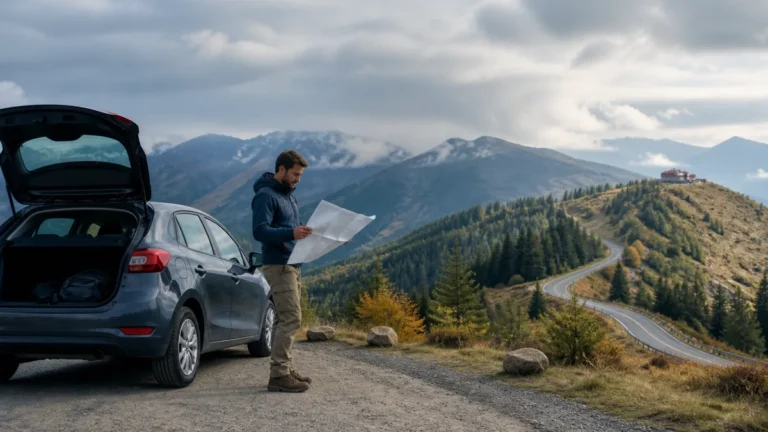
Travel insurance for Romania from USA trips should be built around Carpathian roads, mountain response, private medical payment and cross-border Schengen travel. A Bucharest weekend is different from a rental-car loop through secondary roads and hiking areas. Compare benefits against the route, vehicle and exact activities.
Key takeaways
- Map secondary roads, mountain passes, rural hospitals, fuel stops and safe alternatives.
- Separate rental collision damage, liability, roadside assistance and traveler injury.
- Check whether search and mountain rescue are distinct from medical evacuation.
- Prepare for cash or advance payment at many providers and retain itemized documents.
- Treat Romania as a full Schengen itinerary country while checking every border and exclusion.
Planning information reviewed August 16, 2026. Road conditions, mountain warnings, entry procedures, provider practices and policy terms can change. Verify current information before travel.
Draw the Romania route beyond the cities
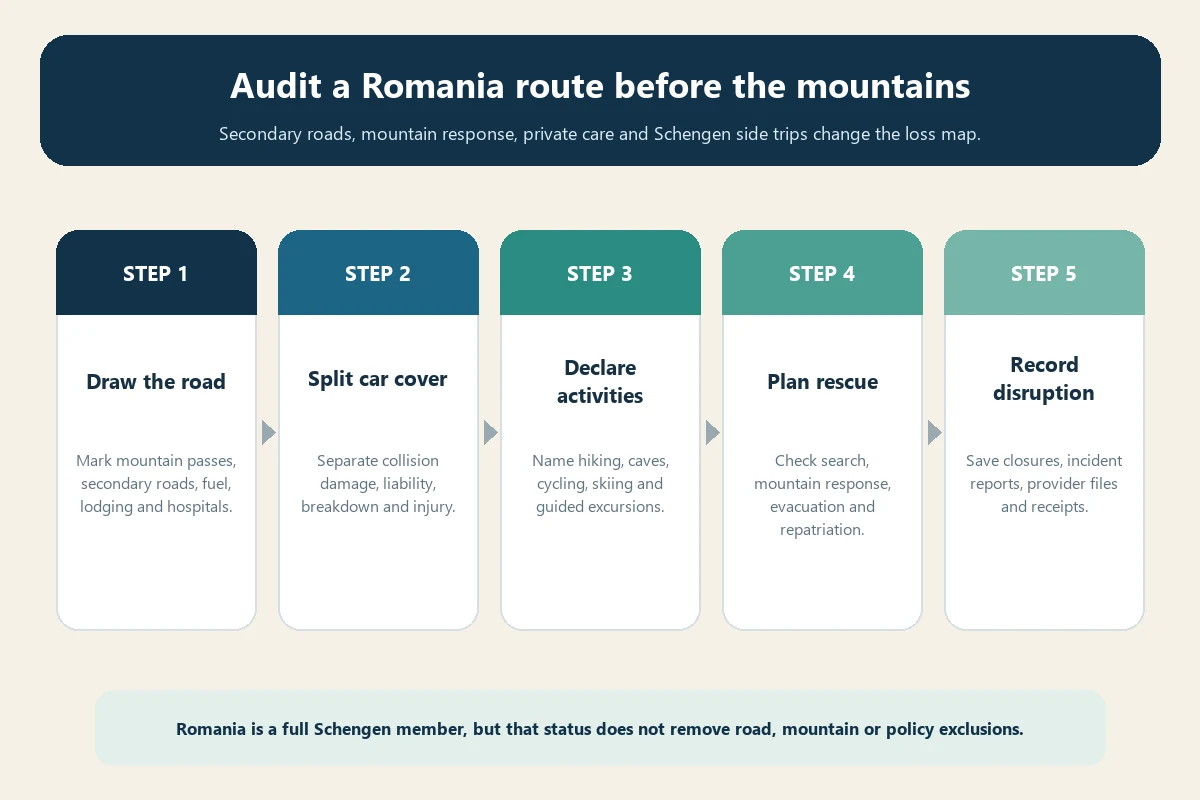
List the U.S. departure, transit airport, Bucharest or Cluj arrival, rental depot, every overnight, mountain pass, trailhead and return connection. Add fuel, charging and daylight constraints. Mark the nearest clinic or hospital to rural stays.
Beside each prepaid booking, record its refund rule. Flexible lodging should not be treated as fully nonrefundable. For a mountain route, include the cost of a safe replacement night or alternate transport, but remember that insurance pays only when a covered event makes that expense eligible.
Use the multi-country Europe insurance guide when Romania is combined with Hungary, Bulgaria, Serbia or another stop.
Update old assumptions about Schengen
Romania is no longer a non-Schengen exception. The Council of the European Union’s official border-control decision confirms that land-border checks with Romania were lifted from January 1, 2025, completing full Schengen membership.
That status does not make every insurance policy or border crossing identical. Passport, nationality, purpose, duration and routes through non-Schengen neighbors still matter. A certificate used for entry also does not prove rental-car, rescue or activity coverage.
The Schengen insurance requirements guide explains entry documentation without turning it into a benefit summary.
Prepare for medical payment and uneven access
The U.S. Department of State’s official Romania travel information says most hospitals and medical professionals require cash payment, and private hospitals often request payment in advance or proof of insurance. It also says adequate care can be harder to find in rural areas.
Ask the existing U.S. health plan whether it covers emergency treatment abroad and how reimbursement works. Ask the travel insurer whether benefits are primary or secondary, how assistance identifies a facility and whether a payment guarantee can be issued.
Carry a practical payment method and the assistance details offline. Obtain the diagnosis, medical report, itemized bill, prescription and payment proof before leaving. The primary medical coverage guide explains coordination.
Separate public ambulance from evacuation
Romania uses 112 for emergency medical services. The State Department says ambulance services are widely available, while responder training and response times can be poor. A local ambulance, inter-hospital transfer, air ambulance and return to the United States are different stages.
Read who decides medical necessity and which facility is permitted. Check advance-authorization rules and what happens when assistance cannot be contacted immediately. Do not assume “evacuation” means transport to a preferred hospital.
The medical evacuation and repatriation guide provides a clause-level audit.
Treat secondary roads as a separate risk
The State Department says many Romanian secondary roads are poor, unpaved, poorly lit and narrow. It warns that mountain roads are dangerous when wet, snowy or icy, and snow removal can be intermittent. Flash floods can affect mountain areas in spring and summer.
Do not follow a navigation shortcut without checking the route type. Confirm whether the rental agreement permits unpaved roads and border crossings. Photograph vehicle condition, tires, glass, supplied first-aid kit, extinguisher and reflective triangles at pickup.
Carry an offline route, fuel margin and the rental assistance number. Safety preparation is not an insured benefit. The Europe road-trip insurance guide provides a vehicle contract checklist.
Split four road protections
| Exposure | Possible source | Frequent gap |
|---|---|---|
| Damage to rental car | Rental waiver, card or travel plan | Tires, undercarriage, unpaved roads |
| Damage or injury to others | Local liability protection | Limit, unauthorized driver or territory |
| Breakdown and towing | Rental roadside service | Driver error or remote recovery charge |
| Injury to traveler | Health and travel medical cover | Alcohol, activity or authorization exclusion |
A credit-card collision benefit is not third-party liability. Confirm the current benefit guide, required payment method, eligible vehicle and country rules.
Document road incidents by legal category
The State Department’s Romania page describes different steps for an injury accident and a property-damage-only collision. In a serious event, protect people and follow local authority instructions. Do not move a vehicle contrary to those instructions.
Keep police or amicable reports, photos, witness information, rental correspondence, towing records and the final damage statement. If a road closure causes an overnight stay, obtain the official closure and why the original route could not be used.
Mountain rescue is not a synonym for treatment
A lost-hiker search, technical extraction, first aid, ambulance transfer and hospital treatment can fall under different benefits. Ask the insurer whether non-medical search and rescue is included, whether there is a sublimit and whether a recognized authority must direct the operation.
Salvamont Romania provides an official mountain-rescue application from the national mountain rescuers’ association. Its location and alert functions can support response, but an app does not replace route planning, local instructions or policy coverage.
Save the intended route, weather and warning checks, turnaround time and emergency contacts. In an incident, preserve coordinates, authority reports and the assistance case number.
Name every Carpathian activity
List hiking, climbing, via ferrata, cave tours, cycling, skiing, horseback riding and off-road vehicle use. Search the contract for exact names and conditions involving guides, marked trails, helmets, altitude, racing and motorized activity.
Coverage for medical treatment after an injury may not include rescue charges, rental equipment or third-party liability. The adventure and winter-sports exclusions guide helps separate the clauses.
Check bears and wildlife without assuming a benefit
Follow current local guidance about wildlife, food storage and trail conditions. A traveler should not approach or feed an animal. Insurance may cover resulting emergency medical treatment under ordinary terms, but it does not make unsafe conduct reasonable.
Ask whether government-advisory, negligence, intoxication or prohibited-activity exclusions could apply to the actual facts. Keep any authority or guide report after an incident.
Weather closures require evidence
Snow, ice, heavy rain and flash flooding can change a Carpathian route. Insurance usually needs a defined event and consequence. A personal choice to avoid a road is not automatically equivalent to an official closure or common-carrier cancellation.
Save the exact road notice, location, time and alternative offered. Record the rental company’s direction before attempting an unsafe detour. When practical, contact assistance before booking costly replacement lodging or transport.
Earthquake disruption uses different evidence
Romania has moderate seismic activity, and Bucharest has a history of earthquake risk. Check whether the policy lists an earthquake as a covered natural disaster for cancellation, delay or interruption, and whether lodging or transport must become unusable.
Preserve an authority notice, hotel closure or carrier cancellation rather than relying on general news. Leaving because of concern can be treated differently from an official closure. Ask assistance before relocating when it is safe to wait, and document refunds from the original provider.
Compare Romania plans against the route
- all countries, dates, transit points and mountain overnights;
- medical maximum, deductible, payment process and rural access;
- ambulance, hospital transfer, evacuation and repatriation;
- search-and-rescue wording, decision maker and sublimit;
- rental damage, liability, breakdown and road restrictions;
- hiking, cave, winter and motorized activity definitions;
- weather closure, delay, cancellation and interruption triggers;
- claim notice, evidence, deadlines and appeal route.
Use the policy issued for the purchaser’s U.S. state. Check all territory and advisory wording with the Europe country-exclusions guide.
Build one chronological Romania claim
Start with the event location and time. Add calls to 112, Salvamont, rental assistance and insurance assistance in order. Keep every instruction. For medical care, add the full clinical and payment file. For transport, add official notices and supplier remedies.
Claim only eligible unrecovered loss after refunds, rental protection and carrier remedies. Link each receipt to its cause. The travel insurance claim guide provides a document index.
Frequently asked questions
Is Romania part of the Schengen Area?
Yes. Romania became a full Schengen member when land-border checks were lifted on January 1, 2025. Travelers must still verify passport, duration and any non-Schengen route requirements.
Will a Romanian private hospital accept U.S. insurance?
Do not assume it will. Private providers often require upfront payment or insurance proof. Ask assistance about payment arrangements and keep complete records.
Does medical evacuation include mountain rescue?
Not automatically. Search, technical rescue, ambulance, facility transfer, evacuation and repatriation can be separately defined and limited.
Does travel insurance cover rental-car damage?
Only if the plan contains an eligible rental benefit and the vehicle, road, driver and event meet its terms. Liability and roadside help are separate.
Is a weather-related mountain detour covered?
Only when a documented trigger and eligible expense meet the contract. An official closure can be treated differently from a voluntary route change.
This article is educational and is not legal, medical or insurance advice. Official authorities, responders, providers and the issued policy control.
