

Travel insurance may cover a CPAP machine only under specific baggage, medical-equipment, delay, or emergency provisions; it does not guarantee a replacement device or uninterrupted therapy. A senior traveler should confirm clinical needs, carry-on treatment, voltage and battery compatibility, humidifier-water access, destination supplier support, and the device’s insured value before departure. Medicare coverage for a prescribed home CPAP does not automatically mean it will pay for a second travel model.
This article is educational, not medical, legal, electrical, aviation, or insurance advice. The treating sleep clinician, equipment supplier, manufacturer, airline, and insurer should guide the exact plan. Never change therapy settings or stop treatment based on general travel content.
Key takeaways
- Confirm whether the exact CPAP and battery can be carried and used on every operating airline.
- Medicare may cover prescribed CPAP therapy under its rules, but a convenience travel-size device may not qualify.
- Travel policies may apply a per-item limit, depreciation, fragile-equipment exclusion, or medical-device rule.
- Build backup plans for power, water, mask, tubing, filters, checked-bag separation, and delays.
- Sleep apnea and related treatment are known before travel, so pre-existing-condition terms matter for connected medical or trip claims.
Reviewed: August 16, 2026.
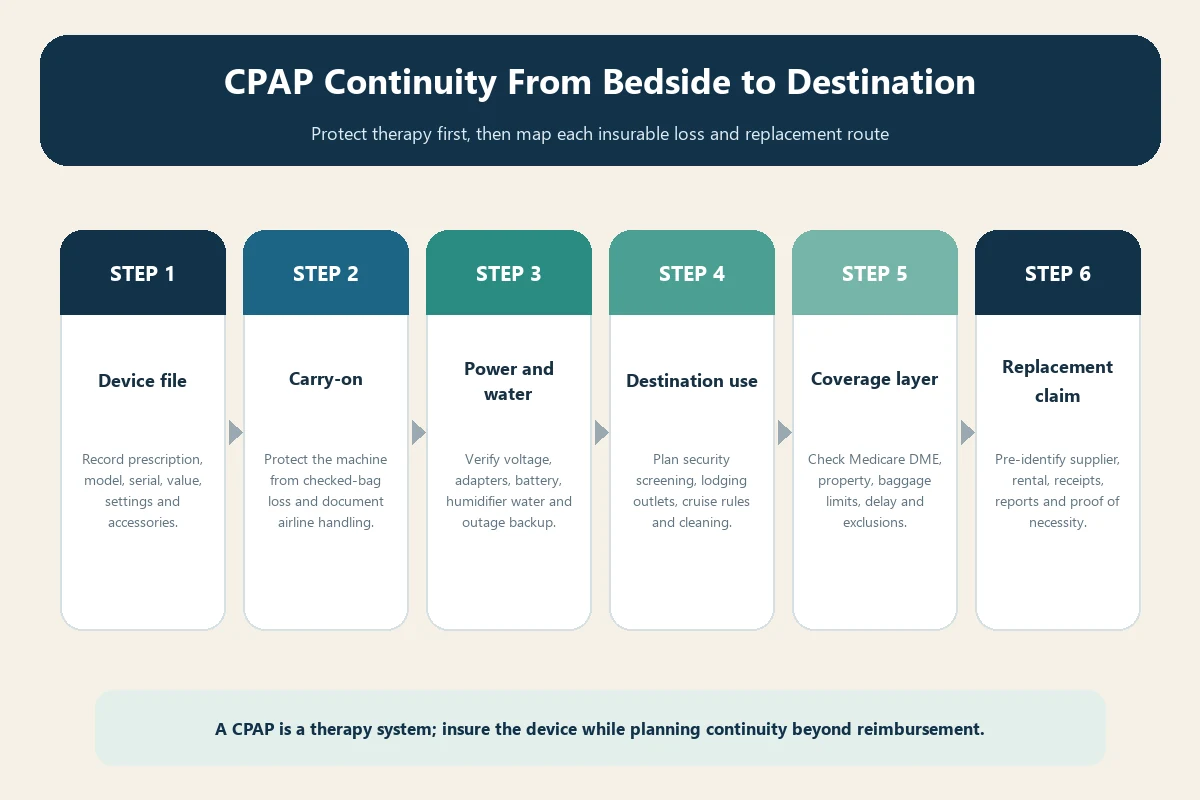
Clinical planning comes first
Ask the sleep clinician whether the traveler is stable, whether CPAP should be used during overnight flights or naps, and what to do if therapy is interrupted. The clinician should decide all settings, mode, pressure, oxygen integration, and medical documentation. Carry a medication and condition summary if other cardiac, pulmonary, or neurologic issues are relevant.
A travel insurance certificate cannot decide whether skipping a night is safe. Create the contingency with the clinical team before choosing a flight schedule or remote destination.
Identify the exact machine and accessories
Record the manufacturer, model, serial number, prescribed mode, power-supply input, battery model, mask, tubing, humidifier, filter, modem, and any oxygen connection. Photograph the equipment and labels. Keep the prescription, supplier agreement, purchase or rental proof, and replacement value.
A travel CPAP can differ from the home unit in humidification, data reporting, noise, battery use, pressure behavior, and accessories. Travelers coordinating several devices can also use our medical equipment and mobility-aid insurance guide. Do not substitute a compact device without clinical approval and proper setup.
Medicare CPAP coverage
Medicare Part B may cover a CPAP device and accessories as durable medical equipment when the beneficiary has obstructive sleep apnea and meets Medicare requirements. Medicare describes an initial trial period and continued coverage conditions, with the equipment supplied through an enrolled supplier.
That benefit does not automatically provide two machines. A second unit purchased for travel convenience can be treated differently from the prescribed covered device. Ask Medicare, the supplier, or the Medicare Advantage plan whether temporary travel, rental, repair, or replacement is covered and what documentation is required.
Medicare Advantage and supplier networks
A Medicare Advantage plan can use preferred suppliers, prior authorization, and network rules for DME. A worldwide emergency benefit does not necessarily include routine CPAP supplies or replacement abroad. Read the Evidence of Coverage for the current contract year.
Ask what happens if the device fails while traveling inside the United States, outside the service area, or internationally. Obtain the supplier’s after-hours number and identify where the plan can authorize a replacement.
Airline carry-on and assistive-device rules
In U.S. air travel, disability rules provide protections for assistive devices. A CPAP carried solely as an assistive device may receive different treatment from ordinary baggage, subject to size, safety, and stowage. International carriers and flights can have different procedures.
Contact each operating airline. Ask whether the device may be carried in addition to the standard allowance, whether it must be removed at security, and whether it can be used onboard. Keep medicine, mask, tubing, and power supply with the machine rather than in a separate checked bag.
Using CPAP onboard
Airline approval to carry the device does not necessarily mean permission to plug in or operate it. Ask about advance notice, medical forms, seating, outlet type, battery requirement, humidifier use, and use during taxi, takeoff, cruise, and landing.
Do not rely on aircraft power as the only source. Outlets can be absent, disabled, incompatible, or restricted. If a battery is allowed, confirm its type, watt-hour rating, terminal protection, carry-on rules, runtime at the prescribed settings, and required reserve.
Battery planning
Calculate the full sleep period plus airport, connection, diversion, ground transport, and outage contingencies. Heated humidification and heated tubing can materially affect power use. Use manufacturer specifications for the exact machine and battery rather than another traveler’s estimate.
Lithium batteries must meet airline and dangerous-goods requirements. Spare batteries generally require carry-on handling and protection from short circuit. Verify the current rule with the airline and FAA PackSafe guidance.
Voltage, frequency, and plugs
Read the power brick’s input label. Many modern units accept a range of voltages, but this must be confirmed for the exact model. A plug adapter changes the plug shape; it does not convert voltage or frequency. An unsuitable converter can damage the device or create a hazard.
Ask the manufacturer whether a surge protector, DC adapter, converter, or specific cord is permitted. Confirm power stability with the lodging, cruise line, campsite, or host. Keep cables accessible and do not create a tripping hazard.
Humidifier water
Follow the manufacturer’s water guidance. Distilled water can be difficult to find in some destinations and may be labeled differently. Ask the supplier what temporary alternative, if any, is safe for the exact humidifier. Do not use an unknown water source based on convenience.
Pack the chamber empty and dry as instructed. Leaking water can damage the machine and may complicate a baggage claim. Confirm whether distilled water can be obtained after security or carried under medical-liquid screening rules.
Filters, masks, tubing, and consumables
A small failed part can make the entire device unusable. Carry compatible spare cushions, filters, connectors, and tubing as clinically and practically appropriate. Check the mask fit before departure and avoid introducing an unfamiliar setup on the first night abroad.
Store consumables clean and dry. Bring the manufacturer and supplier contact information, and identify an authorized destination vendor. Counterfeit or incompatible accessories can affect therapy and warranty.
Trip length and compliance data
Some Medicare or insurer coverage arrangements use documented adherence to determine continued CPAP coverage. Ask the supplier whether travel, lack of cellular modem connection, time zones, or use of a separate device affects data transmission. Preserve SD-card or machine data according to supplier instructions.
A long trip also increases filter, cushion, water, and power needs. Use the senior long-trip guide to align supplies, policy dates, and delay buffers.
How travel insurance may classify a CPAP
The same device can fall under baggage, personal property, medical equipment, or a special exclusion. Review the definition, total baggage limit, per-item limit, depreciation, deductible, fragile-item rule, unattended-property exclusion, carrier-liability requirement, and proof of ownership.
A $1,000 baggage limit does not necessarily mean a $1,000 payment for one CPAP. Our baggage delay and lost luggage guide explains sublimits and documentation.
Loss or damage in transit
Report visible damage immediately to the airline, train, cruise line, hotel, or other carrier and obtain a written incident report. Photograph the case, machine, serial label, and damage. Keep the itinerary, bag tags, check receipts, repair estimate, and supplier diagnosis.
Do not operate a wet, cracked, overheated, or electrically damaged machine until the manufacturer or authorized supplier says it is safe. The medical contingency takes priority over the property claim.
Delayed baggage and CPAP supplies
Baggage-delay coverage may reimburse reasonable necessities after a defined delay, but it may not fund a replacement CPAP, and it cannot guarantee local inventory. Carry the treatment-critical system rather than placing essential parts in checked baggage when airline rules allow.
If an accessory is delayed, call the supplier and insurer. Save the carrier delay confirmation, purchase receipts, and explanation of why the item was necessary. A generic toiletries allowance may have a different limit from medical equipment.
Pre-existing-condition rules
Sleep apnea and CPAP use are known before purchase. A policy may exclude connected losses unless a pre-existing-condition waiver applies. The waiver has its own timing and eligibility conditions and does not create equipment coverage that the policy lacks.
Recent diagnosis, pressure change, new symptoms, mask intolerance, surgery, oxygen addition, or medication change can affect the analysis. Use our pre-existing-condition questions for seniors and ask the insurer to cite the controlling provision.
Medical emergencies are separate from device loss
If the traveler becomes ill because of a therapy interruption or an unrelated condition, emergency medical coverage follows its medical definitions, exclusions, and coordination. The broken-machine claim follows the property or equipment language. Submit distinct records even when the events are connected.
A foreign hospital may require payment. The travel medical direct-billing guide explains assistance, guarantees, and reimbursement. Do not delay urgent care to establish the property claim.
Trip cancellation and interruption
A device failure before departure is not automatically a covered cancellation reason. Ask whether a clinician must certify that the traveler cannot safely go and how equipment failure is treated. If the airline rejects a noncompliant battery or the traveler forgets a power supply, coverage may be absent.
After departure, interruption benefits may address eligible transport and unused arrangements when a covered medical event occurs. A desire to return for a familiar machine is not necessarily enough. Read the covered reason and medical-necessity language.
CPAP travel rehearsal
- Outlet failure: use the approved battery and contact lodging while preserving safe cabling.
- Flight cancellation: calculate another night of power, water, and supplies.
- Machine alarm: follow manufacturer troubleshooting and the clinician’s medical contingency.
- Mask breaks: use compatible spares or authorized supplier support.
- Device is damaged: stop unsafe operation, document the incident, and activate clinical and claim plans.
Document packet
- Prescription and clinician contact
- Machine model, serial number, settings record, and manual
- Supplier contract and after-hours support
- Proof of purchase or rental and replacement value
- Airline confirmation and medical forms
- Battery specifications and runtime plan
- Destination voltage and plug plan
- Spare consumables inventory
- Medicare, MA, and travel insurance documents
- Incident, repair, and claim contacts
Questions for the airline
- Is the CPAP treated as an assistive device on this operating flight?
- Can it be used onboard, and what advance notice is required?
- Is aircraft power permitted, or must the traveler use batteries?
- Which battery type, rating, packaging, and reserve are required?
- Can the humidifier be used?
- What stowage and seating restrictions apply?
- Do partner-airline rules differ?
Questions for the insurer
- Is the CPAP baggage, medical equipment, or excluded property?
- What total and per-item limits apply?
- Is depreciation used?
- What carrier report and repair estimate are required?
- Can delay coverage reimburse essential accessories?
- How do pre-existing-condition rules affect connected claims?
- Is emergency replacement arranged or reimbursed?
- What happens if device failure causes a medical event or interruption?
FAQ
Does Medicare pay for a travel CPAP?
Medicare may cover prescribed CPAP therapy under its DME rules, but a second compact unit for convenience is not automatically covered. Verify medical necessity and supplier rules.
Does a CPAP count as airline carry-on baggage?
It may receive assistive-device treatment under applicable disability rules, but size, contents, stowage, operating carrier, and international rules matter. Confirm before flying.
Will travel insurance replace a lost CPAP?
Only if the certificate covers the loss and its limits, depreciation, exclusions, and documentation allow payment. A per-item sublimit may be lower than replacement cost.
Can a CPAP be used on the plane?
Only with the airline’s approval and compliant power or battery arrangements. Carry permission does not automatically equal permission to operate it.
Bottom line
A CPAP travel plan is a continuity system. Confirm clinical needs, the exact machine, airline acceptance, power, batteries, water, consumables, and destination support. Then verify how Medicare and travel insurance treat purchase, repair, loss, delay, medical events, and interruption. Protect the therapy first and the claim second.
