
Travel insurance should not be assumed to replace an insulin pump, continuous glucose monitor, insulin, or sensors abroad. A senior traveler needs a clinician-approved backup therapy plan, lawful and temperature-safe insulin supply, spare compatible components, airport-screening instructions for the exact devices, and manufacturer support. Insurance may address a covered medical emergency, baggage or equipment loss, delay, cancellation, or interruption, but each benefit has separate limits and pre-existing-condition rules.
This article is educational, not medical, pharmacy, device, legal, aviation, or insurance advice. The diabetes care team, manufacturer, supplier, pharmacy, screening authority, carrier, and insurer should guide the exact plan. Never change insulin, settings, dosing, or device mode based on general travel content.
Key takeaways
- Carry a clinically approved backup plan for pump or CGM failure; insurance cannot create one during an emergency.
- Insulin, pumps, sensors, transmitters, receivers, phones, chargers, and testing supplies form one continuity system.
- Ask the manufacturer how the exact device should be screened; do not assume all pumps and CGMs tolerate the same equipment.
- Travel policies may classify a pump or CGM as medical equipment, baggage, personal property, or an excluded device.
- Diabetes and device use are known before purchase, so connected claims require careful pre-existing-condition review.
Reviewed: August 16, 2026.
Build the clinical backup before the itinerary
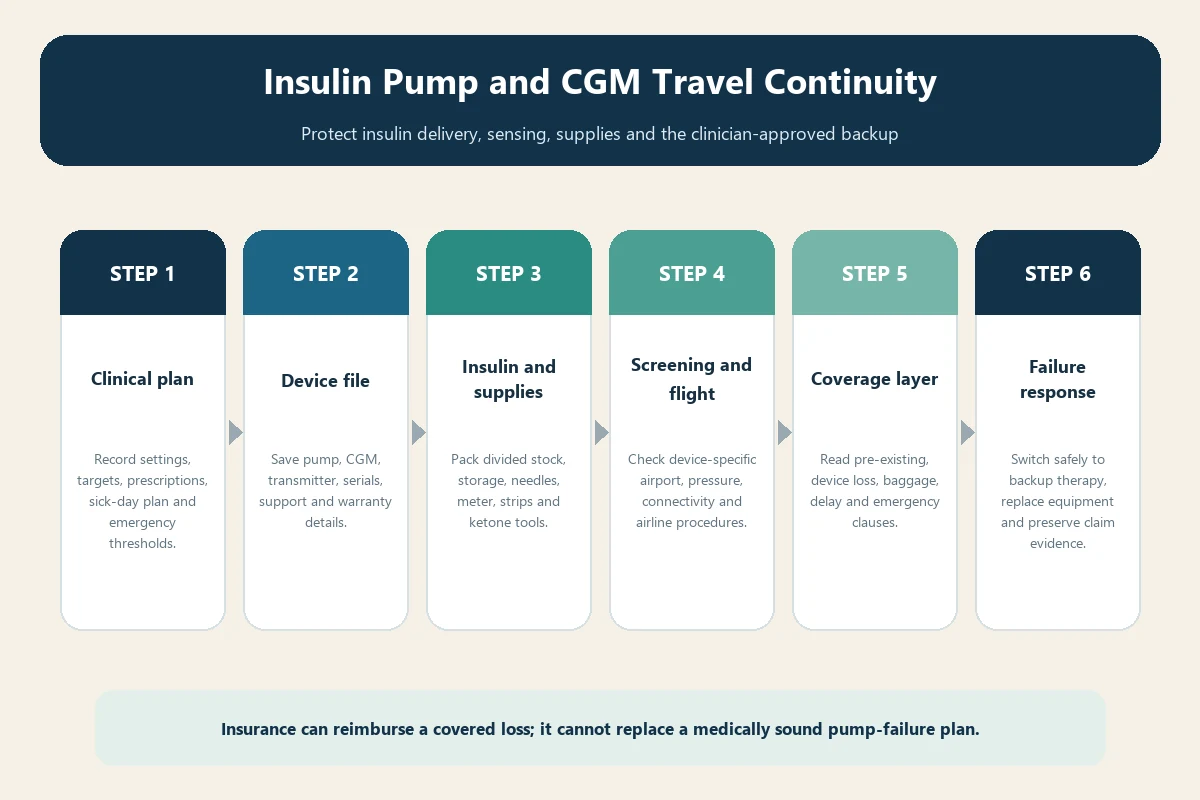
Ask the diabetes care team whether the traveler is stable for the route and how to respond if the pump, CGM, receiver, or phone stops working. The plan should identify backup monitoring, backup insulin delivery, dosing instructions, emergency thresholds, ketone testing when applicable, and who can provide urgent clinical advice.
Travel insurance staff cannot prescribe a replacement regimen. Keep the clinical plan accessible on paper and securely online, along with diagnoses, medicines, allergies, devices, prescriber contacts, and emergency information.
Inventory the complete diabetes system
A pump body alone is not a functioning system. List infusion sets or pods, reservoirs, insertion devices, adhesive, batteries or charger, cables, insulin, syringes or pens for the clinician-directed backup, glucose meter, strips, lancets, CGM sensors, transmitter, receiver or phone, alcohol supplies, sharps plan, and glucagon or other emergency medicine as prescribed.
Record manufacturer, model, serial number, lot numbers where useful, prescription, supplier, replacement value, and support number. Photograph labels and equipment. Our travel medical insurance for diabetes guide covers the broader condition and emergency framework.
Carry more than the scheduled quantity
Count supplies for the full door-to-door trip and add a clinician-approved disruption buffer for cancellations, lost connections, damaged sets, sensor failures, or an extended stay. Stay within prescription and destination-law limits. Do not split essential components so widely that neither bag contains a usable system.
Keep treatment-critical supplies accessible rather than relying on checked baggage. A baggage claim does not restore insulin delivery during the delay.
Insulin temperature and physical protection
Follow the manufacturer and pharmacist instructions for the exact insulin before opening and while in use. Freezing, excessive heat, direct contact with ice, sunlight, a hot vehicle, or an unmonitored hotel minibar can damage insulin. Appearance alone may not reveal a temperature excursion.
Use an appropriate travel container and monitor conditions when required. If exposure occurs, obtain qualified guidance before using the insulin. Our prescription medication travel guide helps organize labels, storage, and legal transport.
Airport screening is device-specific
TSA provides procedures for travelers with diabetes supplies and medical devices, but the device manufacturer determines which screening technologies the exact pump or CGM can tolerate. Some manufacturers warn against particular X-ray or body-scanner exposures. Policies and equipment can change.
Tell the screening officer about the device and request an available alternative if the manufacturer requires it. Carry the device information card and allow extra time. An airport agent’s general assurance should not override written manufacturer instructions.
International screening and transit countries
TSA rules apply at U.S. checkpoints. A return airport or transit country may use different procedures and terminology. Obtain translated medical documentation if useful, contact the airport or airline disability service, and check the destination’s rules for insulin, needles, sensors, batteries, and controlled medicines.
Do not remove pharmacy labels merely to reduce luggage. Keep sharps safely packaged and identify disposal options.
Time zones, meals, and device clocks
Crossing time zones can change meal timing, basal delivery, automated-system data, reminders, and the displayed date. The appropriate adjustment depends on the therapy and traveler. Obtain a written schedule from the diabetes team and confirm whether device, receiver, and phone clocks update automatically.
Do not change the device clock or dosing plan by intuition. Airlines, cruises, and phones may use different time zones during the same day.
Phones, apps, roaming, and pairing
Some CGM and pump systems depend on a compatible phone, Bluetooth, app version, account login, regional software availability, or cloud connection. Offline readings may continue differently from remote sharing. A replacement phone bought abroad may not support the same app or region.
Before travel, update only as the manufacturer recommends, test offline behavior, save support contacts, protect account credentials, and identify whether the dedicated receiver should travel as backup. Do not assume hotel Wi-Fi is secure or reliable.
Battery and charging plan
Map power for flights, transfers, remote days, outages, and an unexpected extension. Confirm charger voltage, plug type, approved power bank, lithium-battery airline rules, and whether heated or cold conditions affect runtime. A plug adapter does not convert voltage.
Keep cables, batteries, and the device together. Ask the manufacturer which third-party chargers or power banks are safe. A cheap incompatible cable can create both therapy and property risk.
Medicare coverage questions
Medicare can cover certain diabetes equipment, supplies, and insulin under Part B or Part D depending on the device and circumstances. Coverage, supplier enrollment, prescription, and utilization rules apply. A covered home system does not automatically mean Medicare pays for a second travel device, foreign replacement, or sensor bought abroad.
Ask whether the pump and insulin are covered under Part B or Part D, which supplier must be used, what quantity can be dispensed, and what happens during domestic or international travel. Medicare Advantage plans may use networks and authorization.
Part D abroad
Medicare states that drug plans generally do not cover prescriptions purchased outside the United States. A foreign insulin purchase or replacement should be treated as a likely personal expense unless the exact plan provides written guidance otherwise.
Request a vacation override or extended supply early. The chronic medication travel guide helps align refill dates with a long itinerary.
Pre-existing-condition rules
Diabetes, insulin, pump, and CGM use are known before the policy is purchased. A travel plan may exclude losses connected to a pre-existing condition unless a waiver applies. A waiver typically has purchase timing and other eligibility requirements and removes only the exclusion for otherwise covered losses.
Recent hypoglycemia, hyperglycemia, hospitalization, medication change, pump start, setting change, sensor issue, or diagnostic test can matter under the policy’s look-back language. Use our senior pre-existing-condition questions.
Device loss and baggage coverage
A pump or CGM may be classified as medical equipment, baggage, electronics, or excluded property. Review the total baggage maximum, per-item and electronics sublimits, depreciation, fragile-item exclusion, unattended-property rule, carrier-liability requirement, and proof of ownership.
A baggage limit can be far below the replacement cost of the entire system. Keep serial numbers, receipts, supplier contracts, prescriptions, photos, and manufacturer replacement procedures. The baggage delay and loss guide explains sublimits.
Manufacturer loaner or replacement programs
Some manufacturers may offer travel loaners or replacement support under defined conditions and locations. Availability is not insurance and may exclude consumables, shipping, customs, or remote destinations. Confirm the program for the exact device, country, travel dates, and warranty.
Record what happens if the pump fails on a weekend, cruise, island, or long flight. A support number that can troubleshoot does not guarantee delivery.
Emergency medical care versus property loss
A failed pump can lead to a medical event, but the claims remain distinct. The emergency medical benefit evaluates the illness and treatment. Baggage or equipment coverage evaluates the device loss. Trip interruption evaluates additional travel. Submit the evidence each provision requires.
Seek urgent care according to the clinical plan without waiting for claim approval. Contact assistance as soon as reasonably possible and save glucose records, device logs, clinician notes, itemized bills, proof of payment, and incident reports.
Direct billing and replacement cash flow
A foreign hospital, pharmacy, or device supplier may require immediate payment. An assistance vendor may refer the traveler without guaranteeing the charge. Ask whether the insurer can arrange direct payment for covered emergency care and whether device replacement is reimbursement-only.
Use the direct-billing guide to distinguish referral, guarantee, and claim payment.
Five-event rehearsal
- Pump fails before boarding: activate the clinician-approved backup and manufacturer process.
- Sensor fails during a connection: use approved backup monitoring and document the failure.
- Insulin overheats: isolate it and obtain pharmacist or manufacturer guidance.
- Supply bag is delayed: use carried reserves and obtain the carrier report.
- Medical event abroad: seek care, contact assistance, and separate medical, device, and trip claims.
Questions for the insurer
- How are diabetes and device use treated under pre-existing-condition terms?
- Is a waiver available, and what purchase requirements apply?
- Are the pump, CGM, receiver, and supplies covered property?
- What per-item, electronics, medical-equipment, and depreciation limits apply?
- Can baggage delay reimburse essential supplies?
- Does emergency medical coverage include a complication connected to diabetes?
- Is routine insulin or planned device replacement excluded?
- Can assistance locate and pay a qualified provider?
- What incident, medical, device, and payment records are required?
FAQ
Will travel insurance replace an insulin pump abroad?
Do not assume so. Device classification, cause of loss, per-item limits, exclusions, and location determine whether any property benefit applies.
Can a CGM or pump go through airport screening?
Follow the exact manufacturer’s screening instructions and tell security staff. Different devices may have different restrictions.
Does Medicare cover insulin bought overseas?
Medicare drug plans generally do not cover prescriptions purchased outside the United States. Arrange the permitted U.S. supply before departure.
Does a pre-existing-condition waiver cover pump failure?
It only removes a specified exclusion for otherwise covered losses. It does not create equipment or routine-treatment coverage absent from the policy.
Bottom line
An insulin pump and CGM trip plan is a therapy-continuity system. Secure the clinician-approved backup, insulin storage, supplies, screening method, power, connectivity, and manufacturer support first. Then verify how the travel policy treats medical emergencies, device loss, delay, interruption, and pre-existing conditions.
