

Europe travel insurance for guided tours should be built from the tour contract, payment schedule and catch-up cost—not from the package price alone. Record which deposits become nonrefundable, who supplies each service, what happens if a traveler misses the group departure, and whether the policy addresses supplier default, single supplements and included activities.
Key takeaways
- Insure eligible nonrefundable exposure, not every number on the invoice.
- The first tour deposit can start time-sensitive insurance deadlines.
- Missed-departure and catch-up coverage must fit the tour’s actual transport.
- Supplier default and tour-operator insolvency are not universal benefits.
- Single-supplement, activity and accessibility risks require explicit wording.
Start with the contract map
An escorted tour can look like one purchase while containing several contracts. The tour operator may bundle hotels, coach transport, guides and admissions. Airfare may be sold by the same company, arranged by an agency or booked independently. Optional excursions may be purchased from local suppliers later.
Create a contract map with one row for each component:
| Component | Contracting party | Refund rule | Insurance question |
|---|---|---|---|
| Land tour | Tour operator | Deposit and cancellation schedule | Eligible trip cost and covered cancellation reasons |
| Airfare | Airline, operator or agency | Fare rule and credits | Delay, missed departure and interruption |
| Pre-tour hotel | Hotel or operator | Rate-specific | Included trip date and nonrefundable exposure |
| Optional excursion | Operator or local vendor | Separate deadline | Activity eligibility and later cost update |
| Single supplement | Tour operator | Contract-specific | Whether a listed benefit addresses the added charge |
Save the current terms and conditions before paying. The Federal Trade Commission’s travel-scam guidance advises consumers to obtain cancellation and refund policies before payment, research the travel company and avoid payment methods that remove practical recourse.
Calculate the insured tour cost correctly
The tour’s total invoice is not automatically the amount to insure for trip cancellation. Build the figure from amounts that are prepaid, eligible under the certificate and nonrefundable if a covered cancellation occurs.
Include each component only after answering:
- Has it been paid or is payment contractually due?
- What would the supplier refund on the cancellation date?
- Would the supplier issue a transferable or nontransferable credit?
- Does the policy treat that credit as a recoverable value?
- Were points, miles or vouchers used, and what redeposit fees apply?
- Is the insurance premium itself refundable or insurable?
Keep a dated cost sheet and revise it as the cancellation penalty increases or optional services are added. Do not simply insure the tour brochure price. The Europe trip insurance purchase checklist provides the source-of-truth fields for travelers, dates, countries and costs.
The NAIC travel insurance guide notes that every policy sets its own limits and covered or excluded situations. For a guided tour, that makes the issued certificate more useful than the operator’s general recommendation or the name of a protection plan.
The deposit date can change eligibility
The first payment toward the trip can start deadlines for a pre-existing condition exclusion waiver, Cancel For Any Reason and other time-sensitive features. A small registration deposit can matter even when the final balance is months away.
Record:
- the date and amount of the first tour payment;
- any earlier nonrefundable flight or hotel payment;
- the policy’s definition of initial trip deposit;
- the purchase deadline for each desired feature;
- rules for insuring later payments; and
- whether all eligible nonrefundable cost must be insured.
Deadlines vary by policy and state. Use the Europe travel insurance timing guide rather than relying on a universal number of days.
Trip cancellation protects listed reasons, not a change of mind
Standard trip cancellation responds only when the event fits a covered reason and every condition is satisfied. A covered illness may qualify; discomfort with the itinerary, a changed preference or a companion deciding not to travel usually does not unless specific wording says otherwise.
Compare the tour contract’s cancellation penalty schedule with the policy’s reasons and maximum. A claim is limited by the eligible loss after refunds and credits, not by the amount the traveler hoped to recover.
The guide to what trip cancellation insurance covers explains how covered reason, effective date, documentation and recoverable value work together.
When CFAR is relevant
Cancel For Any Reason can add flexibility for reasons outside the standard list, but it has its own purchase window, insured-cost conditions, cancellation deadline and reimbursement percentage. It is not a substitute for medical coverage and does not erase every exclusion.
For an expensive tour with a steep penalty schedule, model the maximum unreimbursed remainder before buying. The CFAR guide shows how to compare the added premium with the portion of trip cost that would still remain at risk.
Missed tour departure and catch-up transport
A guided tour often leaves at a fixed time. Missing the first coach, train, ferry or ship can create three losses:
- extra lodging and meals while delayed;
- transport to catch the group at a later stop; and
- unused tour services before rejoining.
Those costs can fall under trip delay, missed connection or interruption, depending on the policy. Confirm:
- which incoming transport qualifies as a common carrier;
- the minimum delay and covered causes;
- whether joining a land tour counts as a protected connection;
- the maximum catch-up transport benefit;
- whether independent air arrangements are eligible; and
- who must approve the replacement route.
Arrival buffers are risk control, not an insurance benefit. If the tour starts in the morning, arriving in the gateway city the previous day can remove a fragile same-day connection. Use the missed-connection coverage guide to test the clause.
Supplier default and insolvency need their own test
A tour operator canceling for business reasons is not automatically the traveler’s covered trip cancellation. Some policies include financial default or insolvency under defined conditions; others exclude it or apply waiting periods, supplier-eligibility rules and restrictions based on where the policy was purchased.
Ask the insurer in writing:
- Is financial default or insolvency a covered event?
- Which entity must fail: operator, airline, hotel or other supplier?
- Is the travel agency treated as the supplier?
- Does the provider have to appear on an eligibility list?
- Is there a waiting period after policy purchase?
- Is a supplier connected to the policy seller excluded?
- What refunds, bonds or credit-card remedies must be pursued first?
If the booking qualifies as a package under applicable EU rules, separate consumer protections may exist. The official Your Europe package-travel guide describes pre-contract information, organizer responsibility and insolvency protection for qualifying packages. A US-sold tour is not automatically covered by that EU framework, so identify the contracting entity and governing terms.
Single supplements and roommate changes
A solo traveler may pay a single supplement from the start. A shared-room traveler can face a new supplement if the roommate cancels. Whether insurance covers that added charge depends on explicit benefit wording, the roommate’s cancellation reason and the policy’s definition of traveling companion.
Do not add a hypothetical future supplement to insured trip cost without confirmation. Instead, obtain the tour operator’s roommate-cancellation terms and ask the insurer whether a single-supplement benefit exists, what triggers it and what limit applies.
Activities, pace and accessibility
A guided itinerary can include walking tours, cycling, boating, cable cars, mountain excursions or food and wine activities. The tour operator accepting a booking does not prove that the travel policy covers every activity.
List included and optional activities, then check the policy’s activity schedule. Pay attention to altitude, winter sports, e-bikes, helmets, alcohol-related incidents and excursions supplied by third parties. The adventure and winter-sports exclusions guide provides a structured review.
For mobility or health needs, obtain the operator’s written description of walking distance, stairs, luggage handling, coach access and assistance. Travel insurance can address a covered medical event; it does not guarantee that the tour is accessible or suitable.
Medical care while separated from the group
A tour director can help contact local services, but the tour is not a health plan or evacuation service. Save the insurer’s assistance number independently and make sure a companion can find it.
The CDC Yellow Book recommends reviewing domestic health coverage, matching supplemental insurance to itinerary and health risks, and preparing for providers abroad to require payment before reimbursement. Confirm medical, evacuation, preauthorization and pre-existing condition terms before the final tour payment.
If the route crosses several countries, complete the multi-country Europe insurance worksheet so that every transit, optional side trip and extension is included.
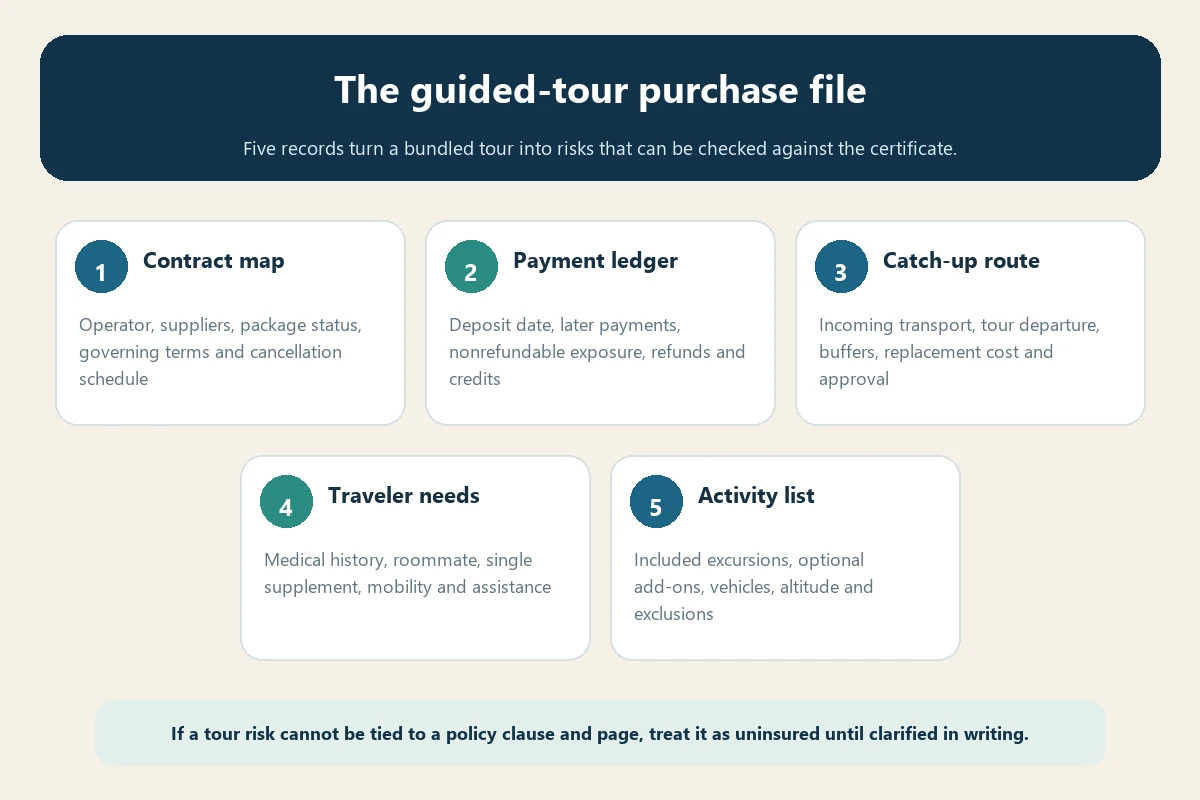
Build the guided-tour purchase file
- Tour brochure and full terms captured on the booking date.
- Invoice separating deposit, balance, air, supplement and add-ons.
- Cancellation penalty schedule and refund or credit rules.
- Supplier list and governing contracting entity.
- Day-by-day itinerary with transport and activities.
- Independent air and pre-tour accommodation details.
- Policy certificate, schedule and state endorsements.
- Written insurer answers about catch-up, default and supplements.
Use the Europe policy comparison worksheet to record each answer with a certificate page. A marketing phrase such as “tour protection” is not a substitute for contract language.
Claim documents after a disrupted tour
Notify the tour operator and insurer promptly. Save the original itinerary, revised itinerary, operator incident report, proof of the covered event, refund statement and itemized replacement costs. If joining the group later, ask the operator to confirm which services were unused and what portion was refundable.
Separate:
- amount paid;
- amount refunded or credited;
- unused nonrefundable tour value;
- extra catch-up transport;
- extra lodging and meals; and
- amount requested under each benefit.
This prevents the same cost from being submitted as cancellation, delay and interruption. The benefit-classification guide helps route each loss to the correct clause.
A guided-tour insurance checklist
- □ Contracting operator and every supplier identified.
- □ First trip-payment date and all deadlines recorded.
- □ Eligible nonrefundable cost separated from refunds and credits.
- □ Independent flights and pre-tour nights included in the itinerary.
- □ Catch-up transport and missed-tour-departure wording checked.
- □ Supplier-default conditions verified from the certificate.
- □ Single-supplement and roommate-change rules documented.
- □ Included and optional activities checked for exclusions.
- □ Medical, evacuation and assistance terms fit every country.
- □ Tour terms, policy and written answers saved offline.
Frequently asked questions
Should I insure the full price of a guided tour?
Insure the eligible prepaid nonrefundable amount required by the policy, not automatically the brochure total. Subtract refunds and recoverable credits according to the certificate and update later payments as required.
Does travel insurance cover missing the tour’s first day?
It may cover eligible catch-up and delay costs if the incoming transport, cause and waiting period satisfy the applicable benefit. The policy must protect the kind of tour departure and connection actually booked.
Will insurance pay if the tour company fails?
Only if the certificate includes a matching financial-default or insolvency event and all supplier, purchase-date and waiting-period conditions are met. Operator bonds, package protections and card remedies may also affect the net loss.
Can insurance pay a single supplement after my roommate cancels?
Some policies have a specific benefit, but it is not universal. Check the roommate’s qualifying reason, the definition of traveling companion, the added charge and the benefit limit.
Traveling without a daily guide? The self-guided Europe tour insurance guide covers prepaid stages, independent navigation, luggage transfers and route interruption.
Adding cooking classes, tastings or food-and-wine experiences? The Europe culinary-tour insurance guide separates package remedies, stand-alone bookings, transport, alcohol clauses, rental cars and medical cover.
A tour leader coordinates the itinerary, but the booking contract and insurance certificate still assign different responsibilities. Use the senior group-tour travel insurance contract stack to verify protection type, trip costs, age, prior conditions, accessibility, single supplements, medical response and claim evidence.
