
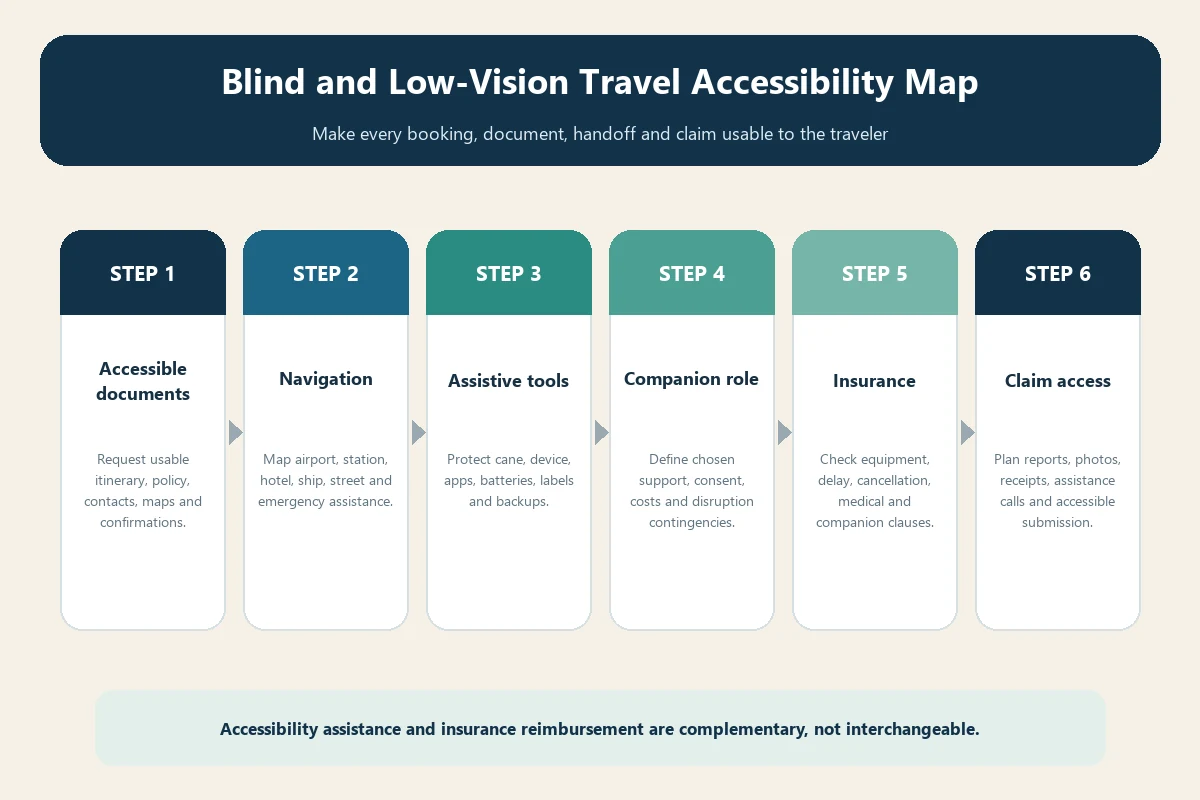
Travel insurance for seniors who are blind or have low vision uses the same core benefits, but accessibility changes how the traveler uses documents, navigates disruptions, protects assistive equipment, communicates with providers, and files a claim. Arrange airport, rail, cruise, tour, and lodging assistance in advance; demand accessible policy materials; document canes and electronic aids; and verify companion, delay, baggage, emergency medical, and evacuation provisions.
This article is educational, not medical, rehabilitation, disability-rights, legal, aviation, or insurance advice. Accessibility rights and services vary by carrier, country, and setting. The traveler should consult qualified mobility, vision, legal, and medical professionals for the exact trip.
Key takeaways
- Ask for the policy, certificate, claim form, and assistance instructions in a format the traveler can use independently.
- Disability assistance is an operational service; insurance reimbursement is a separate contract.
- White canes, magnifiers, accessible phones, braille devices, and other tools need serial numbers, value, and backup plans.
- A companion’s ordinary costs are not automatically covered.
- Rehearse an inaccessible gate change, lost device, hotel relocation, medical emergency, and evacuation.
Reviewed: August 16, 2026.
Start with accessible insurance documents
A policy is not useful if the traveler cannot read or navigate it. Ask the insurer for an accessible HTML, tagged PDF, large-print, braille, or audio option as appropriate. Test headings, tables, links, forms, signature, and screen-reader flow before purchase.
Request the certificate, definitions, exclusions, declarations, assistance numbers, claim forms, privacy notices, and appeal instructions. A sales page is not the contract.
Accessible quote and purchase process
Confirm that the traveler can compare benefits, enter information, review answers, authorize payment, and save records without relying on an untrusted third party. If an agent assists, ask for a written transcript or confirmation of every answer.
Record the policy number, purchase date, initial trip payment, covered travelers, trip cost, and emergency contact in an accessible offline format.
Airport and airline assistance
U.S. disability rules provide assistance for blind and low-vision passengers. Request help with check-in, security, navigating the terminal, boarding, connections, baggage, and arrival as needed. Confirm each operating carrier, not only the ticket seller.
Ask where the escort meets the traveler and whether handoffs occur at connections. Assistance can guide navigation but usually does not provide continuous personal care or medication management.
Rail, bus, cruise, and tour assistance
Contact each operator about boarding, platforms, announcements, seating, cabin orientation, tenders, excursions, and emergency procedures. Ask how itinerary changes are communicated accessibly and who assists during a disruption.
A tour described as accessible may still depend on visual signage, uneven paths, self-guided navigation, or inaccessible apps. Request the actual process.
Accessible lodging
Confirm room layout, lighting, tactile or audible alarms, elevator controls, signage, key system, bathroom, stairs, and emergency route. Request an orientation at check-in and ask how a fire or evacuation alert reaches the traveler.
Keep the hotel address, room, and front-desk number in accessible form. A hotel’s failure to provide a requested feature is not automatically a covered insurance event.
White cane and mobility tools
Keep essential orientation tools with the traveler. Record the cane model, length, folding or rigid design, tip, and replacement source. Carry a spare tip or backup cane when practical.
Our mobility-aid insurance guide explains carrier handling, equipment records, and baggage limits. A mobility tool can receive disability handling while the travel policy separately applies property sublimits.
Electronic assistive devices
Electronic magnifiers, braille displays, smart glasses, accessible phones, GPS devices, and portable scanners can be expensive. Document manufacturer, model, serial number, ownership, replacement cost, battery, charger, and data backup.
Review the travel policy’s electronics and per-item limits, depreciation, unattended-property exclusion, and theft-report requirement. A general baggage maximum can be much higher than the sublimit for one device.
Prescription glasses and hearing overlap
Low-vision travelers may still rely on prescription glasses, sunglasses, filters, or contact supplies. These can have special exclusions or low limits. Carry a spare and prescription when useful.
A traveler with combined hearing and vision loss can use our hearing-aid insurance guide to plan redundant communication.
Phones, apps, and offline access
Airline apps, maps, hotel keys, menus, ride-hailing, and claim portals may not be accessible or may fail offline. Download accessible documents, keep battery power, and create a non-phone backup for critical addresses and contacts.
Ask the insurer whether the claim portal works with assistive technology and whether telephone or mail submission is available. Accessibility should be tested before an emergency.
Medication and labels
Use accessible medication labels, tactile markers, audio tools, or another clinician-approved system. Carry the medicine list with generic name, strength, schedule, indication, prescriber, and allergy. A companion should not reorganize pills without a safe verification process.
The chronic medication guide covers supply, storage, and foreign replacement.
Traveling with a companion
A sighted guide or companion can assist navigation and communication, but the policy may not cover routine companion airfare, room, or caregiving. If the companion becomes ill, cancellation depends on whether that person fits a defined covered relationship and event.
Emergency companion benefits may require hospitalization or evacuation. Ask about bedside travel, companion return, and extra lodging. Our travel companion evacuation guide explains those clauses.
Traveling independently
An independent blind traveler should create accessible check-ins, route sharing, emergency contacts, and a disruption script. Confirm the destination’s emergency number and how to describe the current location.
Carry consent and privacy authorization only as needed. Independence and backup planning can coexist.
Pre-existing-condition questions
Blindness or low vision may be stable, progressive, or related to diabetes, stroke, glaucoma, macular degeneration, or another condition. The underlying diagnosis, recent treatment, symptoms, or surgery can matter under the pre-existing-condition rules.
Answer the application accurately. A waiver removes an exclusion only for otherwise covered losses. Use the pre-existing-condition questions for seniors.
Baggage loss or damage
Report theft, damage, or carrier loss immediately and obtain a written report. Keep photos, serial numbers, receipts, repair estimates, and proof of replacement. Separate essential tools from checked baggage.
The baggage delay and lost luggage guide explains per-item and delay triggers.
Trip delay and inaccessible rebooking
A disruption can move the traveler to an unfamiliar terminal, inaccessible hotel, or late-night ground transfer. Insurance may reimburse eligible delay expenses only after a specified trigger. The carrier’s disability obligations and the policy payment are separate.
Ask the airline for accessible assistance immediately, save the delay notice and receipts, and record any denied service.
Emergency medical care
A foreign provider may use inaccessible forms, visual signage, or unfamiliar consent procedures. Carry a communication preference card and request a qualified interpreter or accessible information as available. A companion should support informed communication without substituting for the traveler automatically.
A travel medical policy covers only eligible treatment under its terms. The direct-billing guide explains hospital payment and assistance.
Trip cancellation and interruption
Cancellation and interruption require a listed covered reason unless another benefit applies. An inaccessible supplier or lost aid is not automatically covered. Ask whether equipment loss, companion illness, or a new medical change qualifies.
Use flexible bookings for accessibility features that are essential but not insured. Keep supplier refunds and credits.
Medical evacuation
Evacuation may be authorized when local care is inadequate. The endpoint is often the nearest appropriate facility. Confirm whether a companion, guide, mobility device, or assistive technology can travel with the patient and how accessible communication continues.
Use the evacuation approval guide.
Five-scenario rehearsal
- Gate changes without accessible alert: contact the airline escort and preserve service records.
- Electronic magnifier is stolen: file the police report and activate the backup.
- Hotel relocates the traveler: verify accessible transport and room before moving.
- Companion becomes ill: use independent navigation or the backup support plan.
- Medical emergency: use the accessible medical summary and assistance contacts.
Run an accessible claim drill
Before departure, open the insurer’s assistance page and claim form with the traveler’s own device and settings. Confirm that phone menus, verification codes, document uploads, signatures, and status messages are usable. Save the international assistance number, policy number, and claim deadline offline in the preferred format.
Choose how receipts, photographs, carrier reports, and medical records will be labeled without relying only on visual thumbnails. If a companion helps, define what they may submit and how the traveler reviews it. Ask the insurer for an alternative channel before an inaccessible portal becomes a deadline problem. Record the accessibility accommodation request and the representative’s response.
Questions for the insurer
- Can all policy and claim materials be provided accessibly?
- How are blindness, low vision, and the underlying diagnosis treated under pre-existing-condition rules?
- What per-item limits apply to assistive electronics and canes?
- Does baggage delay cover temporary assistive equipment?
- What if the essential companion becomes ill?
- Are accessible rebooking costs eligible after a covered delay?
- Can assistance communicate in an accessible channel?
- What companion and evacuation benefits apply?
- How can a claim be submitted without an inaccessible portal?
FAQ
Does blindness make travel insurance more expensive?
Pricing and eligibility vary by insurer and may focus on age, trip, medical history, and benefits. The underlying condition can be relevant.
Does travel insurance cover a white cane?
Possibly under baggage or equipment provisions, subject to cause, limits, exclusions, and documentation. Confirm the classification.
Will the airline provide a guide?
Airlines provide disability assistance under applicable rules, but the exact service and international procedure should be requested and confirmed.
Does insurance pay for a companion?
Routine companion costs usually are not covered unless explicit language applies. Emergency companion benefits can require hospitalization or evacuation.
Bottom line
Travel insurance for blind and low-vision seniors begins with accessible information and operational independence. Confirm assistance, lodging, navigation, devices, medication, and companion backup. Then test baggage, delay, cancellation, medical, interruption, and evacuation provisions in accessible form.
Sources
- APH ConnectCenter — International Travel If Blind or Low Vision
- U.S. Department of Transportation — Passengers With Disabilities
- TSA — Special Procedures
- Medicare — Coverage Outside the United States
- U.S. Department of State — Travelers With Disabilities
- U.S. Department of State — Insurance Coverage Overseas
