

Travel insurance age limits are not one maximum number. A plan can have a minimum enrollment age, maximum entry age, different renewal age, age-rated premium, lower medical maximum after a birthday, separate pre-existing-condition limit, shorter trip duration, or a benefit unavailable above a threshold. A page that says “no age limit” may address enrollment while leaving every other rule unchanged.
This U.S. buyer guide shows where to find each age rule before comparing quotes. It is educational, not insurance, medical, legal, financial, or Medicare advice. Availability and terms vary by product, state of residence, destination, trip length, purchase date, and issued certificate.
Key takeaways
- Separate eligibility, renewal, pricing, trip duration, and benefit limits.
- Confirm the date on which the contract measures each traveler’s age.
- Inspect age-banded medical and evacuation maximums, not only the headline plan maximum.
- Annual plans can have stricter age or per-trip duration rules than single-trip plans.
- Medicare’s limited foreign coverage makes the medical section especially important for U.S. travelers age 65 and older.
Reviewed August 16, 2026. “Age,” “eligible person,” “effective date,” “maximum limit,” “renewal,” “period of coverage,” “pre-existing condition,” and “acute onset” are contract-specific terms.
There are at least eight kinds of age limit
| Rule | What it controls | Where to verify |
|---|---|---|
| Minimum age | Independent applicant or dependent eligibility | Eligibility and definitions |
| Maximum entry age | Whether a new applicant can enroll | Eligibility or application |
| Renewal age | Whether an existing plan can continue | Renewal and termination |
| Age-rated price | Premium for the traveler or age band | Quote and rate filing |
| Medical maximum | Ceiling for eligible treatment | Schedule of benefits |
| Benefit sublimit | Evacuation, pre-existing conditions, or another benefit | Schedule and benefit clause |
| Trip duration | Maximum insured days per trip or policy | Period of coverage |
| Dependent age | When a child needs separate enrollment | Definitions and family eligibility |
The senior travel-insurance age-band guide explains how availability changes as travelers get older. This article is the document audit: it treats every limit as a separate field that must be copied from the issued plan.
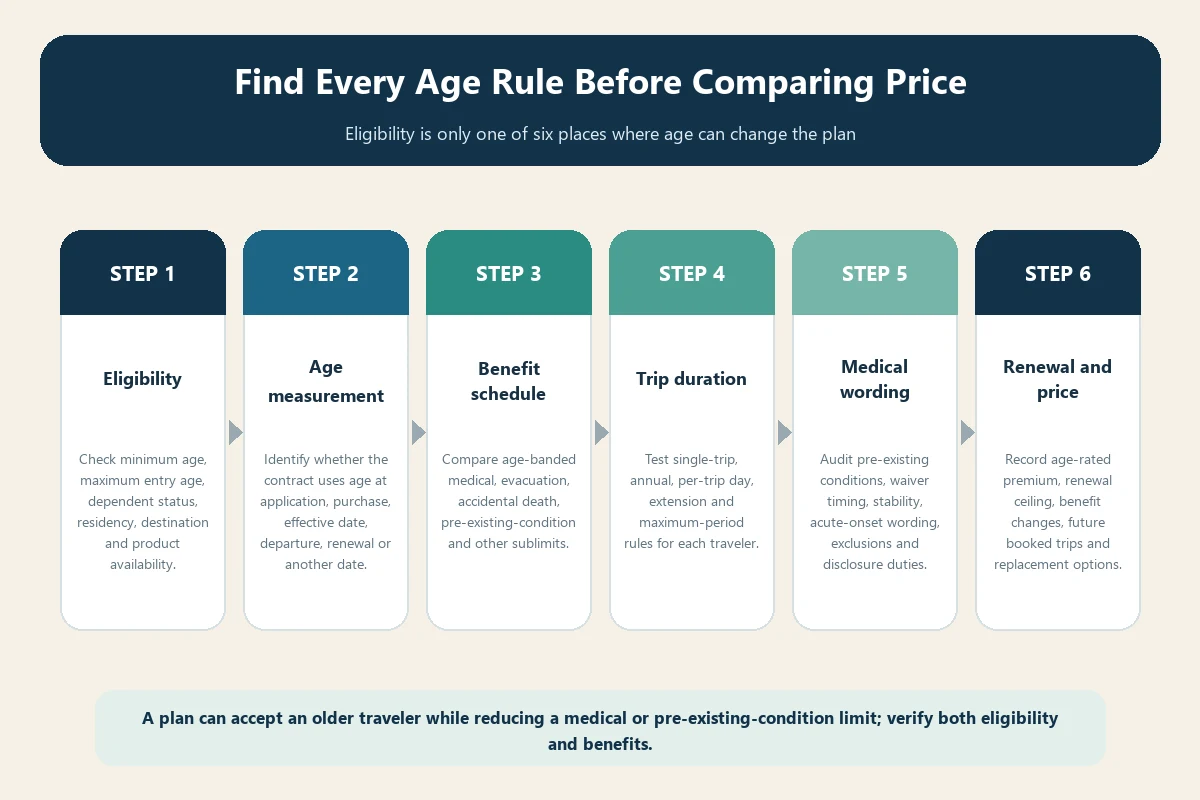
Start with the age measurement date
A traveler can be 69 on the purchase date, 70 on departure, and 71 at renewal. Ask which date the application and certificate use for eligibility, premium, and benefits. Do not assume one date controls all three. Save the quote input, date of birth, purchase confirmation, effective date, scheduled departure, and renewal date.
If a birthday falls between purchase and travel, obtain a written answer before buying. Enter the actual date of birth, not an age rounded for convenience. A mismatch can change the quoted band or create an inaccurate application.
Check eligibility before comparing benefits
Read the eligible-person definition, residency, citizenship, home-country, destination, trip-purpose, and maximum-period rules. A plan may accept U.S. residents traveling abroad but not visitors entering the United States, or the reverse. Another may limit enrollment at a certain age while a different product from the same company continues to quote.
Record whether the rule applies at application, effective date, or throughout the period of coverage. Also check spouses and dependents separately. A family quote does not prove that each person has identical benefits.
“No upper age limit” is an incomplete comparison
A plan can admit a traveler at age 80 or 90 while offering lower medical, evacuation, accidental-death, or pre-existing-condition benefits. Conversely, a plan with a maximum enrollment age can provide stronger limits below that threshold. Compare the plan actually available to each traveler, not a marketing claim about the company.
Build a row for each person and copy the exact plan name, form number, plan maximum, deductible, coinsurance, medical evacuation, return of remains, pre-existing-condition treatment, trip duration, and renewal rule. The medical policy-limits guide helps separate a headline maximum from the limits inside individual provisions.
Age-banded medical maximums can change the real product
IMG’s current Explorer benefit page illustrates a plan-specific age table: it presents several medical maximum choices through age 64, a different maximum for ages 65–69, and another for ages 70–79. This does not describe the whole U.S. market and may change. It demonstrates why a generic “up to” amount is not the maximum available to every age.
Copy the benefit for the traveler’s exact band and selected plan option. Confirm whether the maximum is per injury or illness, per trip, per period of coverage, or lifetime. Then inspect sublimits and coinsurance, because they can reduce payment well before the headline number.
Age can change a pre-existing-condition provision separately
IMG’s current Visitors Protect page provides a second product-specific example: it presents different pre-existing-condition maximums for travelers through age 69 and those age 70 or older. Another plan may use a waiver, stability test, look-back period, medical screening, exclusion, or acute-onset definition instead.
Do not treat “pre-existing conditions covered” as a yes-or-no field. Copy the definition, age threshold, maximum, deductible, eligible conditions, required timing, symptoms, treatment exclusions, and whether evacuation connected to the condition shares the limit. The senior pre-existing-condition questions provide a structured medical-history review.
Compare medical evacuation as its own age field
A medical maximum and evacuation maximum can move together or separately. Ask whether the age table reduces emergency transportation, return to the home country, bedside visit, companion return, or return of remains. Check whether the amount is included in the medical maximum or provided in addition to it.
The evacuation limit risk worksheet helps compare a route’s exposure with the actual available maximum. A plan accepting an older applicant is not useful if its available transportation limit is too low for the intended destination and medical risk.
Single-trip and annual plans require separate quotes
An annual plan can impose a maximum age for new enrollment or renewal and cap the length of each trip. A single-trip plan can remain available at older ages but price each journey separately. Quote both using the same travelers, destinations, trip days, prepaid cost, medical needs, and desired limits.
For an annual plan, record the policy-year effective date, renewal date, maximum days per trip, extension rules, trips already underway at expiry, and future trips booked beyond renewal. The annual-plan waiver guide shows why a plan-year rule can differ from a single-trip purchase window.
Turning a birthday mid-policy can affect renewal
A birthday usually does not erase an active policy merely because the traveler enters a new band, but the certificate determines the outcome. The more common issue is renewal: the traveler can complete the current period yet become ineligible to renew or receive different benefits next year.
Ask whether benefits are locked at the policy effective date, recalculated per trip, or measured when a claim occurs. Confirm in writing. If renewal may fail, do not book nonrefundable future travel on the assumption that the same annual plan will continue.
Medicare does not remove the need for this audit
Medicare’s official foreign-travel coverage page says Medicare usually does not cover care outside the United States, with limited exceptions. It notes that travelers may choose travel insurance and that some Medigap policies may cover foreign emergency care. Verify the traveler’s actual Medicare, Medicare Advantage, Medigap, retiree, employer, and other coverage.
The State Department’s age 65+ traveler guidance recommends insurance that covers emergency medical, dental, and evacuation services and advises carrying medical information and emergency contacts. These recommendations do not determine whether a particular plan accepts an age or covers a claim.
Price changes are not age-limit changes
A premium can rise with age even when eligibility and benefits remain the same. Conversely, a benefit can decrease at an age threshold without an obvious premium jump. Separate the quote into traveler age, trip cost, trip length, destination, plan, optional benefits, and taxes or fees so the reason for a difference can be investigated.
Compare net protection, not only price. Record the maximum possible uninsured loss after deductibles, coinsurance, sublimits, exclusions, and other coverage. A cheaper plan with a severe age-banded medical cap can transfer much more risk to the traveler.
Check state-specific forms and availability
U.S. travel-insurance forms and benefits can vary by state of residence. A national product page may summarize a plan family while the issued policy contains a state-specific form, endorsement, or limitation. Enter the correct residence and retrieve the sample form for that state before relying on a comparison.
Save the quote date because products can change. At purchase, compare the delivered certificate with the sample reviewed. Use any free-look period stated in the contract to resolve a mismatch while cancellation remains possible.
Dependent ages can create a hidden family limit
Some plans include younger dependents at no additional premium, while others require each traveler to enroll. The definition can depend on age, student status, financial dependency, residence, relationship, or travel with an insured adult. A child reaching the cutoff can need a separate plan even when the parents remain eligible.
Record each person’s status rather than copying one family answer. Confirm whether an included dependent receives the same medical maximum, deductible, and optional benefits as the primary traveler.
Use a one-page age-limit worksheet
- Traveler name, date of birth, age on purchase, effective, departure, and renewal dates
- Product, plan option, state form, residency, destination, and trip purpose
- Minimum age, maximum entry age, dependent rule, and renewal ceiling
- Single-trip maximum days, annual per-trip days, total period, and extension rule
- Medical maximum, deductible, coinsurance, and material sublimits for the exact age band
- Evacuation, repatriation, return-of-remains, and companion limits
- Pre-existing-condition definition, waiver or acute-onset rule, age threshold, and maximum
- Premium, insured trip cost, optional benefits, free-look deadline, and written confirmations
The travel medical sublimits guide is useful for the final pass. An age rule can appear in a table, footnote, definition, eligibility clause, exclusion, rider, or state endorsement rather than beside the benefit name.
Ask the insurer precise questions
- Which date determines age for eligibility, premium, and each benefit?
- What is the maximum entry and renewal age for this exact product and state?
- Which medical and evacuation amounts are available to this traveler’s band?
- Do any pre-existing-condition, accidental-death, or other benefits change by age?
- What is the maximum trip duration now and at renewal?
- Will a birthday before departure or during the policy change coverage?
- Which issued form and endorsements contain those answers?
The State Department’s general travel-insurance checklist recommends checking destination validity, trip length, medical care, transportation, current medical conditions, activities, and a 24-hour assistance line. Add the age fields above so a plan that looks suitable in general is verified for the actual traveler.
Age bands are steps, not slopes
Insurers group ages into bands and price each band as a block. The premium increase between the last year of one band and the first year of the next is therefore far larger than the increase between two ages inside the same band. A traveler close to a boundary sometimes pays less by buying before the birthday, where the plan rates on purchase age and the certificate allows it. It does nothing on a plan that rates on departure age, so confirm the measurement date first.
Bands are applied by date of birth, before anyone looks at medical history. Price, the medical and evacuation maximums on offer, and the maximum entry age are all set this way, so a healthy applicant and an applicant with several conditions can face the same band-driven ceiling. Health enters the comparison later, through the pre-existing-condition provision.
Couples are rated individually
On a joint quote, each traveler is usually rated on their own band, so a couple spanning a boundary sees a blended premium rather than a single rate. Quoting the two travelers separately sometimes produces a different total, and occasionally a different available medical maximum for the older traveler. Run both versions with identical trip inputs and keep the separate quotes with the joint quote so the difference can be explained at purchase.
What to prioritize when age raises the price
When the premium climbs with age, the common reaction is to reduce the insured trip cost. For an older U.S. traveler that is usually the wrong lever, because the trip-cost benefit protects money with a known ceiling while the medical benefits protect against costs with no ceiling. Rank the fields in this order before trimming anything:
- Emergency medical maximum. The figure that decides whether a hospital admission abroad is financially survivable. Do not economize here first.
- Emergency evacuation and repatriation. Air-ambulance transport across an ocean is among the most expensive things a policy can be asked to fund, and it is exactly the benefit that shrinks at higher bands.
- Primary rather than secondary medical coverage. Primary coverage pays without requiring a claim to another plan first. That matters when the other plan is Medicare, which will generally decline foreign care.
- Direct payment arrangements. An insurer that can guarantee payment to an overseas hospital saves the traveler from fronting a large bill and pursuing reimbursement afterward.
- Return of remains. Rarely discussed and rarely costly to include; without it, the alternative is a burden placed on family at the worst possible time.
- Trip cancellation amount. Important, but it protects a bounded sum.
One caution before choosing a medical-only plan to cut cost: most pre-existing-condition waivers require the full prepaid nonrefundable trip cost to be insured within the purchase window. Choosing medical-only coverage can forfeit the waiver, and the waiver cannot be added later. If the waiver is needed, insure the full cost and look for savings elsewhere.
Destination changes the arithmetic. Care costs and evacuation distances differ enormously between regions, and the calculation for a European itinerary is set out in travel insurance for seniors traveling to Europe.
Where availability narrows
Two thresholds are worth planning around, with the caveat that every insurer sets its own bands. From around 70, the number of insurers quoting begins to thin and the highest medical maximums start to disappear from the options list; the specific changes are covered in what changes at the age bands after 70. Beyond 80, the market narrows further, medical maximums drop again, and annual multi-trip coverage becomes hard to find, though single-trip coverage generally remains available. A first refusal is not evidence that the whole market has closed; gather several quotes before concluding that.
Annual policies typically disappear before single-trip policies do. A traveler who still falls inside an annual plan’s ceiling should also check whether its medical maximum matches what a single-trip plan would offer at the same age. Sometimes it does not, and the annual plan is cheaper only because it carries a lower limit.
The Schengen figure is a floor, not a target
The rule requiring a minimum of EUR 30,000 in medical coverage valid across the Schengen area applies to Schengen visa applicants. U.S. passport holders visiting the Schengen area for short stays do not apply for that visa, so the rule does not bind them. The number is still a useful reference point, because it shows how little EUR 30,000 buys in a serious hospital admission followed by evacuation. Most older travelers should be comparing maximums well above it, and treating a plan that only meets the visa floor as a warning sign rather than a match.
The practical conclusion
Travel insurance age limits are a set of contract variables, not a market-wide cutoff. First verify eligibility and the age measurement date. Then compare medical and evacuation maximums, sublimits, pre-existing-condition wording, trip duration, renewal, dependents, and price for every traveler.
A useful comparison cites the exact form and age band behind each number. That prevents “accepted at age 80” from being confused with “the same benefits at age 80,” and it reveals when a single-trip plan, annual plan, travel medical plan, or different product structure better matches the trip.
Age 75 is a quote input, not a universal cutoff, and the available medical, evacuation, waiver and duration terms can differ by product. Use the travel insurance over 75 comparison guide to hold the itinerary constant and compare the exact U.S. contract, age band, benefit limits, trip days, payment mechanics and price.
A plan that accepts an 85-year-old can still fail the trip if its exact-age medical, evacuation, duration or pre-existing-condition terms are too narrow. Use the travel insurance over 85 adequacy guide to reject the wrong product class or insufficient benefits before comparing premiums.
Travel insurance over 90 may be available in some product classes, but eligibility can coexist with lower age-banded benefits or no trip-cancellation cover. Use the travel insurance over 90 availability and risk guide to verify an actual quote, classify every material limit, and stop when the residual trip risk remains unacceptable.