
Seniors can need travel insurance for trips within the United States even when Medicare covers their medical care. Domestic travel insurance is mainly about prepaid trip loss, delays, baggage, rental exposure, and medical-network or transport gaps. It is not the same product as visitor medical insurance for a non-U.S. resident entering America.
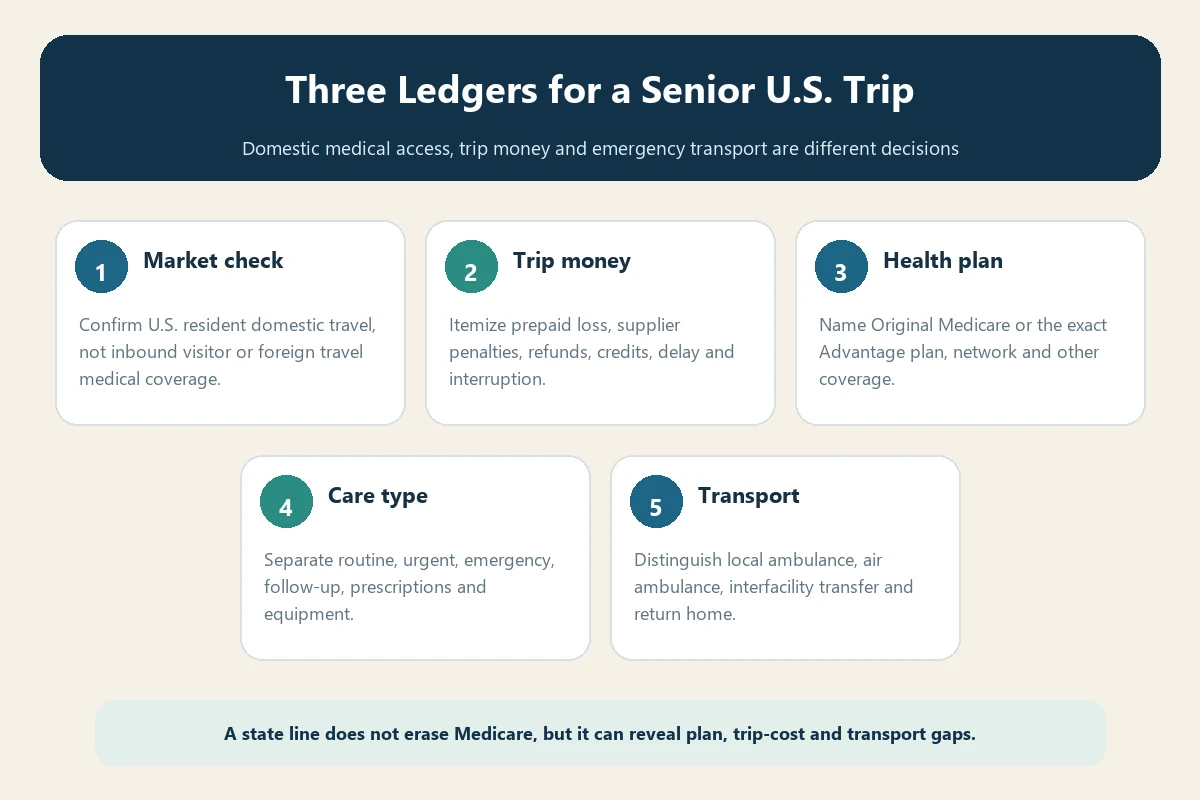
This guide is for a U.S. senior traveling domestically. It builds three separate ledgers: trip money, health-plan access, and emergency transport. It does not recommend a policy or replace advice from Medicare, a health plan, clinician, or licensed insurance professional.
Key takeaways
- Separate U.S.-resident domestic travel from inbound visitor insurance.
- Original Medicare and Medicare Advantage use different provider-access rules.
- Trip cancellation protects defined prepaid loss; it does not expand a Medicare network.
- Domestic ambulance coverage is not transport home or hospital-of-choice coverage.
- Buy only after itemizing the financial gaps that existing plans do not cover.
Reviewed August 16, 2026. “Emergency,” “urgent care,” “network,” “covered reason,” “trip,” and “nearest appropriate facility” are plan- or policy-defined terms.
First, confirm which USA travel market applies
| Traveler | Trip | Typical coverage question |
|---|---|---|
| U.S. resident | Another U.S. state or territory | Trip protection plus existing health-plan access |
| Non-U.S. resident | Visiting the United States | Inbound visitor medical coverage |
| U.S. resident | Foreign country | Outbound travel medical and trip protection |
| U.S. resident | Cruise with foreign ports | Shipboard and foreign-care rules |
Google results for “seniors domestic USA” often rank plans for parents visiting America from another country. Those plans use different residence, network, underwriting, and territory rules. Put residence and destination at the top of every quote before comparing price.
Ledger 1: calculate the prepaid trip risk
List airfare, train, tour, cruise, hotel, rental, event ticket, single supplement, and other prepaid nonrefundable expenses. Record the supplier’s cancellation schedule, refund, credit, and rebooking options. Add the amount a delay or early return could create.
Travel insurance can reimburse eligible prepaid loss when a listed covered reason and all policy conditions are satisfied. It does not cover every change of mind, forecast, family concern, or supplier dispute. The National Association of Insurance Commissioners advises consumers to review each policy’s limits, included situations, and exclusions.
The delay, interruption, and cancellation guide helps place each expense in the correct benefit rather than counting the full trip cost under every line.
Ledger 2: identify Original Medicare or Medicare Advantage
Medicare says Original Medicare allows a beneficiary to use any doctor or hospital that takes Medicare anywhere in the United States. Provider participation and assignment still affect billing. Confirm the destination provider, planned treatment, and supplemental coverage.
Medicare Advantage plans generally use a network for non-emergency and non-urgent care. Medicare says emergency and urgent care remain available when needed even if the provider is out of network, but plan rules and member costs vary. HMO plans generally require network care except emergency care, out-of-area urgent care, and temporary out-of-area dialysis.
Do not write “Medicare covers me nationwide” without naming Original Medicare or the exact Medicare Advantage plan. Request the current Evidence of Coverage, Summary of Benefits, provider directory, service-area rules, and member-services answer for the destination.
Map routine, urgent, and emergency care separately
- Routine care: refills, monitoring, therapy, planned appointments, and ongoing treatment.
- Urgent care: prompt treatment needed but not necessarily a hospital emergency.
- Emergency care: immediate evaluation for a serious or dangerous condition.
- Follow-up after emergency: services after stabilization, which can return to network or authorization rules.
A plan can cover the emergency room but require coordination for follow-up or rehabilitation. Ask where the traveler would obtain an urgent refill, dialysis, infusion, oxygen, or other time-sensitive service. Travel insurance often excludes routine and expected care.
Check Medigap, employer, retiree, military, and other coverage
For Original Medicare, Medigap can help with eligible deductibles and coinsurance according to the plan. Employer, retiree, Medicaid, military, or other coverage can coordinate differently. Medicare Advantage members cannot buy Medigap for that plan.
Create a payer-order column for hospital, physician, ambulance, prescriptions, and equipment. A travel policy’s medical benefit may be secondary or may exclude losses payable by another plan. Confirm before assuming duplicate coverage.
Ledger 3: distinguish ambulance from evacuation
Medicare Part B can cover medically necessary ambulance transportation when another method could endanger health. Its official booklet says covered ambulance service generally goes to the nearest appropriate medical facility that can provide the needed care. Air ambulance may be covered when immediate rapid transport is medically required and ground transport cannot provide it under the stated circumstances.
That is not the same as a travel-policy promise to move the patient home, to a preferred hospital, or across the country after stabilization. The hospital-of-choice guide separates local ambulance, interfacility transfer, and member-selected transport.
Test a remote U.S. destination
A national park, island, mountain area, rural county, or long road trip can be inside the United States yet far from definitive care. Identify local EMS, the nearest appropriate hospital, the next specialty center, ground access, weather limitations, and communication. Search the health plan network for each.
Travel insurance or a transport membership may add defined services, but rescue, ambulance, evacuation, and hospital transfer can use different contracts. The evacuation limit worksheet helps map route and decision-maker without assuming one national price.
Compare trip protection without duplicating health coverage
A domestic comprehensive policy may include cancellation, interruption, delay, baggage, emergency medical, and evacuation benefits. If Medicare and supplemental coverage already address medical expenses, evaluate whether the travel policy is secondary and what residual gap remains. The right comparison may prioritize trip cost, transport coordination, or delay rather than a redundant medical maximum.
Do not remove medical benefits solely because Medicare exists. Check deductible, network, services outside Medicare, ambulance, equipment, and claim coordination. Compare the issued certificate, not marketing categories.
When annual coverage can fit domestic travel
A senior taking many domestic trips may consider an annual plan, but the policy year is not proof that every journey is covered. Verify minimum distance from home, overnight requirement, per-trip maximum, trip-cost ceiling, state form, and age at renewal.
The annual versus single-trip guide provides a trip ledger. A large, expensive one-time tour can need different cancellation limits from repeated weekend visits.
Audit prescription and equipment continuity
Check destination pharmacy networks, vacation overrides, refill timing, refrigerated medicine, oxygen, dialysis, durable medical equipment, and replacement after loss. A domestic trip avoids customs restrictions but not network, stock, prior authorization, or supplier limitations.
Carry the Medicare or plan card, medication list, generic names, clinician contacts, and equipment information. Ask the plan for destination-specific instructions rather than relying on a pharmacy logo.
Model three domestic losses
- Before departure: a covered illness prevents a prepaid tour. Calculate supplier refund, insurance cancellation, and excluded amounts.
- During the trip: an out-of-area urgent visit is followed by non-urgent care. Map network, authorization, cost sharing, and travel interruption.
- Remote emergency: local ambulance reaches the nearest appropriate facility, but the traveler wants transport closer to home. Separate Medicare-covered transport from any additional plan or membership.
This exercise reveals whether the gap is trip money, health-plan access, transport, or personal preference. Insure the actual gap.
Prepare the domestic trip packet
- Original Medicare or Medicare Advantage identification and member contact
- Medigap, employer, retiree, military, or other coverage cards
- Destination providers, urgent-care sites, pharmacies, and equipment suppliers
- Travel certificate, assistance number, declarations, and claim forms
- Trip-cost invoices, supplier penalties, refunds, and credits
- Medication, allergy, clinician, accessibility, and emergency-contact information
- Ambulance, hospital, transport, and itemized medical records
Use age as a review trigger, not a buying rule
A birthday does not by itself prove that a domestic policy is necessary, but it can change pricing, eligibility, benefit limits, and the documents an insurer expects. Compare the traveler’s age on the policy’s defined date, not an assumed cutoff. Our travel insurance age-limits guide explains how to verify the rule in the certificate. Then return to the three ledgers: insure only the prepaid trip loss, plan-access exposure, or transport gap that remains.
Also record the enrollment and purchase dates. Some time-sensitive benefits depend on buying soon after the first trip payment, while cancellation coverage generally does not protect a problem that was already known. A clear timeline helps a senior traveler compare eligibility and exclusions without treating age as a diagnosis or assuming every policy uses the same definition.
Questions to ask before buying domestic travel insurance
- Is the quote for a U.S. resident traveling domestically?
- What prepaid loss remains after supplier refunds and credits?
- Is the medical benefit primary or secondary to Medicare-related coverage?
- How does the exact Medicare Advantage plan cover destination urgent and emergency care?
- What happens after stabilization or for non-urgent follow-up?
- Does evacuation mean nearest appropriate facility, hospital of choice, or another endpoint?
- Are national parks, islands, cruises, and planned activities covered?
- Does the policy require a minimum distance or overnight stay?
- Are annual benefits capped per trip or policy year?
- Which documents prove each loss?
FAQ about domestic travel insurance for seniors
Does Medicare make domestic travel insurance unnecessary?
No. Medicare addresses eligible health care, while travel insurance can address covered trip cancellation, interruption, delay, baggage, and some medical or transport gaps. Compare each lane separately.
Can Original Medicare be used in another state?
Medicare says Original Medicare can be used with doctors and hospitals that take Medicare anywhere in the United States. Verify the provider and any assignment or supplemental-coverage details.
Does Medicare Advantage work outside the home state?
Emergency and urgent care are covered under Medicare rules, but non-urgent out-of-area access, networks, cost sharing, follow-up, and additional benefits depend on the exact plan.
Will Medicare fly a traveler home after a domestic emergency?
Do not assume so. Medicare ambulance coverage focuses on medically necessary transport and the nearest appropriate facility. Return-home or hospital-of-choice transport can require separate coverage.
Bottom line
Seniors do not buy domestic travel insurance because Medicare disappears at a state line. They buy it when a defined trip-cost, network, transport, delay, or baggage gap remains. Confirm the market, build the three ledgers, test one emergency, and compare only policies that address the uncovered risk without duplicating claims.