
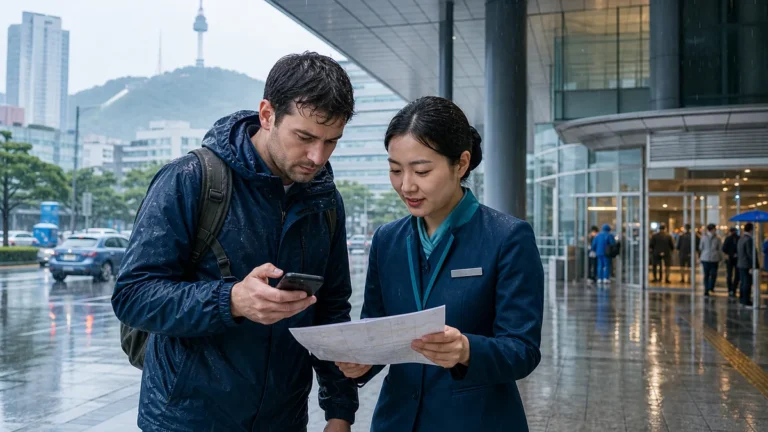
Travel insurance for South Korea from USA trips should be chosen around medical payment, route-specific weather exposure and documented supplier action. Seoul may offer strong medical access and many transport alternatives, while a rural hike, Busan connection or Jeju segment can create a different delay and evacuation problem.
Key takeaways
- Prepare to pay for treatment even when the policy has medical coverage.
- Use Korean government alerts as evidence, then record the affected booking.
- Audit Seoul, regional rail and Jeju as separate route segments.
- Do not treat peninsula tension or a civil drill as automatic cancellation coverage.
- Preserve original bills, transport notices, refunds and assistance case numbers.
Planning information reviewed August 16, 2026. Advisories, emergency systems, transport operations, provider access and policy terms can change. Recheck official and supplier information for the travel dates.
Start with the actual South Korea itinerary
List every city, overnight stay and paid reservation. A Seoul-only trip has dense transport and medical options. A route that adds Busan, mountain parks, coastal activities or Jeju creates separate weather, transfer and assistance dependencies.
Record domestic flights, KTX reservations, airport trains, ferries, tours and separately booked hotels. Mark the last workable connection each day. This route ledger makes it possible to compare benefits against a real loss rather than a generic destination label.
Use the delay, interruption and cancellation guide to classify added nights, replacement transport and unused bookings before comparing limits.
Plan for medical payment before reimbursement
The current U.S. Department of State South Korea travel guidance says travelers are responsible for medical treatment. It notes that most U.S. plans are not accepted abroad and that many overseas providers accept cash payment.
Ask the travel insurer whether direct payment is available at a named facility or only attempted after authorization. Confirm the deductible, payment guarantee process, claim form and translation rule. Keep secure access to funds even when assistance promises to coordinate care.
The health insurance abroad guide provides questions for the U.S. plan. The primary versus secondary coverage guide explains which payer reviews first.
Check provider access beyond Seoul
State Department guidance says facilities are available in most large cities, while adequate care can be harder to find in rural areas. It also notes that language support can vary and that a doctor shortage has affected appointments and surgeries at some teaching hospitals.
Ask assistance to identify suitable options for two scenarios: an urgent illness in Seoul and a serious injury far from a large city. Determine whether the team can arrange interpretation, confirm acceptance and coordinate a transfer to higher-level care.
Do not assume the nearest clinic can provide the required specialty. A policy limit cannot create an available bed, specialist or ambulance. The practical value is the process for locating, authorizing and paying an appropriate provider.
Build an official alert stack
The Republic of Korea government operates the English Safe Korea disaster portal. It provides emergency alerts, weather information, safety guidance and a facility map that includes shelters and emergency medical centers.
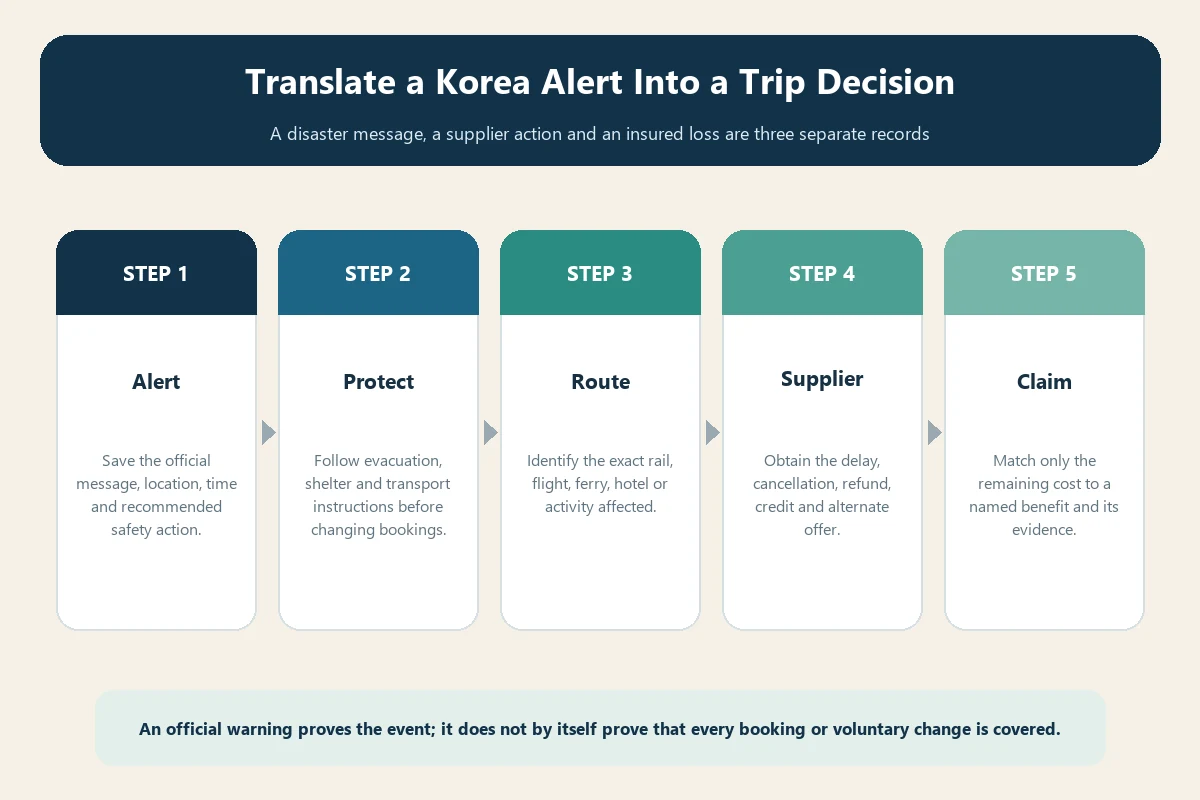
Bookmark the portal and store the hotel address and route offline. Save the original alert, translation, affected location, issue time and official instruction. Then save the airline, railway, ferry, hotel or tour decision that changed the trip.
An alert can prove that an event occurred. It does not prove that every voluntary change is insured. The affected booking, minimum delay, covered reason and purchase timing still control the claim.
Separate monsoon rain from typhoon disruption
The State Department identifies June through August as monsoon season and May through November as typhoon season. These periods overlap, but the evidence may differ. Heavy rain can produce localized flooding or landslides without a named typhoon affecting every part of the country.
Safe Korea’s official heavy-rain safety guidance tells people to monitor disaster information and plan evacuation routes. Follow life-safety instructions first. Contact suppliers and the insurer after reaching safety.
The weather-delay guide explains why a forecast, carrier cancellation and policy threshold are different facts. Build a dated chronology for each.
Audit KTX and local transport separately
List the operator, service number, ticket terms, scheduled time and alternate option for each rail segment. A KTX reservation, airport train, metro ticket and local bus do not necessarily share one refund rule or policy definition.
If service stops, obtain the operator’s notice and refund or rebooking decision. Ask whether the exact service qualifies as a common carrier and whether the minimum delay is measured from scheduled departure, actual arrival or another point.
Keep the original itinerary and replacement route. If a rail delay causes a missed separately ticketed flight, record both supplier decisions. Do not combine them into a single unexplained total.
Treat Jeju as a transport dependency
A Jeju trip can depend on a domestic flight or ferry plus a timed hotel, rental vehicle and activity. Note the last feasible crossing or flight and the consequence of losing it. Check whether the policy covers the resulting extra night, missed segment or unused reservation.
Obtain each refund before claiming. A hotel credit, airline voucher and tour refund reduce the unreimbursed loss even when the weather caused the original disruption. The ferry travel insurance guide shows how to separate operator closure, port access and onward bookings.
If coastal conditions make movement unsafe, follow official instructions. Insurance authorization should never delay sheltering or evacuation.
Do not confuse security tension with a covered event
The State Department says tensions on the Korean Peninsula remain high and that South Korea conducts civil emergency drills. A news report, missile launch elsewhere or scheduled drill does not automatically make a traveler’s booking eligible for cancellation.
Ask how the policy defines terrorism, civil disorder, government advisory, evacuation and destination inaccessibility. Check territorial wording and any advisory-based exclusion. Avoid broad assumptions about regional events.
The country exclusions and advisories guide provides a method for comparing advisory language with the policy’s actual trigger.
Plan emergency calls and assistance
Korea’s official tourism site lists 112 for police and 119 for fire emergencies. Its emergency contact guidance also identifies 1339 for help connecting with a nearby hospital.
Store those numbers, the insurer’s international line and the policy number offline. Give a companion a card with allergies, medicines and emergency contacts. Record each insurer call with the time, representative, instruction and case number.
The assistance line versus claims guide explains that coordination is not a coverage decision. A referral or case number does not guarantee payment.
Test medical evacuation by stage
Medical evacuation may begin with local stabilization, continue with ground transport and end at a facility the insurer considers medically appropriate. It does not always mean a flight to the United States.
Ask who decides medical necessity and destination. Check whether prior approval is required when reasonably possible, how rural extraction is treated and whether a companion or dependent child is included. Confirm the territorial limit.
The medical evacuation planning guide maps the chain. Review every stage instead of selecting a plan only by its headline limit.
Check hiking, skiing and water activities
Give the insurer the exact activity, season, route, guide status, maximum elevation and equipment. Ask whether rescue, nonmedical extraction and treatment are separate benefits. A maintained city trail and technical mountain route may be evaluated differently.
Follow park, weather and operator restrictions. Document a closure or evacuation order. The adventure and winter sports exclusions guide offers a structured comparison.
If an activity provider offers rescheduling, preserve that value. Coverage generally addresses eligible, unreimbursed loss rather than replacing a usable credit.
Compare policies with one Korea scenario
Use identical traveler ages, dates and prepaid costs. Include a Seoul stay, KTX ticket, Jeju flight, nonrefundable activity, heavy-rain alert, rail suspension and urgent clinic visit requiring payment.
- What must the traveler pay before care?
- Can assistance confirm an appropriate provider and payment method?
- Which alert or supplier action can trigger a benefit?
- What delay threshold applies to rail, flight and ferry segments?
- How are rural transport and medical evacuation authorized?
- Which exclusions apply to activities and regional events?
Read the certificate and endorsements. Avoid copying Google’s generic price ranges or fixed recommended limits. The right comparison depends on the route, prepaid exposure, health plan and policy definitions.
Assemble a claim file by event
Keep medical records, itemized bills, payment proof, prescriptions and insurer instructions in one folder. Keep official alerts, carrier notices, supplier refunds, replacement tickets and delay expenses in another.
Preserve Korean originals and translated working copies. Record the won amount and actual card conversion. The travel insurance claim guide explains how to disclose supplier and health-plan recoveries.
Label each cost with the date, person, location and reason. A chronological file helps the insurer connect the event to the exact booking and remaining loss.
Run a payment and alert rehearsal
Before departure, ask one traveler to simulate finding an official alert, identifying the affected booking and calling assistance from a locked phone screen. A companion should be able to locate the same policy number, emergency contacts and itinerary without relying on the primary traveler.
Run a second rehearsal for a clinic that requests immediate payment. Confirm which card or cash reserve is available, where itemized records will be stored and who will notify the U.S. health plan. A five-minute rehearsal often reveals missing access or authorization before it becomes urgent.
Bottom line
A strong South Korea plan is built from route facts rather than destination slogans. Verify medical payment, official alerts, transport dependencies, activity rules and evacuation authority. Then preserve the supplier and clinical records that turn a disruption into a supportable claim.
