
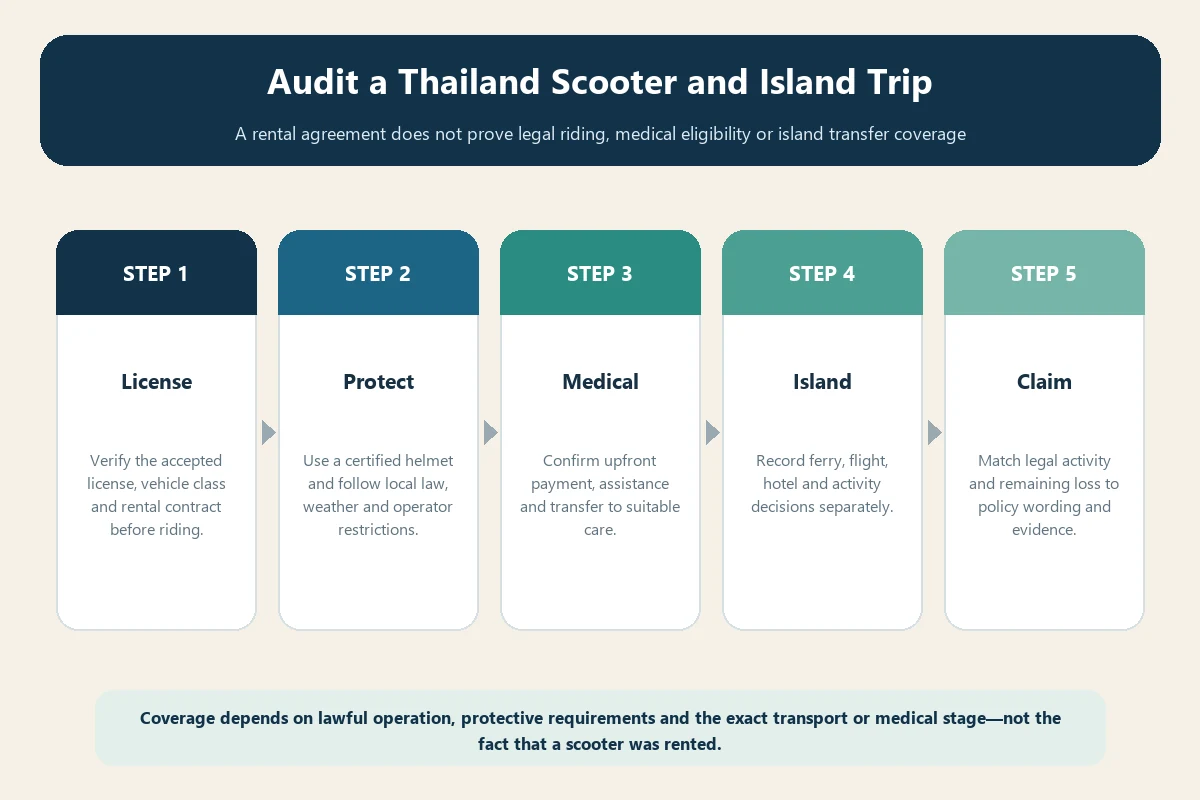
Travel insurance for Thailand from USA trips should be tested against lawful scooter use, upfront medical payment and island transport dependencies. A rental shop handing over a motorcycle does not prove the traveler is licensed, the vehicle class is covered or an accident claim will be eligible.
Key takeaways
- Verify the accepted license and vehicle class before renting.
- Check helmet, alcohol and other conduct exclusions in the certificate.
- Prepare for upfront hospital payment and inter-hospital transfer costs.
- Audit ferries, domestic flights and island hotels separately.
- Use Thai weather warnings plus supplier records for monsoon claims.
Planning information reviewed August 16, 2026. Entry rules, licensing, weather, medical practices and policy terms change. Recheck official and supplier information for the travel dates.
Build the Thailand route before choosing limits
List Bangkok, northern cities, beach areas and every island as separate route segments. Add domestic flights, ferries, transfers, rental vehicles, tours and nonrefundable hotels. Note the last workable connection each day.
A city hospital scenario differs from an injury on an island or rural road. The route determines which facilities, transfers and transport contracts matter. Use the delay, interruption and cancellation guide to classify added lodging and unused bookings.
Do not treat rental availability as legal authority
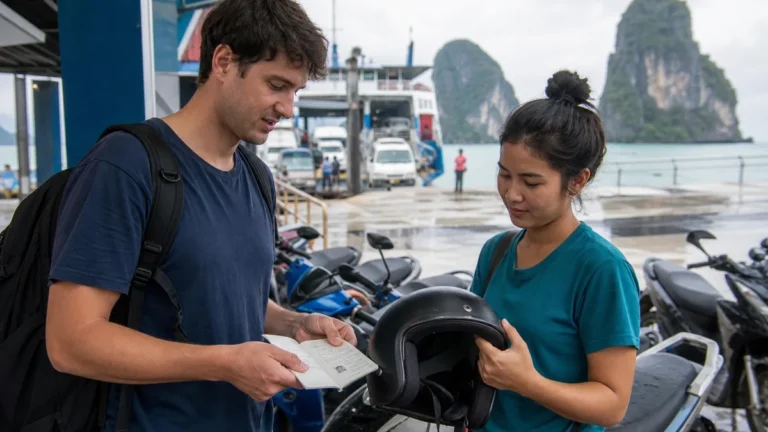
Before renting a scooter or motorcycle, verify the license Thailand accepts for that vehicle class. Ask the rental company for the contract, registration and insurance details. Then ask the travel insurer what license evidence it requires.
Do not rely on a verbal statement that “tourists do this.” A lawful rental contract, liability insurance and travel-medical eligibility are separate questions. If the license is not valid, choose a licensed driver or other transport.
Audit the motorcycle exclusion line by line
Give the insurer the engine size, vehicle class, route, driver, passenger status and intended use. Ask about helmet requirements, alcohol, racing, off-road use, unpaved roads and local-law exclusions.
The activity exclusions guide provides a comparison method. Get written answers and save the certificate page. A high medical limit cannot repair an excluded activity.
Prepare for upfront hospital payment
U.S. Department of State Thailand destination information says hospitals and doctors require upfront payment before service or admission and that cards are not always accepted.
Ask whether assistance can issue a payment guarantee to a named facility. Confirm the deductible, direct-billing process and claim documents. Keep lawful cash and card capacity even when reimbursement is expected.
The health insurance abroad guide structures the separate call to the U.S. plan.
Compare Bangkok care with island care
State Department guidance says adequate facilities exist in Bangkok and other major cities, while rural and island care may be below U.S. standards. Public-hospital language support can also vary.
Ask assistance to identify a suitable facility for Bangkok and one island scenario. Determine how the traveler reaches higher care, who accepts the patient and who pays the transfer. Do not assume “evacuation” means a flight home.
Map inter-hospital transfer authority
Official guidance says patients bear costs for transfer to or between hospitals. Ask who determines medical necessity, destination and transport method. Confirm prior-approval rules when contact is reasonably possible.
The medical evacuation planning guide separates stabilization, local transfer, higher care and possible repatriation. Preserve the clinician recommendation and receiving-facility acceptance.
Use official Thai weather warnings
The Thai Meteorological Department publishes current warnings and events, forecasts, heavy-rain areas and marine information. Save the warning, province or sea area, issue time and recommended action.
Then obtain the ferry, airline, hotel or tour decision. An official monsoon warning proves conditions; it does not show that every supplier stopped. The weather-delay guide explains timing and thresholds.
Audit each island crossing
List the ferry operator, terminal, sailing, island hotel and onward flight. Record port access and the last feasible return. A marine warning can stop small craft while larger services or flights operate differently.
Ask what happens if the outbound journey operates but the return is canceled. Preserve refunds, credits and added-night receipts. The ferry insurance guide separates sailing, port and onward losses.
Check regional health guidance
The CDC publishes current Thailand traveler health guidance. Review it with a clinician based on the exact provinces, season, length and activities.
Health guidance is not a policy guarantee. Ask how illness, preventive treatment and pre-existing conditions are handled. Carry permitted prescriptions in original packaging with documentation.
Separate liability from medical coverage
Travel medical benefits address eligible injury costs. They do not automatically pay damage to a rented scooter, another vehicle or another person. Ask the rental company about local liability and damage coverage.
The rental vehicle abroad guide helps distinguish collision, liability and medical layers. Verify whether its advice applies to motorcycles, which are often excluded from rental-car benefits.
Plan assistance before an incident
Store local emergency numbers, policy details and the assistance line offline. Give a companion allergies, medicines and consent information. Ask how the insurer handles an island clinic after hours.
The assistance versus claims guide explains why coordination is not final approval. Record every representative, instruction and case number.
Compare policies with one Thailand scenario
Use identical ages, dates and prepaid costs. Include Bangkok, a southern island, a ferry, a lawfully licensed scooter plan, heavy rain and a hospital asking for advance payment.
- What license and helmet evidence is required?
- Which motorcycle exclusions apply?
- Who funds local care and transfer?
- What marine or carrier action triggers delay coverage?
- How are island lodging and missed flights treated?
- Which records and notice deadlines control the claim?
Read the certificate. Ignore generic fixed limits from search results; route, lawful conduct, medical process and prepaid exposure determine the comparison.
Build the evidence file
For riding, keep the accepted license, rental contract, vehicle details, helmet evidence, police report and medical record. For weather, keep the TMD warning, carrier notice, supplier recovery and replacement receipts.
The claim filing guide explains payer coordination. Record Thai baht and actual conversion, and disclose every refund or credit.
Rehearse the safer alternative
Before paying, price a licensed car with driver, taxi, transfer or public transport. If the traveler cannot prove lawful motorcycle authority or policy eligibility, the alternative may remove a major exclusion and liability risk.
For islands, save a backup hotel and later ferry or flight option. Planning an alternative is not a promise of reimbursement, but it supports safe, reasonable decisions when conditions change.
Run a scooter paperwork audit before payment
Create one page that identifies the proposed rider, passenger, vehicle class, engine capacity, rental dates and every road or island where the scooter will be used. Attach the license evidence that Thai authorities and the insurer say is acceptable. Ask the rental operator to identify the registered owner, plate, existing damage, security deposit, breakdown procedure and local liability arrangement. Photograph the vehicle and protective equipment before departure, but do not let photos substitute for the written contract.
Send the same facts to the insurer in a question that can be answered without ambiguity: “If this named traveler lawfully operates this exact class of vehicle on this route while wearing the required helmet, which medical, evacuation, liability and property benefits could apply, subject to the certificate?” Save the response with the policy. If an answer refers only to “motorcycling,” ask whether passenger status, paved versus unpaved roads, organized tours and recreational use change the result.
Repeat the check if the operator substitutes a different vehicle. A last-minute upgrade can change engine size, licensing class, deposit exposure and policy treatment. Decline the replacement when the legal or insurance answer is no longer established.
Build an island medical and transport ledger
For each island stay, record the clinic hours, plausible hospital, ferry terminal, airport if any and the contact method that works after hours. Add scheduled services and realistic ground-transfer time without assuming that an ambulance, boat or seat will be available. The purpose is to expose dependencies before choosing a remote hotel or activity—not to predict a medical destination.
Place every potential payment in a separate row: clinic deposit, ambulance, boat transfer, ground transport, hospital admission, companion lodging and replacement flight. Beside it, note whether the policy describes direct payment, reimbursement, a sublimit or no benefit. Ask assistance which steps require authorization and what to do when communication is unavailable during an emergency.
Keep emergency spending separate from ordinary disruption costs. A medically necessary transfer, a hotel chosen for convenience and a missed flight may be evaluated under different sections. Itemized receipts and a short timeline help the claims reviewer follow why each cost occurred.
Test the return journey, not only arrival
Island itineraries often concentrate risk on the final connection. Work backward from the international departure: identify the last ferry or domestic flight that leaves a reasonable margin, the next available service and a place to stay if the crossing stops. Compare that plan with the policy’s minimum delay, missed-connection definition and covered reasons.
If rain or sea conditions worsen, obtain a time-stamped operator decision before abandoning a ticket. Ask whether rebooking is offered, whether the original fare is refundable and whether the international airline will change the onward segment. Insurance generally evaluates the remaining eligible loss after those recoveries, so a complete record should show both the extra cost and the value returned.
Bottom line
A strong Thailand plan verifies lawful scooter operation, upfront medical payment, inter-hospital transfer and island transport. Follow official weather guidance, recover supplier value and preserve the records that connect an eligible event to the remaining loss.