

Travel insurance for US Virgin Islands trips should be built island by island, with a verified health-plan network and an authorized route to higher-level care. St. Thomas, St. Croix and St. John share one territory but not one medical-access pattern. A ferry, public ambulance, charter flight and medical aircraft can serve different purposes and different policy definitions.
Key takeaways
- Confirm a realistic clinic or hospital for every overnight island.
- Verify U.S. health-plan participation instead of assuming domestic access.
- Separate ferry, charter, ground ambulance and medical flight authorization.
- Track hurricane alerts, port conditions and carrier cancellations by time.
- Preserve schedules, clinical records, approvals, bills and supplier refunds.
Planning information reviewed August 16, 2026. Provider networks, vessel and flight schedules, port conditions, alerts and policy terms can change. Confirm current details for the exact islands and dates.
Start with the island sequence
Write the itinerary as a chain rather than a destination name. Include the arrival airport, every ferry or small-aircraft segment, overnight island, lodging, excursion and final U.S.-bound flight. Add check-in cutoffs, last departures and backup lodging near each transfer.
The sequence matters because the first available medical facility may not provide the specialty a traveler needs. The official Medicare travel page treats the U.S. Virgin Islands as part of the United States. That does not mean every provider accepts Medicare, every private plan has the same network or every transport is a covered ambulance service.
The U.S. trip insurance guide helps separate medical and trip benefits. Verify the domestic plan first, then compare travel policies for the remaining transport, cancellation and delay risks.
Assign a realistic facility to each island
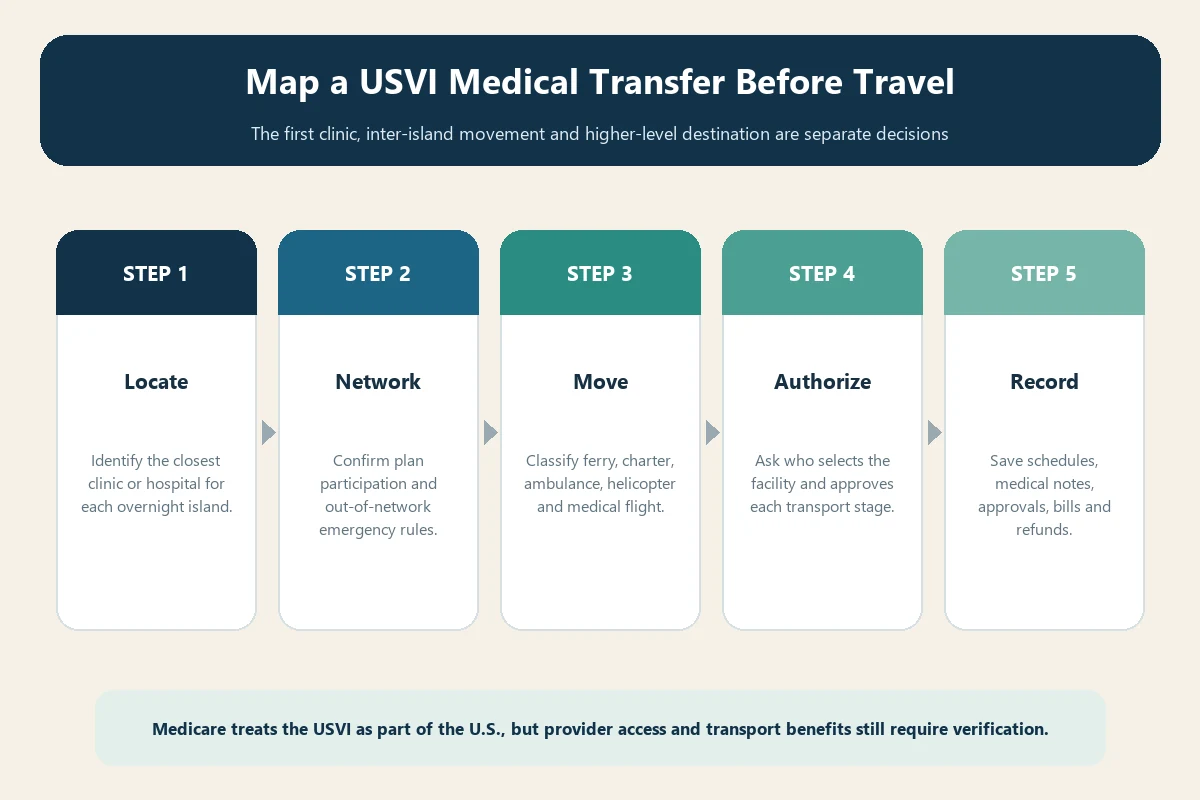
For St. Thomas and St. Croix, identify a hospital and an urgent-care alternative. For St. John, identify the local first-response or clinic option and the realistic route to St. Thomas if higher-level assessment is needed. Record hours, phone numbers, driving time and after-hours instructions.
The Virgin Islands Department of Health lists territory services and locations through its official health pages. Its community health services page shows services and contact points on St. Croix and St. Thomas, while also distinguishing scheduled and referral services. Use such listings to start a map, not to infer that a traveler can obtain every specialty at every site.
Ask the health plan to confirm each facility’s participation and emergency rules. Save a current directory result and call the provider using its legal billing name. The health-plan travel audit offers a useful framework for network, reimbursement and ambulance questions even in a U.S. territory.
Separate stabilization from higher-level transfer
A patient can be stabilized locally and still require a service unavailable on that island. Ask the insurer who determines medical necessity, who locates the receiving physician and whether the receiving facility must accept the patient before transport begins. Record what happens when the preferred facility has no bed.
Break the route into stages: local response, ground ambulance, inter-island movement, receiving ambulance and hospital admission. One approval may not cover all stages. A travel insurer may coordinate medically necessary transportation while the domestic plan handles hospital care, or the order may differ by product.
The medical evacuation limit guide explains why a large dollar limit is not enough. Facility adequacy, insurer control, transport type, medical escort and destination selection determine how a benefit actually works.
Classify every boat and aircraft
A scheduled passenger ferry may meet a policy’s common-carrier definition; a private water taxi, yacht charter or excursion boat may not. A scheduled inter-island aircraft, ordinary charter and air ambulance are also distinct. List the legal operator, ticket type and published schedule for each paid segment.
The ferry travel insurance guide provides a transferable contract audit: operating schedule, carrier status, weather policy, last departure and refund process. Apply it to the actual USVI operator rather than assuming every boat is treated like public transportation.
If a vessel is canceled, obtain the carrier’s written reason and refund decision. A traveler’s fear of rough water, an operator safety cancellation, a Coast Guard port condition and a medical restriction are different events. Preserve the document that matches the expense being claimed.
Protect baggage across small-carrier segments
Inter-island aircraft, water taxis and ferries can apply different baggage limits from the mainland airline. Record weight, size, special-item and check-in rules for every operator. A bag accepted on the U.S.-bound flight may require a fee, separate handling or later transport on a smaller segment.
Keep medication, identification, policy details, one change of clothing and essential medical equipment in the traveler’s personal item when permitted. Photograph checked items and retain every tag. If a carrier delays or leaves a bag behind, obtain a property report and the earliest promised delivery in writing before buying replacements.
Baggage delay normally reimburses necessary purchases after a stated waiting period, subject to per-item and total limits. It may not cover an item voluntarily sent on a later boat because the traveler exceeded a published allowance. Separate a carrier-caused delay from a shipping choice and request the operator’s reimbursement first.
Plan the companion’s island handoff
If the patient moves from St. John to St. Thomas or from St. Croix to the mainland, a companion may be separated from luggage, lodging and a rental vehicle. Ask whether bedside travel, companion transport, extra lodging, dependent return or vehicle return is covered. Each benefit may require treating-physician certification and insurer approval.
Give the companion access to consent, medical history, payment method and all carrier contracts. During the incident, one person should track the clinical handoff while another records canceled reservations and refunds. Keep the patient’s movement and the companion’s commercial travel on separate receipt lists.
Test assistance with an inter-island case
Give each insurer the same scenario: a traveler becomes seriously ill on St. John, receives initial assessment and needs a specialist service on St. Thomas or the mainland. Ask who chooses the facility, how movement is authorized and whether a companion can travel.
Then change one fact at a time. What if public ferry service has ended? What if weather prevents a helicopter? What if the domestic health plan recommends a different hospital? Ask whether the assistance team can arrange a guarantee of payment and how the traveler documents a transport that had to begin before contact was possible.
The assistance line versus claims guide distinguishes real-time coordination from later eligibility review. A case number and instruction are essential evidence, but they are not a promise that every charge will be reimbursed.
Build hurricane decisions around official alerts
The Virgin Islands Territorial Emergency Management Agency coordinates territorial disaster response and offers Alert VI notifications. The National Hurricane Center preparedness hub explains tropical cyclone hazards, watches and warnings. Follow both official sources, plus the carrier and lodging provider responsible for the booked service.
Record the purchase date, first trip payment, forecast development, watch or warning, port condition, airline or ferry cancellation, lodging closure and evacuation order. A named storm does not automatically trigger every benefit. Policy definitions and timing control.
The weather-delay guide shows how a carrier cancellation and time threshold can matter more than rainfall alone. Ask about severe weather, natural disaster, mandatory evacuation, destination uninhabitability and missed-connection wording.
Plan for service outages without overclaiming
After a storm, electricity, water, mobile service, roads and port operations can recover on different timelines. Ask the lodging provider what is actually unavailable and whether the property remains open. A loss of amenities may be inconvenient without meeting a coverage definition.
If a traveler relocates, preserve the official instruction, property notice and assistance case. Request refunds and credits first. Added lodging, meals, transport and unused nights should be listed separately so the insurer can apply the correct benefit and threshold.
Use the delay, interruption and cancellation guide to classify timing. Do not combine a delayed ferry meal, unused villa night and new mainland flight into one undocumented total.
Audit excursions and charter days
For diving, sailing, snorkeling, fishing or a private-island day, record the operator, vessel, route, certifications, safety briefing and cancellation terms. Confirm whether the exact activity is eligible under the policy and whether an optional sports benefit is required.
Ask how the operator contacts emergency services away from a harbor and where it would deliver an injured traveler. A charter operator’s transport can be useful without being a medically authorized evacuation. Preserve the incident report, witness details and operator insurance information.
Compare policies with one three-island route
Use identical traveler ages, dates and prepaid costs. Include St. Thomas, St. John and St. Croix, a scheduled ferry, one private charter, a domestic health plan, a specialty transfer and a hurricane-related port closure.
- Which facilities are in the medical network on each island?
- Who approves ground, marine and air medical transport?
- Which vessels qualify as common carriers?
- Are the planned water activities eligible?
- Which official storm or port event can trigger a trip benefit?
- What evidence and notification deadlines apply?
Build the transfer evidence packet
Store the itinerary, provider checks, medical summary, consent, policy, assistance number and supplier contracts offline. During an incident, save clinical notes, receiving-facility acceptance, transport approval, vessel or flight notice, itemized bills, payment proof and every refund.
The travel insurance claim guide provides a clear chronology. Disclose health-plan and supplier reimbursement and claim only the remaining eligible loss.
When coverage is secondary, include the domestic health plan’s explanation of benefits or written noncoverage decision. Match each receipt to a service, location and time. A ferry ticket, ambulance charge and medical-flight deposit should never appear as one unlabeled transport total.
Bottom line
The strongest USVI plan does not treat three islands as one medical neighborhood. Verify the health network on each overnight island, classify every vessel and transport stage, and connect hurricane losses to dated official and supplier evidence. That turns a generic policy into a route-specific plan.
