
Travel insurance wildfire smoke flight cancellation coverage depends on what actually happened to the booked trip—not merely whether smoke was visible or air quality was poor. A strong claim connects an official hazard, a flight-specific carrier action, covered policy language, timely purchase, and documented loss that no supplier returned.
Wildfire conditions can change by the hour. A fire may trigger an evacuation without affecting a distant airport; a satellite plume may remain aloft; unhealthy ground-level air may coexist with operating flights; or firefighting activity may restrict a section of airspace while airlines reroute. This U.S. guide explains how to separate those facts and build a defensible recovery file. It is educational, not medical, emergency, aviation, legal, or insurance advice.
Wildfire smoke flight cancellation coverage at a glance
- Put personal safety and official evacuation instructions first.
- Preserve the fire, smoke, air-quality, airport, and aviation records separately.
- Get the airline’s flight-specific reason and every refund or rebooking offer.
- Compare policy purchase time with the first known wildfire or smoke alert.
- Test the exact covered reasons, exclusions, thresholds, and benefit definitions.
- Subtract airline, hotel, card, and other recoveries before claiming net loss.
Reviewed August 17, 2026.
Fire, smoke, AQI, and flight disruption are different facts
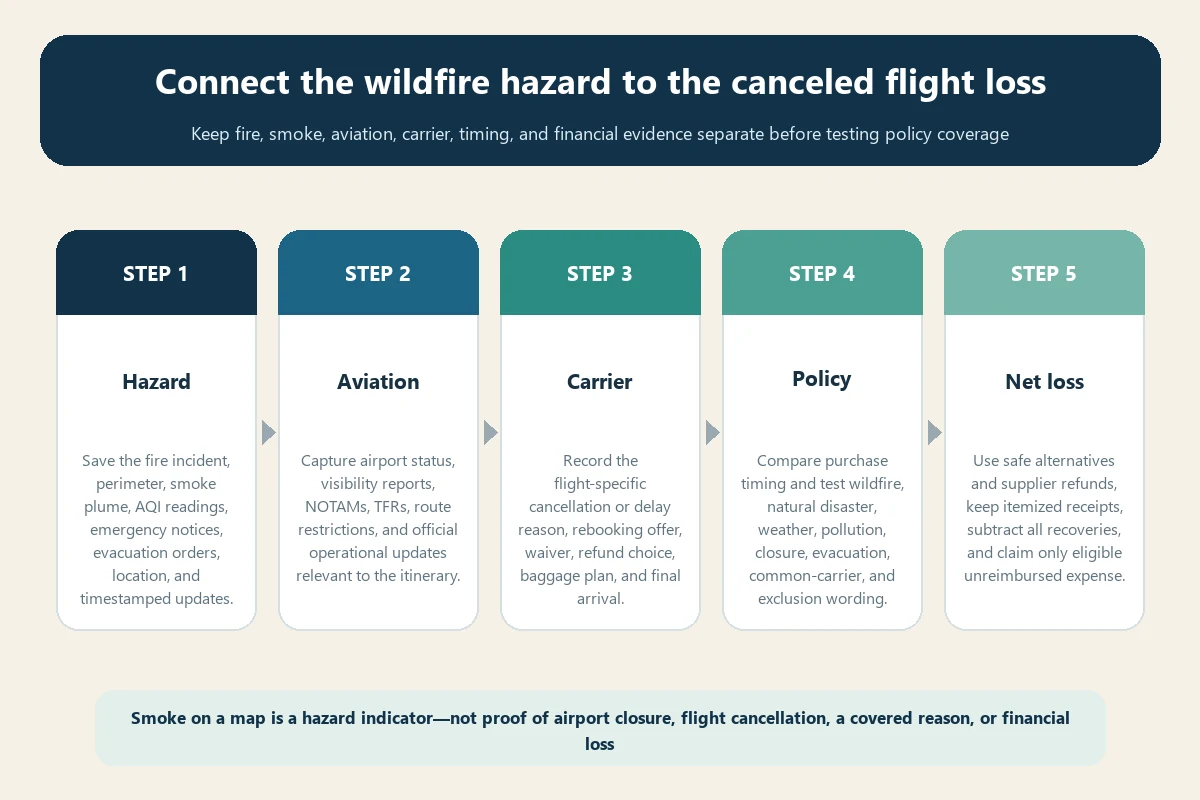
A fire perimeter identifies an incident area. A satellite-detected plume shows smoke in the atmosphere. An Air Quality Index reading estimates pollution near the surface. Aviation visibility and airspace restrictions describe operational conditions. None of these records, standing alone, proves that the insured flight was canceled.
The official AirNow Fire and Smoke Map information explains that its map combines fine-particle readings, fire locations, smoke plumes, and outlooks. AirNow also cautions that satellite plumes may not reflect ground-level air quality. Save the layer, location, legend, timestamp, and URL rather than submitting an unlabeled screenshot.
What usually creates a stronger coverage path
Policy wording varies, but a documented operational consequence is generally stronger than fear or discomfort alone. Examples include the carrier canceling the booked flight, a qualifying common-carrier delay, the airport becoming inaccessible, an official evacuation affecting the destination, or covered damage making booked lodging uninhabitable. Each still must match the contract’s definitions, effective dates, thresholds, and exclusions.
If the flight operates and the destination remains accessible, choosing not to travel because the air looks smoky may be treated as a voluntary cancellation. Poor AQI can be a serious health concern, but it does not automatically become a named trip-cancellation reason. A traveler with symptoms or a medical vulnerability should seek appropriate professional care; any medical coverage path will have its own evidence and conditions.
Verify airport and airspace consequences
Check the origin, connection, destination, and plausible alternates. Preserve official airport status, carrier alerts, and route information at the time of disruption. The FAA’s NOTAM and Temporary Flight Restriction resources provide access to operational notices. A wildfire TFR often protects firefighting aircraft in a defined area; it does not necessarily close a commercial airport or cancel every nearby route.
Record the restriction’s location, radius, altitude, effective period, purpose, and later revisions. Then show how it affected the booked flight. This distinction matters because a route can be adjusted around a restricted area. For broader disruptions, use the evidence method in our airspace closure coverage guide.
Obtain the airline’s flight-specific reason
Save the original itinerary, ticket number, flight number, scheduled times, cancellation notice, app messages, emails, and chat transcript. Ask the airline to state whether the cause was wildfire, smoke or visibility, airport closure, air traffic restriction, aircraft positioning, crew displacement, or a network decision. A generic “operational reasons” label may be insufficient, so preserve later explanations too.
Document every option: same-day reroute, later flight, alternate airport, waiver, voucher, cash refund, ground transport, and hotel assistance. If the airport itself closes, our airport closure coverage guide explains the separate proof chain.
Use the airline remedy before insurance
For travel to, from, or within the United States, the U.S. Department of Transportation says a passenger is entitled to a refund when the airline cancels the flight and the passenger does not accept the alternative transportation or compensation offered. Review the current DOT airline refund guidance before choosing between a refund and rebooking.
That choice affects the insurance calculation. If the airline refunds the ticket, the same airfare is not an insured net loss. If a safe reroute is accepted, reasonable extra lodging, meals, local transport, or a missed connection may instead fall under delay or interruption benefits, subject to their limits. See trip delay versus interruption versus cancellation before selecting a claim form.
Check the known-event timeline
Travel insurance is intended for unforeseen events. Build one timeline with trip booking, each nonrefundable payment, policy purchase, coverage effective time, fire discovery, first official public alert, smoke advisory, evacuation order, aviation restriction, and carrier action.
Coverage may be unavailable if the policy was bought after the wildfire or its travel impact became known or foreseeable under the contract. Buying after seeing a cancellation forecast does not convert an existing problem into a new insured event. Our guide on when to buy travel insurance explains why timestamp evidence matters.
Read the policy for the actual trigger
Search the certificate and schedule for wildfire, fire, natural disaster, natural catastrophe, weather, smoke, air pollution, contamination, common carrier, airport closure, airspace closure, evacuation, inaccessible destination, and uninhabitable accommodation. Also read exclusions and definitions, not just a marketing summary.
Important questions include:
- Must the common carrier stop service for a minimum number of hours?
- Does an airport or destination need to be closed or evacuated?
- Does lodging need physical damage before it is considered uninhabitable?
- Are smoke, pollution, or environmental contamination excluded?
- Does weather coverage require a carrier delay rather than a personal decision?
- What proof, notice deadline, and maximum benefit apply?
For a qualifying carrier delay, use the expense rules in our trip delay reimbursement guide. If the disruption breaks a connection, review missed connection insurance and its scheduled-connection threshold.
Distinguish cancellation, delay, diversion, and interruption
Trip cancellation usually concerns abandoning the trip before departure for a covered reason. Trip delay can reimburse limited necessary expenses while waiting. Missed connection benefits address a qualifying late arrival that breaks an onward connection. Trip interruption may apply after departure when a covered event forces an early return or revised trip.
A flight may also depart and divert because conditions change. Preserve the diversion airport, arrival time, carrier instructions, onward transport, and baggage status. The flight diversion coverage guide shows how to document that path without incorrectly calling it a cancellation.
Reroute only when it is safe and reasonable
Do not drive through an evacuation zone, closed road, active fire area, or hazardous smoke merely to reduce a claim. Follow emergency management, transportation, airport, and carrier instructions. If the airline proposes an alternate airport, verify road access, the fire’s direction, lodging availability, rental-car rules, and whether the plan preserves the rest of the itinerary.
Contact the insurer’s assistance line before making a major replacement purchase when safety and time allow. Record the representative, time, case number, advice, and any preauthorization. If immediate action is necessary, write down why the option was reasonable and retain contemporaneous alerts.
Build an evidence packet by layer
- Hazard: official incident name, perimeter, smoke plume, AQI, alerts, evacuation orders, and updates.
- Aviation: airport status, NOTAM or TFR, visibility or route restriction, and relevant effective times.
- Carrier: itinerary, cancellation reason, rebooking, waiver, refund, and final transport outcome.
- Policy: certificate, schedule, purchase receipt, effective date, covered reason, exclusion, and threshold.
- Financial: supplier terms, refund requests, responses, itemized receipts, card credits, and remaining loss.
Name files consistently and keep the original messages. A claim narrative should link them in order: hazard developed, operational authority or carrier acted, booked service failed, traveler used a safe reasonable response, suppliers returned available funds, and a defined amount remained.
Calculate only the unrecovered amount
Create a ledger with supplier, original charge, currency, service date, reason unused, refund requested, refund received, credit or voucher, card protection, replacement expense, and net amount claimed. Do not combine a refundable ticket with a hotel charge or estimate a round number when receipts exist.
Insurers commonly coordinate with supplier refunds and other recoveries. The guide to supplier refunds and insurance recovery explains how to avoid duplicate reimbursement. Keep pending items marked pending and update the insurer if a later credit posts.
Common wildfire smoke claim mistakes
- Submitting only a dramatic smoke photo without a location or timestamp.
- Treating unhealthy AQI as proof that the airport or flight closed.
- Assuming a wildfire TFR covers every commercial flight nearby.
- Canceling voluntarily before asking the carrier about operations and remedies.
- Buying coverage after the event was publicly known.
- Using the wrong benefit when the trip was delayed, diverted, or interrupted.
- Claiming airfare or hotel costs that were already refunded or credited.
- Taking an unsafe reroute or making undocumented premium purchases.
How to file the claim
Notify the insurer within the policy deadline and request the form for the benefit that matches the sequence. Attach the policy, purchase proof, itinerary, airline explanation, official hazard and aviation records, supplier correspondence, receipts, and net-loss ledger. Keep a copy of the entire submission and record the claim number.
If the examiner asks for more information, answer the exact request and preserve the response. If coverage is denied, request the specific policy provision and factual basis, then compare them with the timeline and evidence. Our step-by-step guide to filing a travel insurance claim can organize the final package.
Bottom line
Wildfire smoke can cause an insurable travel disruption, but smoke near a route is not automatic cancellation coverage. The strongest file separates the fire and AQI evidence from the aviation consequence, proves the airline’s action, matches that consequence to policy wording and timing, uses safe carrier and supplier remedies, and claims only the documented net loss.
