
Travel insurance airspace closure coverage depends on who restricted which airspace, when, for what reason, and how the restriction affected the booked flight. A local security TFR, volcanic ash corridor, wildfire response zone, conflict prohibition, and airline’s voluntary route avoidance do not receive one insurance answer.
This U.S. guide explains how to verify the aviation order, protect airline remedies, test policy wording and timing, choose safe alternatives, and calculate net loss. It is educational, not legal, aviation, security, or insurance advice.
Airspace closure is not one standardized event
Airspace may be prohibited, restricted, temporarily limited, closed along a route, unavailable at certain altitudes, or subject to an operator-specific advisory. Some restrictions permit authorized traffic while scheduled passenger operations stop.
Obtain the actual notice, coordinates, altitude, start, end, issuing authority, affected aircraft or operators, and exceptions. Do not treat a news headline as the governing aviation record.
NOTAM and TFR are operational evidence
The FAA’s NOTAMs, TFRs, and Aircraft Safety Alerts page links official notices and graphical temporary flight restrictions. A TFR can restrict operations within a defined area and time for safety or security.
Save the notice while active because it can change or expire. Record the identifier and effective version. The notice proves an aviation restriction, not automatically that a passenger’s flight was canceled or an insurance benefit applies.
Domestic temporary restrictions can have narrow scope
FAA guidance explains that temporary flight restrictions can arise from wildfires, hurricanes, major events, emergency response, or national security. Some affect drones or general aviation more than scheduled airlines.
Confirm whether the booked operating carrier and route were included. A TFR near an event venue does not prove that every commercial flight to the metropolitan area was unusable.
International conflict-zone restrictions use different tools
The FAA’s International Crisis Management and Response guidance describes advisories, prohibitory NOTAMs, and special regulations used when conflict, military activity, heightened tension, or weapons hazards threaten U.S. civil aviation.
Another state’s aviation authority can issue its own closure or direction. Preserve which authority controls the affected airspace and which rule applies to the carrier, aircraft registration, or crew.
A carrier may avoid airspace without a formal closure
An airline can suspend a route or choose a longer path because its safety assessment, insurer, crew policy, or operating permit makes the planned flight undesirable or unavailable. That decision can be prudent even when no authority formally closes the whole area.
Ask whether the carrier canceled due to a government prohibition, advisory, internal security assessment, unavailable overflight permission, crew issue, fuel constraint, or commercial choice. The distinction can affect policy exclusions and airline amenities.
Start with the airline refund or reroute
When the carrier cancels, DOT’s airline refund guidance says passengers who decline travel or alternative compensation are entitled to a refund regardless of the cancellation reason.
Request eligible airfare and ancillary-service fees. Compare any confirmed reroute before accepting; a reroute, cash refund, and voucher have different consequences for the remaining loss.
Map the full reroute, not only new flight numbers
A lawful alternative may use different airspace, airport, country, carrier, aircraft, or ground connection. Check advisories, entry and transit documents, baggage, accessibility, connection protection, ticketing, and arrival time.
Save route and price evidence at the decision time. A replacement flight that later encounters the same restriction may not be reasonable mitigation if the risk was already visible.
Policy wording may name airspace closure directly
Some enhanced disruption benefits expressly mention airspace or airport closure. Many standard policies instead list severe weather, natural disaster, strike, mechanical breakdown, common-carrier delay, or another finite set.
Copy the coverage grant, definitions, exclusions, waiting period, and limits. Do not assume a product covers closure because its marketing page uses the broad phrase “travel disruption.”
Government-action exclusions can control
A restriction issued by an aviation authority may interact with exclusions for government action, regulation, prohibition, or order. Another policy may expressly preserve a narrow common-carrier or natural-disaster benefit.
Read the grant and exclusion together. Ask the insurer to cite the clause connecting the order to the particular expense rather than issuing a generic statement that all closures are excluded.
Conflict closures require war-clause review
War, hostilities, military action, weapons hazards, insurrection, and related indirect consequences can be broadly excluded. Terrorism may be defined separately and can have a narrow exception.
Use our war-related flight cancellation guide to choose refund, safe reroute, crisis departure, CFAR, and the correct policy stage. Do not strip the conflict from the causal chain by describing only the closure.
Volcanic ash may be a natural-disaster branch
A volcano can close airports, create hazardous ash corridors, or cause carriers to avoid affected airspace. Coverage can depend on natural-disaster definitions, distance, destination impact, carrier stoppage, purchase timing, and known-event language.
Preserve official volcano or aviation notices and the airline’s flight-specific response. Ash far from the itinerary is not enough.
Wildfire and smoke restrictions need geographic proof
Temporary restrictions may protect firefighting aircraft and emergency operations. Smoke can also reduce airport capacity without closing the broader airspace.
Record the restricted polygon, altitude, dates, booked route, airport status, carrier decision, and official hazard information. Separate flight restriction from ordinary weather delay using our weather-delay coverage guide.
Launch and event restrictions may be predictable
Rocket launches, air shows, major sporting events, presidential movement, and planned military activity can create temporary restrictions. Scheduled and publicly announced events may trigger foreseeability or known-event disputes.
Record when the restriction was announced, when travel and insurance were purchased, whether the airline scheduled through it, and whether only a short route adjustment occurred. Planned TFR existence does not automatically create an insured cancellation.
Known-event timing is route-specific
An authority may first issue an advisory, then a limited restriction, then a broader prohibition. Airlines may act at different points. Insurers can publish their own event notices.
Create one timeline for first trip deposit, policy purchase, advisory, NOTAM or order, carrier change, cancellation, traveler response, and expense. Do not claim one universal cutoff across all routes and policy forms.
Delay, cancellation, and interruption remain separate
A closure can delay departure, cancel a pretrip flight, strand the traveler mid-trip, or break an onward segment. Each stage can use a different benefit, waiting period, covered reason, and expense measure.
Use our delay, interruption, and cancellation comparison to classify the loss. Do not force the entire disruption into the benefit with the largest headline limit.
ATC flow restrictions are not necessarily closure
A ground stop or delay program meters traffic without prohibiting all flight through the airspace. Congestion, weather, runway capacity, or equipment can trigger such initiatives.
Use our ATC delay coverage guide when the airspace remains open but traffic is controlled. Preserve the exact initiative rather than upgrading a delay into a closure.
Diversions create a second operating event
An aircraft may encounter a restriction after departure and divert to a different airport or country. That creates arrival, immigration, baggage, onward transport, and accommodation issues beyond the original closure.
Use our flight-diversion coverage guide to document the new landing point, carrier plan, final arrival, and net expense.
Missed connections need itinerary evidence
A reroute around closed airspace can add hours and break connections. Preserve the protected ticket, minimum connection, carrier rebooking, onward departure, baggage status, catch-up option, and final arrival.
Our missed-connection insurance guide explains separate waiting periods and replacement costs. Avoid claiming one ticket under several benefits.
Follow safety instructions before claim strategy
Do not enter restricted areas, travel to a closed airport, cross unsafe ground routes, or pressure a carrier to use hazardous airspace. Follow aviation authorities, local officials, embassy alerts, airport instructions, and the operating carrier.
Contact insurer assistance when safe and practical. Record why emergency action occurred without prior authorization if immediate movement was necessary.
Protect every supplier remedy
Contact hotels, cruises, tours, rentals, events, and transfers before their no-show deadlines. Ask for refund, credit, date change, waiver, or protected late arrival and preserve the response.
Insurance generally evaluates unrecovered eligible cost. A supplier amount that remains refundable is not yet a final loss.
Build a restriction-and-loss packet
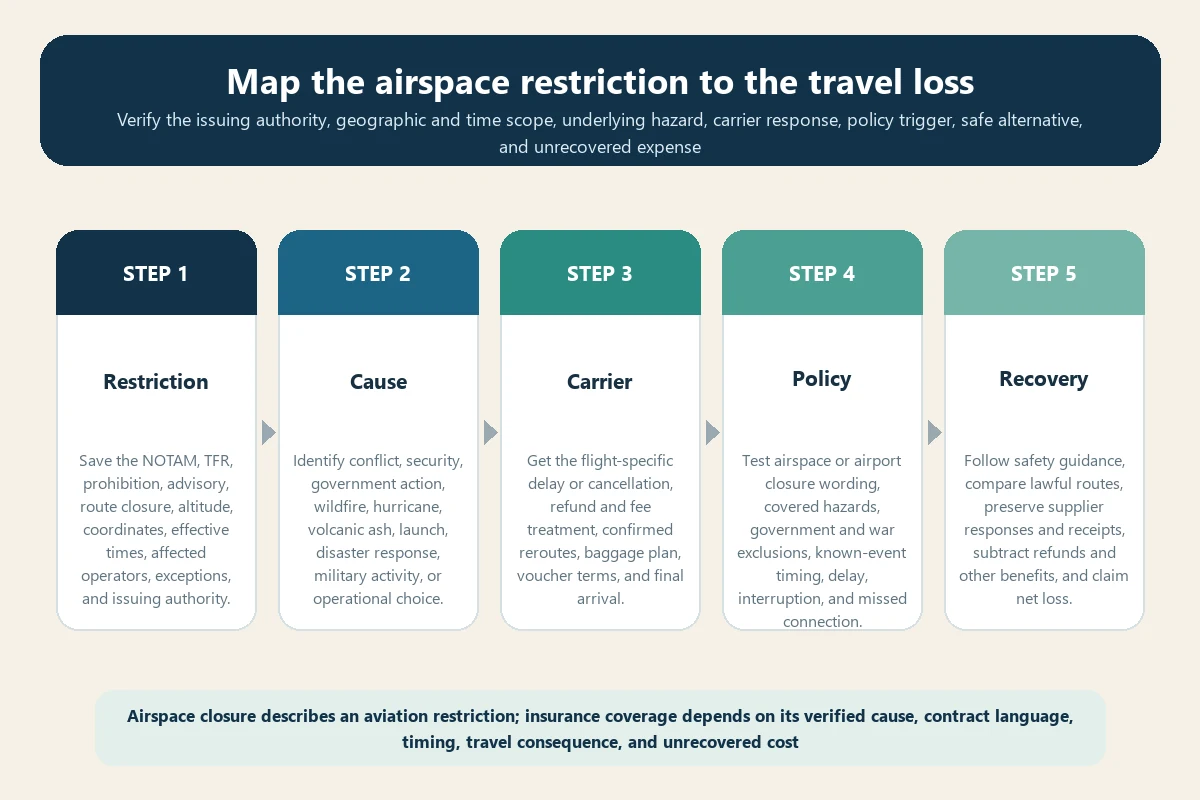
Include the restriction or advisory, issuer, identifier, coordinates, altitude and times; carrier reason and itinerary; refund or reroute offers; policy and purchase proof; official hazard records; final arrival; unused bookings; supplier responses; receipts; and other benefits.
Use our supplier-refund and subrogation guide to reconcile recoveries, then file through the travel-insurance claim process before deadlines.
Airspace-closure checklist
- Save the exact restriction, authority, scope, and effective times.
- Determine whether the booked carrier and route were included.
- Identify conflict, security, weather, disaster, event, or another cause.
- Get the airline’s flight-specific reason and refund options.
- Check the full safety and document chain of any reroute.
- Test express closure wording, exclusions, and known-event timing.
- Classify delay, cancellation, interruption, diversion, and connection separately.
- Follow official safety guidance and document assistance contacts.
- Request downstream supplier refunds or changes promptly.
- Subtract all recoveries and claim only eligible net loss.
Bottom line
Travel insurance airspace closure coverage starts with a verified aviation restriction, not a headline. Map its authority, scope, cause, carrier consequence, purchase timeline, contract language, safe alternative, and remaining expense.
That sequence distinguishes a closed route from ordinary delay and shows whether any unrecovered loss reaches the issued policy.
An airport closure requires facility-specific evidence and a separate recovery sequence. Use this travel insurance airport closure coverage guide to verify the closure, compare carrier alternatives, preserve refund rights, test policy wording, and document net loss.
Volcanic ash needs hazard-specific aviation evidence and a flight-cancellation recovery sequence. Use this volcanic ash flight cancellation travel insurance guide to verify alerts, preserve airline refunds, test natural-disaster wording and timing, and claim net loss.
Wildfire smoke requires separate hazard, aviation, and flight-specific evidence. Use this wildfire smoke flight cancellation travel insurance guide to distinguish AQI from an operational disruption, preserve airline remedies, test policy wording and claim net loss.
