

Travel medical insurance for cancer survivors requires more than a remission date. The issued certificate may apply a pre-existing-condition look-back, a time-sensitive waiver, ongoing-treatment exclusions or a separate exclusion for cancer. Surveillance, maintenance medicine, a new unrelated illness and a cancer-related emergency can therefore receive different decisions.
This guide helps U.S. travelers organize insurance questions after cancer treatment. It does not determine medical readiness, recurrence risk or treatment timing. Discuss the itinerary with the oncology team before paying nonrefundable costs or changing care.
Key takeaways
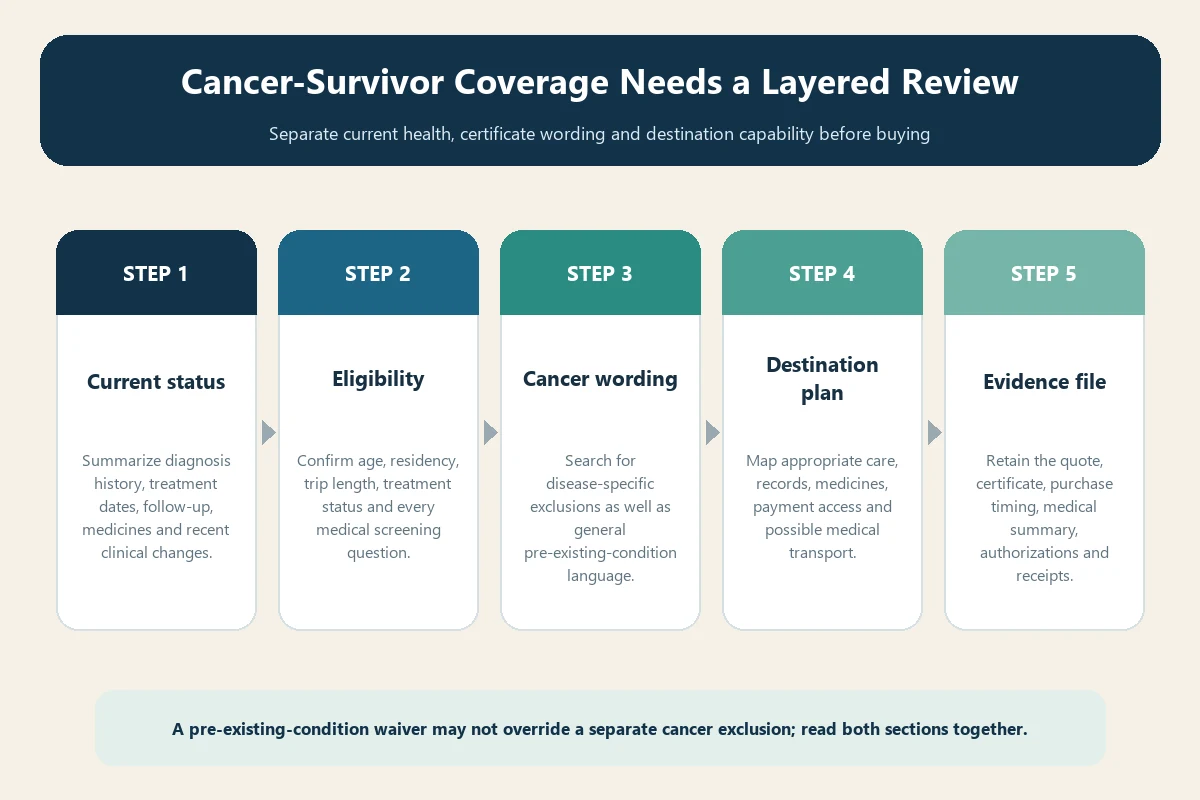
- Build a dated treatment and surveillance history instead of relying on the word “survivor.”
- There is no universal remission or “62 day” rule across all U.S. travel insurance certificates.
- Check for both a general pre-existing-condition clause and a separate cancer or malignant-neoplasm exclusion.
- Separate planned surveillance, ongoing medicine, treatment side effects, recurrence and an unrelated new illness.
- Disclose exactly what the application asks and keep medical, purchase and claim records.
Reviewed August 16, 2026. Cancer history and policy forms vary widely; verify the issued certificate and obtain individualized oncology guidance.
Define the traveler’s current phase accurately
“Cancer survivor” can include people after surgery, chemotherapy or radiation; people receiving maintenance therapy; and people living with controlled or active disease. Insurance applications may ask about diagnosis, treatment, prognosis, symptoms or medication rather than identity labels.
Use the clinical record’s dates and terms. Do not select a favorable label that omits ongoing care.
Build a complete treatment timeline
List diagnosis, surgery, chemotherapy, radiation, immunotherapy, targeted therapy, transplant, hospitalizations, complications, last active treatment, maintenance treatment and follow-up. Add recent imaging, laboratory work, biopsies and clinician recommendations.
The look-back period guide helps match these dates to a certificate definition. Treatment recommended but not yet received can matter.
Reject universal remission periods
Google results may mention a fixed number of days or years, but no single period applies to every U.S. travel policy. One form may use a look-back window, another a diagnosis exclusion, and another a waiver with a purchase deadline.
Ask the insurer to identify the exact clause that makes a date relevant. Do not assume a generic “62 day rule” controls a certificate unless that form actually contains it.
Separate surveillance from active treatment
Routine scans, laboratory tests and oncology follow-up are planned care. A travel medical policy designed for unexpected illness may not pay for them abroad. Scheduling a surveillance appointment near travel can also affect an application or look-back analysis.
The follow-up care guide shows how location, purpose and timing change eligibility. Plan routine surveillance with the oncology team rather than expecting travel insurance to replace it.
Check for a diagnosis-specific cancer exclusion
Search the full form for cancer, carcinoma, malignancy, malignant neoplasm, tumor, oncology and metastasis. A separate exclusion can operate independently from a general pre-existing-condition clause. A waiver of the general clause does not automatically remove it.
A current Atlas Travel specimen illustrates this risk by listing all forms of cancer or malignant neoplasm among excluded medical expenses. It is one product example, not a market-wide rule.
Evaluate a waiver clause by clause
A qualifying waiver may require purchase within a time-sensitive period, medical ability to travel and coverage of required trip costs. Later trip payments may need timely updates. Confirm which exclusion is waived and which diagnosis-specific exclusions remain.
The waiver checklist provides an evidence file for purchase timing, trip costs and eligibility.
Document maintenance and preventive medicine
List current prescriptions, doses, start dates and purpose. Ongoing hormone therapy, targeted medicine, symptom management or infection prevention can be medically important yet still count as routine or continuing treatment under a certificate.
The chronic medication guide separates routine supply, a new prescription, loss and an acute event. Bring enough lawful medicine plus a permitted delay buffer.
Plan around treatment schedules
Do not assume the policy will fund an infusion, injection, port care or laboratory monitoring that was planned before departure. Coordinate the trip window with the oncology team and confirm the consequences of delays or destination changes.
If travel is for the purpose of obtaining treatment, a medical-tourism exclusion can apply. Read that clause even when the trip also includes leisure.
Address immune status separately
Past or current treatment can affect immune function, vaccine decisions and infection risk. The oncology or travel-medicine clinician should assess destination, season, itinerary and timing. Insurance eligibility does not prove a destination is medically appropriate.
CDC’s current chronic illness guidance recommends early consultation, sufficient medicine, a condition-and-treatment letter and supplemental medical and evacuation insurance.
Define unrelated illness versus cancer-related care
A broken ankle or new infection may be unrelated to prior cancer, while fever after immune-suppressing treatment, treatment complications or recurrence may be connected. The overseas clinician should document the actual diagnosis and medical reasoning.
Do not ask for wording designed to avoid the history. The insurer will apply the certificate to the complete record.
Test an unexpected emergency service by service
Separate physician evaluation, laboratory work, imaging, medicine, ambulance, emergency department and hospitalization. Determine which charges are medically necessary for the eligible event and which relate to routine surveillance.
The travel medical benefits guide connects services to definitions, exclusions and maximums. A covered hospital visit does not make every oncology-related charge eligible.
Calculate sublimits and deductibles
Apply the overall medical maximum, prescription or diagnostic sublimits, deductible, coinsurance and any benefit-specific cap. Ask whether multiple visits share one maximum and whether the plan is primary or secondary.
The policy limits guide provides a cost worksheet. Model a full emergency episode, not just the first consultation.
Confirm medical evacuation eligibility
Transport may be necessary when appropriate oncology, surgical or intensive care is unavailable locally. Confirm whether a cancer-related event survives the relevant exclusion, who selects the receiving facility and whether insurer authorization is required.
The evacuation limits guide explains why the nearest adequate facility, medical stability and plan control are central.
Research destination care before buying
Identify hospitals, laboratories and pharmacies capable of managing likely complications. Check language, weekends, remote segments and payment requirements. Ask the assistance center whether it can coordinate with the U.S. oncology team.
The CDC Yellow Book’s travel insurance guidance recommends planning providers and understanding that foreign care often requires payment up front.
Prepare medicine and medical documentation
Carry original packaging, generic medicine names, prescriptions, allergies, treatment summary, port or device information and clinician contacts. Verify every transit and destination country’s medicine restrictions.
The U.S. Department of State medicine guidance recommends extra supply, original packaging and a doctor letter. It also notes that the U.S. government does not pay foreign medical bills.
Disclose facts without over-disclosing blindly
Answer every application question completely and accurately. If wording is unclear, ask the insurer or licensed seller how to report the diagnosis, treatment dates, current medication and pending tests. Save the question and answer.
Do not rely on an informal phone reassurance when the application or certificate says something different. The issued documents control.
Prepare for up-front payment and secondary coverage
Ask whether the plan can arrange direct billing or a guarantee of payment. Carry an emergency payment method within the traveler’s means. If the plan is secondary, identify which domestic-insurer decision is required first.
The health insurance abroad guide helps assign each payer and identify evacuation gaps.
Build a complete claim file
Keep the application, issued form, waiver evidence, travel dates, overseas clinical notes, diagnosis, itemized bills, medicine records, payment proof and assistance references. Include only accurate records and preserve originals.
The claim documentation guide provides a timeline for notices and supplemental evidence. Track every insurer request.
Use current consumer guidance
NAIC’s current travel insurance guide emphasizes that every policy sets its own covered situations, limits and exclusions. Ask about pre-existing conditions and approval requirements before care.
This is more reliable than assuming one “best” company covers every survivor or cancer history.
Run a surveillance-and-fever scenario
Imagine a traveler completed active treatment, takes maintenance medicine and has routine imaging scheduled after return. Fever abroad leads to an emergency evaluation, laboratory work and short admission. Test the treatment history, medicine, pending surveillance, diagnosis, separate cancer exclusion, waiver, services and documentation.
The scenario distinguishes planned care from a new emergency and shows exactly which policy clause could change the result.
Ask these questions before buying
- How does the form define pre-existing conditions for the documented cancer history?
- Is there a separate cancer, malignancy or neoplasm exclusion?
- Which exclusion does a waiver remove, and which remain?
- How are remission, maintenance therapy, surveillance and pending tests treated?
- Are treatment side effects, recurrence and unrelated illness evaluated differently?
- Can cancer-related medical evacuation ever qualify?
- What disclosure, authorization and secondary-coverage rules apply?
- Which oncology records and claim documents will be required?
Make the final survivor coverage decision
Choose only after the documented history passes both the general pre-existing-condition analysis and every cancer-specific clause. Verify the waiver, services, limits, evacuation and evidence requirements against the issued form.
Pair the policy with oncology clearance, medication supply, destination care, payment capacity and a plan for surveillance or symptoms. A realistic scenario is the best test of whether the coverage matches the traveler.
Travel during chemotherapy is a treatment-timeline decision before it is an insurance decision. Use this senior chemotherapy travel insurance guide to separate planned care, immune risk, pre-existing-condition rules, cancellation, unexpected emergencies, and evacuation.
