

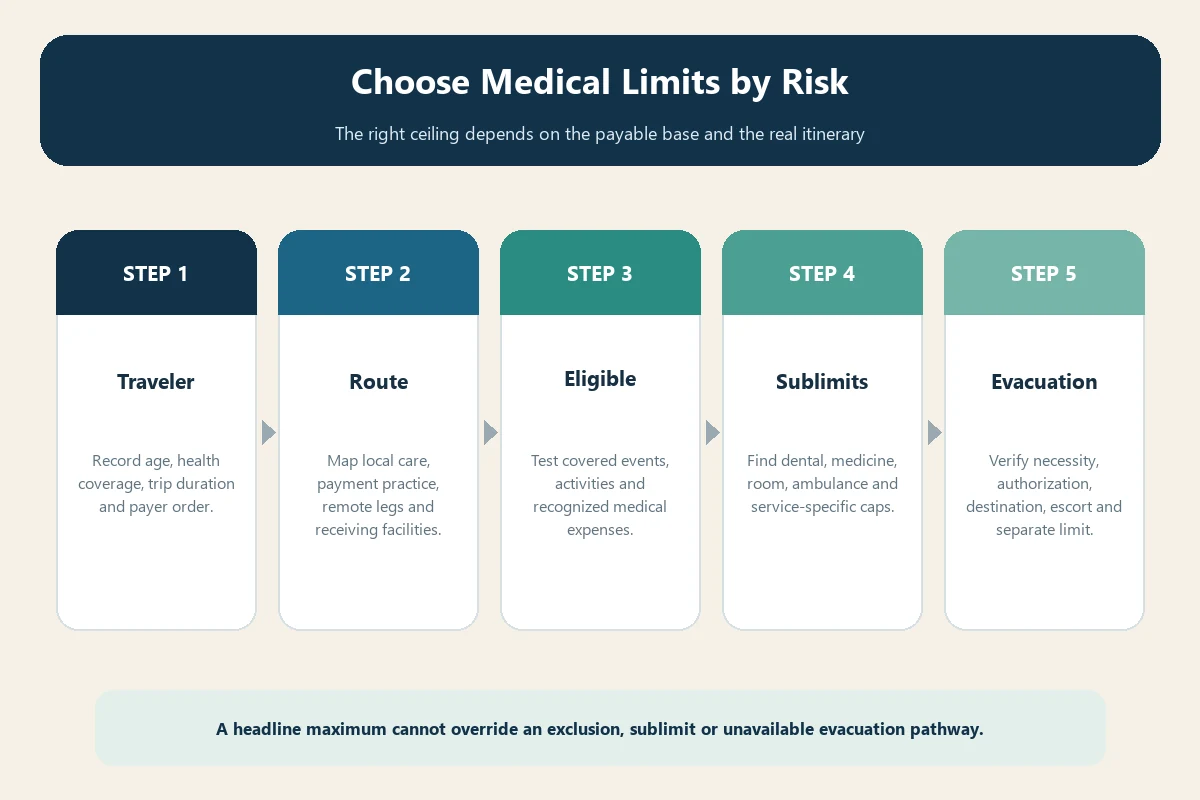
Travel medical insurance policy limits should be chosen by testing what counts toward each limit, which smaller ceilings apply and how the real itinerary changes exposure. One impressive maximum can hide separate caps for evacuation, dental care, prescriptions, room charges or activities.
Key takeaways
- Compare medical, evacuation and service-specific limits separately.
- Ask whether the limit is per person, incident, trip or policy period.
- Model deductible, coinsurance and excluded charges before estimating the traveler’s share.
- Check age bands, trip duration, destination, activities and existing U.S. coverage.
- Reject universal limit recommendations that are not tied to a policy and route.
Planning information reviewed August 16, 2026. Medical costs, provider practices, policy limits and government guidance can change. This framework does not recommend one dollar amount for every traveler.
Define every number on the benefit schedule
Start with the overall medical maximum, emergency evacuation maximum, repatriation limit, dental limit, prescription limit, local ambulance limit and any companion or bedside-visit benefit. Copy the exact label and policy section beside each number.
Ask whether the amount applies per insured person, per incident, per trip or across an annual policy period. Two plans with the same displayed medical maximum can produce different results when one renews per trip and another aggregates claims.
Separate a maximum from an eligible expense
A limit is the most the insurer will pay under stated conditions. It does not make an excluded treatment eligible. The expense must first satisfy the definitions of covered sickness or injury, medical necessity, coverage dates, geographic area and recognized provider.
Review the coverage limits guide for the difference between a headline number and the payable base. A plan with a lower maximum but fewer relevant sublimits can outperform a larger headline in one scenario.
Map the traveler’s existing coverage
The U.S. Department of State’s travel insurance guidance recommends asking the domestic health insurer about emergency and routine care abroad. Obtain the geographic, network, authorization and claim-filing answer in writing.
Medicare’s official travel outside the U.S. page says Medicare usually does not cover foreign care, with narrow exceptions. Medigap or employer coverage may add a layer. Do not count any payer until its actual document supports the itinerary.
Build a destination care pathway
Identify likely first care, higher-capability care and a practical evacuation destination for each remote segment. Review the State Department country page and CDC destination health page. Provider capacity and payment expectations matter alongside nominal treatment prices.
The health insurance abroad guide provides a route-based worksheet. A destination with cash-first providers creates a liquidity issue even when the final eligible claim fits under the limit.
Evaluate the medical maximum
Model a plausible sequence rather than one average visit: assessment, imaging, admission, physician services, medicines, follow-up and local transport. Ask whether eligible charges are reduced to a usual, reasonable or negotiated amount before the maximum is applied.
Do not turn a hypothetical sum into a forecast. The purpose is to expose the policy mechanics. The insurer can pay no more than eligible charges after exclusions, deductible, coinsurance, other insurance and the applicable maximum.
Evaluate evacuation separately
Evacuation is not simply a larger medical bill. Ask who determines necessity, chooses the receiving facility and arranges transport. Check medical escort, commercial flight, air ambulance, companion and return-home language.
The evacuation limits guide focuses on operational wording. A high limit cannot guarantee safe weather, aircraft availability, border permission or a receiving bed.
Find every sublimit
Search the certificate for “maximum,” “limit,” “per day,” “per visit,” “per tooth,” “per prescription,” “per occurrence” and “aggregate.” Review hospital room, intensive care, therapy, dental, medicine, ambulance and medical-device provisions.
A service sublimit can stop payment before the overall maximum is reached. Create a separate line for each cap and whether deductible or coinsurance is applied before or after it. Ask the insurer to identify the governing clause, not just confirm that a service is “covered.”
Calculate the deductible effect
A deductible can apply per person, incident, trip or period. Confirm whether it attaches to the combined eligible medical claim or separately to categories of service. A repeated deductible changes the traveler’s exposure on a trip with several unrelated events.
The travel insurance deductible guide offers comparison examples. The zero-deductible guide explains why removing one cost-sharing layer does not remove exclusions, coinsurance or sublimits.
Calculate coinsurance and allowed amounts
Coinsurance is a percentage of a covered or allowed amount after the deductible under many health-plan structures. The official HealthCare.gov coinsurance definition illustrates the sequence, but a short-term travel policy may use different terms.
Ask whether the percentage changes by network, country, facility or service. Determine who bears a provider charge above the amount the insurer recognizes. Do not assume the displayed medical maximum also caps every possible out-of-pocket charge.
Look for an out-of-pocket maximum
HealthCare.gov defines an out-of-pocket maximum for Marketplace plans and lists costs that may not count toward it. A travel medical certificate is not automatically a Marketplace plan and may have no comparable protection.
Search for explicit language. If none exists, model the deductible, coinsurance, noncovered expenses and charges above recognized amounts separately. Never infer an out-of-pocket cap from the medical benefit limit.
Check age-based limits
Some products change the medical maximum, deductible or eligibility at an age band. Record each traveler’s age on the effective date and confirm whether the number shown in a quote matches the certificate. A family comparison should not apply one limit to every member without verification.
Ask whether renewal or a birthday during a long trip changes coverage. Save the quote, application answers, schedule and issued policy. Marketing tables can omit age-specific conditions.
Check trip-duration rules
An annual plan may cap the length of each journey even while the policy remains active. A single-trip plan may end on a fixed date, after return home or when a maximum duration is reached. Extension terms can require purchase before expiry.
Match every travel day, side trip and transit country to the coverage period. A large maximum does not apply outside eligible dates. Long-term travelers should also distinguish short-term travel medical coverage from comprehensive international health insurance.
Check activity eligibility before limit size
Scuba diving, climbing, skiing, racing, motorcycling and remote expeditions can be excluded or limited. Give the insurer the certification, depth, altitude, guide, equipment and competition status. An activity exclusion can reduce an apparently large limit to zero for that event.
The activity exclusions guide helps compare medical, rescue and evacuation as separate clauses. Record any upgrade or endorsement on the issued schedule.
Test pre-existing-condition wording
A look-back period, stability definition or time-sensitive waiver can affect otherwise eligible treatment. Do not assume the limit says anything about the condition. Preserve the first trip payment, policy purchase and requested medical disclosures.
The pre-existing condition guide separates waiver eligibility from the maximum. Ask how an acute recurrence and ongoing expected care are treated.
Run three severity scenarios
Use identical policy terms in three examples: a minor outpatient event, a hospital admission and a remote event requiring authorized transfer. For each, list eligible expense, service sublimit, deductible, coinsurance, other insurance and benefit payment.
This stress test reveals which number actually binds. The minor claim may be dominated by a deductible, the admission by a service sublimit, and the remote event by evacuation authorization rather than the overall medical maximum.
Compare payment operations
The CDC’s travel insurance page advises travelers to examine existing coverage and notes the value of a policy that can make payments to hospitals directly. Ask whether assistance can issue a guarantee and how long eligibility review takes.
Direct payment is not a benefit-limit increase. It is an operating feature. The traveler may still need a deposit, and the provider can refuse the arrangement. Keep secure contingency funds and request itemized records.
Use assistance and claims correctly
Assistance may locate care, open a case and coordinate an evacuation. Claims applies definitions and limits later. Record every case number, instruction and authorization, especially before a costly nonemergency transfer.
The assistance versus claims guide explains the handoff. A verbal statement should be followed by written confirmation tied to the certificate whenever circumstances allow.
Create a limit comparison matrix
Use rows for outpatient care, inpatient care, ambulance, prescription, dental, evacuation, repatriation and companion benefits. Use columns for eligible event, service limit, aggregate limit, deductible, coinsurance, authorization, other-payer order and evidence.
Mark unknowns rather than filling them with assumptions. Ask the insurer the same scenario for every quote. Save the response beside the final policy so the comparison remains auditable.
Reconcile currencies and provider balances
A limit may be stated in U.S. dollars while the provider bills in another currency. Ask which date and conversion method the insurer uses. Preserve the original invoice, card settlement and explanation of benefits so the calculation can be reproduced.
Determine whether a charge above the insurer’s recognized amount remains payable to the provider. A policy can stay below its maximum while the traveler still owes an excluded service, coinsurance share or provider balance. Add these liabilities to the comparison matrix instead of presenting the maximum as complete protection.
Bottom line
The correct limit is not a universal number found in a search result. It is a set of policy ceilings that must fit the traveler, route, activities and existing coverage. Compare eligible expenses, sublimits, cost sharing, evacuation operations and provider payment together, then preserve the document that controls each number.
A large medical maximum can still contain smaller ceilings. Use the travel medical insurance sublimits guide to check room, dental, medicine, therapy and transport caps before comparing plans.
Rehabilitation may have its own referral, visit and timing rules. Check the travel medical insurance physical therapy guide before arranging repeat treatment abroad.
