

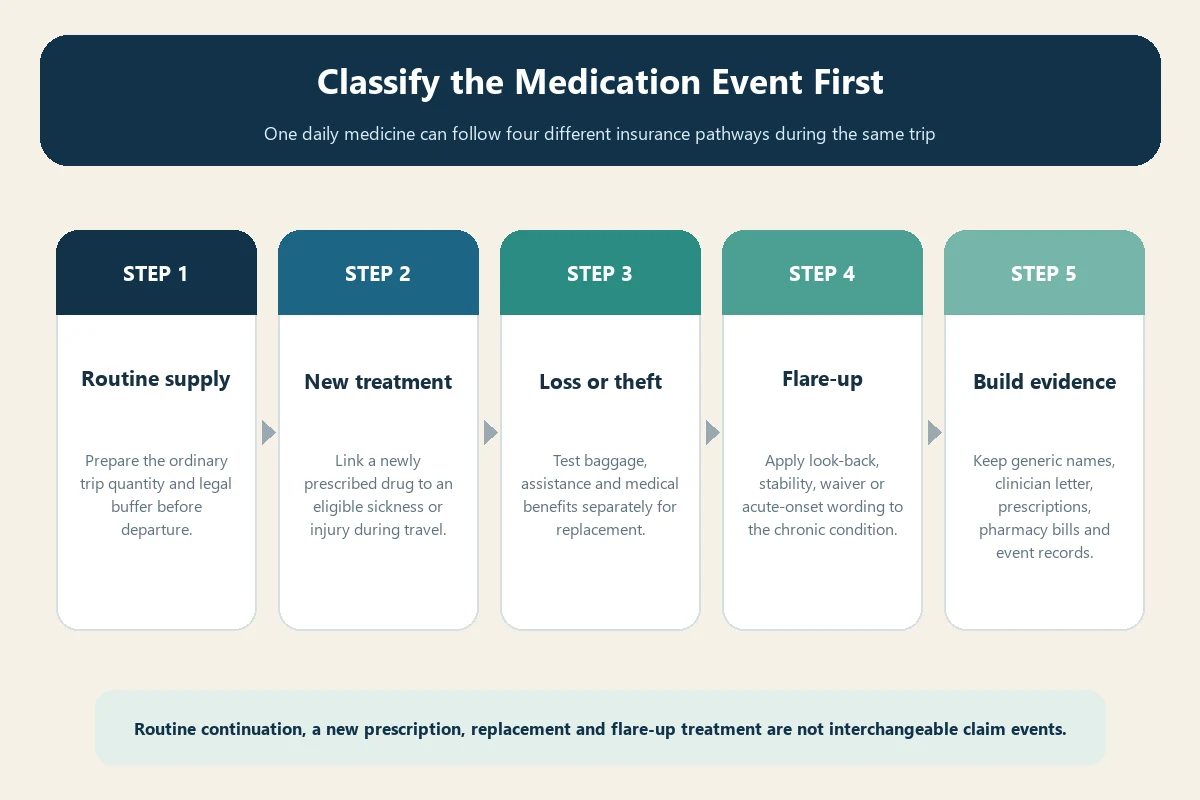
Travel medical insurance for chronic medication should be evaluated as four separate events, not one promise. Routine medicine brought from home, a new prescription after an unexpected illness, replacement of lost tablets and treatment for a chronic-condition flare-up can receive four different coverage decisions under the same certificate.
This guide helps U.S. travelers prepare medicine legally and test insurance wording. It does not recommend changing a dose, substituting a product or traveling against medical advice. Make clinical decisions with the prescribing professional and check destination law with the appropriate embassy or health authority.
Key takeaways
- Plan and pay for the ordinary trip supply unless the certificate explicitly says otherwise.
- Separate a new prescription for a covered event from continuation of medicine required before departure.
- Lost or stolen medication may involve baggage or assistance services without making the replacement drug a medical benefit.
- A dose change, symptom flare or recent treatment can affect a pre-existing-condition look-back test.
- Carry original packaging, generic names, prescription copies, a clinician letter and extra supply permitted by law.
Reviewed August 16, 2026. Medicine rules and insurance forms change; verify current destination requirements and the issued certificate.
Build the four-event map first
Write four rows: routine supply, new covered prescription, lost or stolen supply, and flare-up treatment. Add the likely benefit or exclusion beside each. This simple map prevents a misleading yes-or-no answer from being applied to every medication expense.
The prescription medication insurance guide explains the broader claim categories. This article focuses on the additional timing and stability issues created by daily treatment for a chronic condition.
Assume routine medicine is a planned expense
Medicine the traveler already needs before departure is generally foreseeable. Many travel medical certificates are designed for unexpected sickness or injury during the trip, not regular refills. Some forms expressly exclude treatment or medication that must continue during travel.
Ask the domestic health plan or pharmacy about vacation overrides and quantity limits early. CDC guidance notes that some insurers pay only for a 30-day supply, so longer travel can require coordination with the prescriber and insurer.
Distinguish a new prescription from ongoing supply
A physician abroad might prescribe an antibiotic for a newly covered infection or pain medicine for a covered injury. That drug can be tested as part of the eligible event. The same pharmacy visit might also include the traveler’s ordinary blood-pressure medicine, which follows a different rule.
Ask the pharmacy to itemize products separately. The medical record should connect the new drug to the new diagnosis and state the treatment date, strength, quantity and generic name.
Treat lost medicine as its own event
Loss does not create a new illness. A policy might offer assistance with locating a pharmacy, a baggage benefit for a stolen item or a limited prescription-replacement service. None of those automatically means the medical-expense benefit reimburses the refill.
Record when, where and how the loss occurred. Obtain a police or carrier report when required, keep replacement receipts and ask which benefit receives the claim. Do not report ordinary depletion as loss.
Test a flare-up under the pre-existing-condition definition
A chronic condition may be stable clinically yet still meet a contractual pre-existing-condition definition. Review the look-back period for symptoms, treatment received, treatment recommended, medication changes, tests or advice. Build the timeline before requesting a quote.
The look-back period guide turns those terms into dated questions. Use records rather than memory, especially after a recent refill, dose adjustment or specialist contact.
Understand stability without inventing a universal rule
There is no single market-wide stability period. One certificate may use a defined look-back window, another may focus on treatment or symptoms, and another may offer only a narrow acute-onset benefit. A clinician’s view that the condition is “stable” is important medically but does not replace the contract definition.
Ask the insurer to identify the exact clause that applies to a recent medication change. Save the form number, edition and written response with the quote.
Evaluate a pre-existing-condition waiver
A waiver can remove a pre-existing-condition exclusion if every requirement is satisfied. Typical conditions may involve a purchase deadline, required trip-cost coverage and medical ability to travel when the plan is bought. Each form differs.
Use the pre-existing-condition waiver checklist to preserve purchase and eligibility evidence. The waiver does not convert ordinary refills into unexpected medical expenses unless the certificate says so.
Prepare enough lawful supply
The CDC’s chronic illness travel guidance advises carrying enough medicine for the trip plus extra for delays. Determine how much the destination permits and how it must be declared. Longer stays may require additional authorization.
Keep medicine in original labeled packaging and in carry-on luggage when permitted. Split critical supplies only when the prescriber, security rules and storage requirements allow it.
Use generic names and a clinician letter
Brand names vary between countries. Ask the prescriber for a letter listing the condition, generic drug name, dose, schedule, allergies and necessary equipment. Bring copies of prescriptions and the clinician’s contact information.
The U.S. Department of State medicine guidance recommends original packaging, copies of prescriptions and a doctor letter. It also warns that a medicine legal in the United States can be restricted abroad.
Check every country on the itinerary
Rules can apply at transit airports as well as the final destination. Contact the foreign embassy for each country and verify controlled-substance, psychotropic, injectable, refrigerated and quantity rules. Save official written instructions or permit approval.
Do not rely on a travel forum screenshot. Destination law can change, and informal advice may omit transit or customs requirements.
Plan storage, refrigeration and equipment
Temperature-sensitive medicine needs an approved transport and storage plan. Confirm airline rules for cool packs, needles, pumps and spare batteries. Ask the accommodation about refrigeration without assuming a minibar maintains a medical storage range.
Insurance may cover an eligible new medical event without covering spoiled medicine caused by improper storage. Identify the cost and replacement plan before departure.
Compare emergency assistance with insurance payment
An assistance center can locate a doctor, translator or pharmacy and may help communicate with the prescriber. That service does not decide the final claim by itself. Ask whether prescription replacement is a service, an insured expense or both.
The primary care coverage guide helps plan the first clinical evaluation abroad. A valid local prescription may be required even when the traveler has a U.S. prescription copy.
Prepare for brand and formulation differences
A drug sold under a familiar name can have a different formulation or may be unavailable. Never substitute solely on the advice of a hotel, driver or unverified seller. Use a licensed clinician and pharmacy, and confirm the generic ingredient and strength.
Counterfeit medicines are a known travel risk. Bring the permitted supply from home rather than planning to buy routine medicine at the destination.
Handle a dose change before departure
A recent increase, decrease, new drug, stopped drug or rescue medication can matter to both medical planning and insurance timing. Ask the prescriber whether the traveler is fit for the itinerary and what warning signs require care.
Then compare the dated change with the certificate’s look-back language. Do not delay necessary treatment to satisfy an insurance condition.
Plan for an unexpected dose change abroad
If a clinician abroad changes treatment because of an eligible new event, keep the diagnosis, rationale, old and new dose, prescription and follow-up plan. If the change responds to the underlying chronic condition, the pre-existing-condition analysis may apply.
The follow-up care guide helps connect repeat visits and prescriptions to the original episode. Ask what happens after the traveler returns home.
Coordinate domestic and travel coverage
The domestic plan may fund the advance supply while the travel policy addresses an unexpected eligible event abroad. If the travel plan is secondary, it may require an explanation of benefits from the domestic insurer. Identify the payer for each row of the four-event map.
The health insurance abroad guide provides a coverage-gap worksheet. Do not assume a pharmacy network or manufacturer program operates internationally.
Calculate the real medication exposure
List the replacement value of the routine supply, expected dispensing fees, clinician visit, laboratory tests and possible hospitalization. Compare those costs with deductible, coinsurance, prescription sublimits and the overall medical maximum.
The travel medical benefits guide shows how separate charges can share one maximum. A small drug invoice might depend on an excluded visit or diagnosis.
Assemble a medication claim file
Keep the pre-trip medicine list, clinician letter, prescriptions, original labels, loss report if relevant, overseas physician report, itemized pharmacy invoice and payment proof. Show which medicine was routine and which was newly prescribed.
The claim documentation guide provides a submission ledger. Never alter a receipt or ask a clinician to omit a pre-existing diagnosis.
Use official insurance guidance as the baseline
The CDC Yellow Book’s insurance guidance recommends confirming overseas health coverage, pre-existing-condition terms and reimbursement rules. It also advises carrying health records and current medicine information.
NAIC’s current consumer travel insurance guide emphasizes that each policy sets its own covered situations and exclusions. That is why the four-event map must be completed against an actual certificate.
Run a realistic delay-and-loss scenario
Imagine a traveler takes two daily medicines and packs a permitted ten-day buffer. A flight disruption adds three days, then one container is stolen. The traveler also develops an unrelated infection requiring a new antibiotic. Test the ordinary buffer, theft report, replacement assistance, local prescription, new covered illness and three different invoices.
A plan that handles the antibiotic may still deny the routine refill. A baggage benefit may address the stolen item while a medical benefit handles the physician visit. The scenario exposes those boundaries before travel.
Ask these questions before buying
- Is medication required to be continued during the trip excluded?
- Are prescriptions for a newly covered sickness or injury eligible?
- Does the plan reimburse lost or stolen medicine, or only help replace it?
- How does the look-back definition treat refills, tests and dose changes?
- Does a waiver apply, and which expenses remain routine or excluded?
- Are there prescription sublimits, deductibles or authorization rules?
- What happens if treatment continues after return home?
- Which medical, pharmacy and loss records must accompany a claim?
Make the final medication decision
Do not buy a plan based on the phrase “prescription coverage.” Prepare the routine supply lawfully, test the chronic condition under the exact look-back rule, and classify new treatment, loss and flare-ups separately.
The safest plan is operational as well as contractual: the traveler has enough permitted medicine, a clinician letter, accessible records, a licensed-care pathway and an insurance certificate whose limits and exclusions match the specific events that could occur.
Diabetes adds equipment, temperature and emergency-treatment questions. Use the travel medical insurance for diabetes guide to test insulin supply, device failure and complications separately.
Autoimmune disease creates both flare and infection pathways. Use the travel medical insurance for autoimmune disease guide to test medicine, planned treatment and emergencies separately.
A recent prescription event needs its own timeline. Use the travel insurance medication change and pre existing condition guide to classify starts, stops, dose adjustments, substitutions and routine refills.
Medicare Part D generally does not pay for prescriptions purchased outside the United States. Use this Medicare Part D travel medication plan to arrange supply, vacation overrides, lawful transport, storage, loss, and emergency backup before departure.
Scheduled dialysis abroad, an unexpected medical emergency, and trip cancellation are three different coverage questions. Use this senior dialysis travel insurance planning guide to align treatment, pre-existing-condition rules, supplies, transport, and claims before booking.
Taking a blood thinner is not one insurance risk: the underlying condition, medication continuity, bleeding, thrombosis, cancellation, and evacuation follow different rules. Use this senior blood thinner travel insurance guide to plan supply, monitoring, emergencies, and claims.
Parkinson’s travel planning must align medication timing, mobility, communication, rest, assistance, and insurance. Use this senior Parkinson’s travel insurance guide to test pre-existing-condition rules, delay, cancellation, emergencies, companion needs, and evacuation.
Travel insurance for epilepsy depends on the seizure timeline, medication stability, recent care, activity, and policy—not the diagnosis alone. Use this senior epilepsy travel insurance guide to plan medicine, support, emergency response, cancellation, interruption, and evacuation.
Traveling with several medicines is a system problem: every prescription, prescriber, refill, time zone, storage rule, interaction, and backup must align. Use this senior multiple-medication travel insurance guide to plan continuity, pre-existing conditions, emergencies, and claims.
