
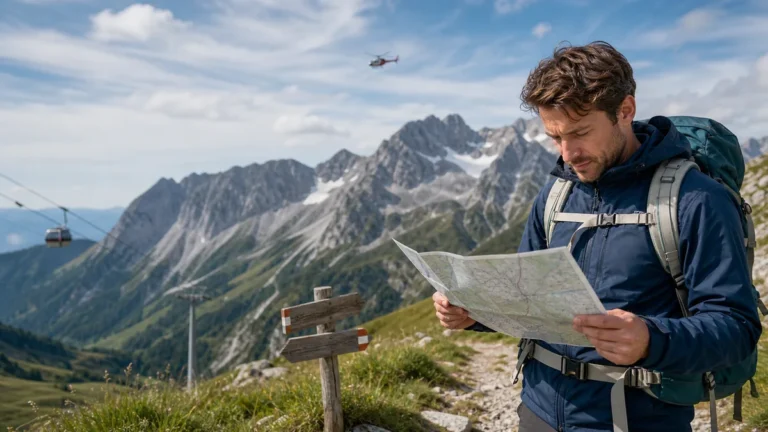
Travel insurance for Austria from USA trips should be matched to the route, not purchased from a destination label alone. A Vienna museum weekend, an Alpine hut hike and a ski holiday can expose a traveler to very different medical-payment, mountain-rescue, activity and transport risks.
Key takeaways
- Confirm how overseas treatment is paid because U.S. health coverage and Austrian providers may not coordinate directly.
- Check mountain search and rescue separately from emergency medical evacuation.
- Declare skiing, hiking, climbing, cycling and any guided or high-altitude activity before purchase.
- Cover the complete trip, including neighboring countries, overnight flights and rail or road connections.
- Use the insurer’s assistance service early and preserve medical, transport and payment records.
Trip-planning information reviewed August 16, 2026. Policy terms, Austrian operating conditions and entry rules can change; verify them before departure.
Start with the actual Austria itinerary
Write the route as a sequence of dates and activities. Include the U.S. departure, arrival airport, city nights, mountain bases, day trips, border crossings and return. Add every booked activity: downhill or cross-country skiing, snowboarding, snowshoeing, hiking, via ferrata, climbing, cycling, paragliding or a guided glacier excursion.
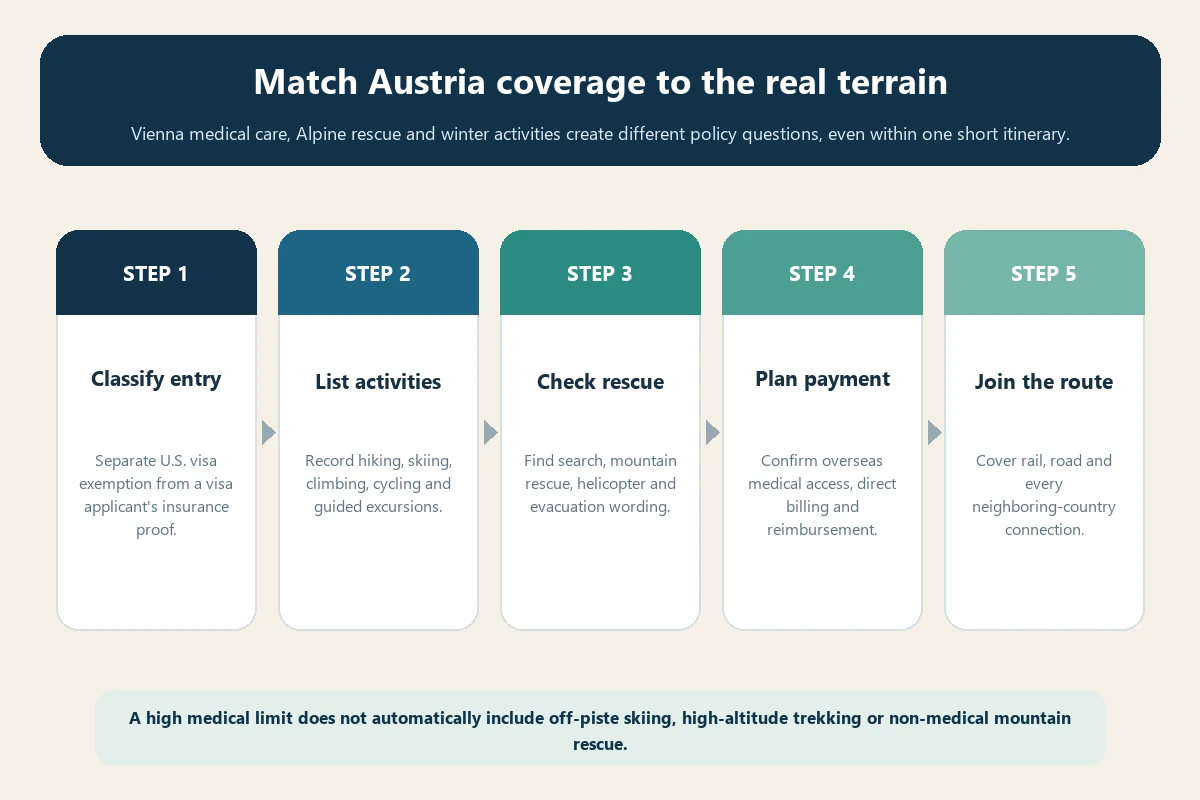
This list prevents a common mismatch. A plan can have a large emergency-medical maximum while excluding the activity most likely to generate the claim. A policy may cover an injury on a marked walking trail but restrict technical climbing, off-piste skiing or participation above a stated elevation. Definitions, not the marketing label, control.
If Austria is one stop on a longer route, use the multi-country Europe insurance guide to align dates and territory across the entire journey.
Entry rules and private insurance are different questions
Many U.S. citizens visit the Schengen Area for short tourism without applying for a traditional visa, subject to the current entry rules. A traveler who must apply for a Schengen visa can face formal insurance-proof requirements. Nationality, residence, passport, purpose and duration determine the entry procedure; the policy seller does not.
For a visa application, compare the certificate with the current authority checklist and the Schengen travel insurance requirements. For a visa-exempt tourist, private insurance remains a financial and assistance decision rather than proof that grants admission.
Do not confuse a future travel authorization, an entry stamp and an insurance contract. Each has a separate function. Insurance cannot cure an immigration defect, and visa-exempt status does not pay a medical or rescue bill.
Medical care and the payment path
Austria has a developed medical system, but a U.S. traveler’s central insurance question is how a specific provider will be paid. A clinic or hospital can request payment, a deposit or insurance evidence. A U.S. health plan may offer limited overseas benefits, may operate only by reimbursement or may exclude routine out-of-network care.
Ask both insurers precise questions before travel:
- Does the existing U.S. plan cover emergency and urgent care in Austria?
- Is the benefit primary or secondary, and what deductible or coinsurance applies?
- Can the travel insurer arrange direct billing, or must the traveler pay first?
- Which authorization, itemized bills, medical reports and proof of payment are required?
- Does the plan include medically necessary transport and repatriation under separate limits?
The U.S. Department of State’s official travel-insurance guidance advises travelers to understand overseas medical and evacuation coverage before departure. The primary medical coverage guide explains payment order, but “primary” does not guarantee that an Austrian provider will bill the insurer directly.
Mountain rescue is not one benefit
In the Alps, “evacuation” can describe several different services. Search teams may locate a missing or stranded person. Mountain rescue may move that person from difficult terrain. A helicopter can transfer an injured traveler to an appropriate hospital. Medical repatriation may later return the traveler to the United States when medically necessary and approved.
Those services are not interchangeable. Some contracts pay emergency medical transport but exclude non-medical search and rescue. Others impose a separate rescue sublimit, require the event to arise from a covered activity or exclude transport when the traveler is not medically injured. Read the definitions for search, rescue, ambulance, air ambulance, evacuation and repatriation.
Austria’s official visitor-planning information lists the European emergency number 112, ambulance 144 and mountain rescue 140. Save the appropriate numbers offline, but call instructions and dispatch decisions belong to local responders. Insurance authorization should not delay help in a genuine emergency.
The medical repatriation guide shows why transport to a nearby hospital is different from an eventual return home.
Audit skiing, hiking and other activities
Start with the policy’s covered-sports list and general exclusions. Then inspect definitions such as amateur, recreational, organized, competitive, professional, backcountry, off-piste, technical, guided and high altitude. A resort ticket, guide booking or helmet does not automatically bring an excluded activity into coverage.
| Planned activity | Policy language to find | Evidence to retain |
|---|---|---|
| Marked-trail hiking | Elevation, technical terrain and rescue restrictions | Route, weather notices and guide details |
| Resort skiing | Winter-sports rider, piste and equipment terms | Pass, rental record and incident report |
| Off-piste or touring | Explicit backcountry inclusion, guide and avalanche conditions | Guide credentials, itinerary and rescue record |
| Via ferrata or climbing | Technical-climbing grade, equipment and altitude limits | Operator terms and booking confirmation |
| Cycling or e-bike | Road, mountain, competition and motor-assisted definitions | Rental agreement and police report if relevant |
The Austrian National Tourist Office publishes separate practical inspiration for hiking in Austria and snowshoe hiking. Those pages help define the physical itinerary; they do not certify insurance coverage. Send the planned activity description to the insurer and keep a written response with the policy.
Road, rail and neighboring-country connections
Austria is often combined with Germany, Czechia, Slovakia, Hungary, Slovenia, Italy or Switzerland. Verify that the policy’s territory covers every stop and transit. Include a cross-border rental car, night train or separate airline ticket in the timeline.
The tourist office’s official getting-around guide describes Austrian rail, road and local transport options. Insurance does not replace carrier passenger rights. A trip-delay benefit normally requires a covered reason, a minimum delay and contemporaneous carrier evidence. Missed-connection benefits can also distinguish a common-carrier connection from a self-created itinerary.
Driving travelers should read the Europe road-trip insurance guide. Rental-vehicle damage, third-party liability, roadside assistance, personal medical coverage and trip interruption are separate protections.
Read exclusions before comparing limits
A large headline maximum can conceal a decisive exclusion. Review existing medical conditions, alcohol or drug provisions, pregnancy, mental-health care, sports, altitude, epidemics, war, civil disorder, government restrictions, foreseeable events and failure to follow safety rules.
Check whether an existing-condition waiver is available and what purchase deadline or insured-trip-cost rule applies. Do not assume a stable condition is automatically included. If medication is essential, carry it lawfully in original packaging with supporting documentation and plan for delay.
The country-exclusions guide helps distinguish a geographic restriction from an event or activity exclusion. Read the complete policy that applies to the buyer’s U.S. state.
Compare plans with an Austria-specific worksheet
Place the exact policy language beside each risk rather than scoring plans by price alone. Record the medical maximum and deductible; search-and-rescue benefit; medical evacuation and repatriation limit; activity rider; trip cancellation reasons; interruption benefit; delay threshold; baggage and sports-equipment terms; rental-car provisions; and assistance contact.
Also compare the claim process. Note whether notice is required within a specified time, whether the assistance service must approve transport, and whether original documents or translations may be requested. If two clauses conflict, request written clarification or choose a policy whose wording fits the trip more clearly.
What to do if an incident occurs
Protect life and health first. Contact emergency services or appropriate medical care. When reasonably possible, call the insurer’s assistance line, open a case and ask about the provider, authorization and payment path. Save the case number and every instruction.
Collect an itemized invoice, medical report, diagnosis, prescriptions, receipts and proof of payment. For a mountain event, preserve the rescue report and location. For a delay, obtain the carrier’s written cause and timing. For theft or a collision, follow the policy’s police-report requirement.
The travel insurance claim guide provides a document workflow. A phone call can begin assistance, but a formal claim normally still requires the policy’s forms and evidence.
Frequently asked questions
Is travel insurance mandatory for every U.S. tourist visiting Austria?
Not as a universal private-insurance rule for every short U.S. tourist. Travelers who require a Schengen visa can face formal proof requirements. Everyone should verify the current entry rules for the specific passport and trip.
Does U.S. Medicare cover treatment in Austria?
Medicare coverage outside the United States is generally very limited and applies only in defined situations. Travelers should confirm their exact coverage and consider suitable overseas medical and evacuation protection.
Does medical evacuation include Alpine search and rescue?
Not automatically. Search, mountain rescue, helicopter transport, hospital transfer and repatriation can be separately defined and limited.
Will a winter-sports add-on cover off-piste skiing?
Only if the actual wording includes it and all conditions—such as guide, marked-area or avalanche restrictions—are met. “Winter sports” is not a universal definition.
Should one policy cover Austria and neighboring countries?
A single trip policy can simplify dates and claims if its territory and benefits cover the complete route. Confirm every country, transit and activity rather than assuming a Europe label is sufficient.
This article is educational and does not provide legal, medical or insurance advice. Official authorities, local responders and the issued policy control.
