

Travel insurance for Laos from USA trips should be built around limited local care, advance deposits and a realistic cross-border evacuation chain. It should also use current entry guidance, not old COVID-era claims that still appear in commercial search results.
Key takeaways
- Current official guidance recommends insurance; it does not list COVID insurance as an entry requirement.
- Medical facilities are extremely limited and providers often accept cash.
- Serious cases may require ground or air transfer to Thailand.
- Rainy-season roads, landslides and remote routes affect response.
- Regional crime, unrest and unexploded-ordnance guidance must match the itinerary.
Planning information reviewed August 16, 2026. Entry rules, advisories, roads, medical access and policy terms can change. Recheck primary sources and suppliers for the travel dates.
Correct the entry-rule record first
The current State Department Laos travel guidance lists a visa, passport validity and blank-page rules. It highly recommends travel insurance but does not present the old COVID insurance rule as a current entry condition.
The official Lao eVisa FAQ lists passport, photograph and application requirements. Recheck both sources and the carrier before departure. Do not copy a stale commercial mandate.
Map the route by medical access
Separate Vientiane, Luang Prabang, Vang Vieng, southern routes and remote stays. List roads, trains, boats, domestic flights, tours and border crossings. Note communications and the nearest plausible stabilization point.
Use the delay and interruption guide to classify replacement transport and unused bookings.
Plan for extremely limited care
Official guidance says medical facilities and services in Laos are extremely limited and may not meet basic international standards. Tourism and emergency-response infrastructure is limited outside major cities.
Ask assistance where it would direct a traveler for a minor problem and for a serious injury. A directory entry is not proof of capability, acceptance or payment.
Prepare cash and deposit capacity
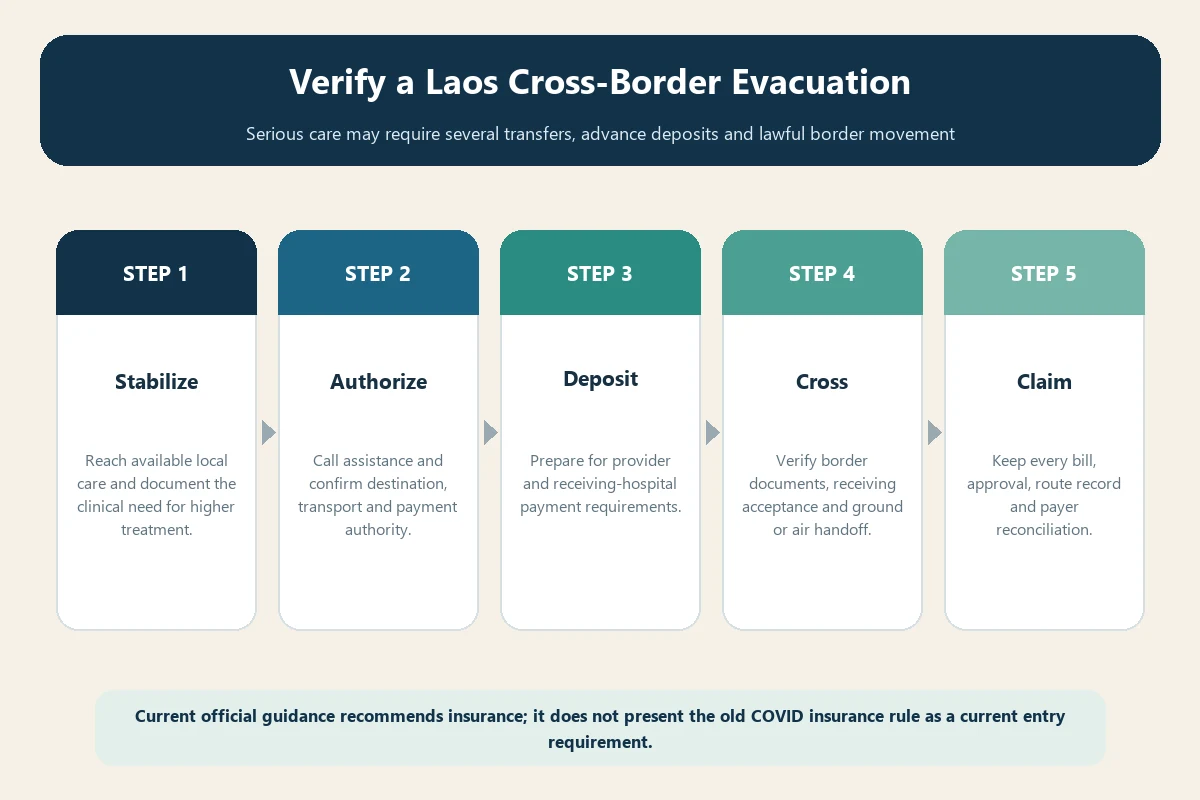
State guidance says most providers accept only cash. It also warns that hospitals in Laos and Thailand can require large deposits before treatment.
Ask whether the insurer can guarantee payment and which facilities accept it. Keep secure backup funds and itemized records. The health insurance abroad guide structures the U.S. plan call.
Build the Thailand evacuation chain
Official guidance says serious cases frequently require evacuation to private hospitals in Thailand by ground or air ambulance. That is an observed operational pattern, not a promise that every patient will go to Thailand.
Ask who determines medical necessity, receiving hospital and transport. Confirm border documents, receiving acceptance and payment. The evacuation planning guide maps each handoff.
Do not assume the highest limit solves access
Weather, road condition, aircraft availability, clinical stability and receiving capacity can delay movement. A large limit cannot create an ambulance or border clearance.
The evacuation limits guide helps compare authority, sublimits and companion benefits. Preserve the treating clinician and assistance decisions.
Audit rainy-season roads
State guidance says road conditions worsen during the rainy season and landslides are common, including on routes between provincial capitals. Avoid night driving and build schedule margin.
Obtain operator cancellation, road closure and alternate-route evidence. The weather-delay guide explains why weather, supplier action and policy thresholds are separate.
Check advisory geography and unexploded ordnance
The current advisory identifies increased-risk provinces, routes, special economic zones and areas with unexploded ordnance. Match each place to the actual itinerary and stay on well-used paths.
The country exclusions guide provides a territorial audit. Insurance cannot make an excluded or officially discouraged activity safe.
Review health guidance by route
The CDC publishes current Laos traveler health guidance. Review it with a clinician for region, season, activities and health history.
Carry lawful medicines in original packaging. Ask the insurer about illness, preventive care and pre-existing conditions rather than assuming all treatment is included.
Test boats, trains and cross-border tickets
List each Mekong boat, railway, bus, domestic flight and Thai connection separately. Ask which qualifies as a common carrier and how missed connections are measured.
Preserve cancellations, refunds and replacement receipts. The ferry guide helps separate river transport, access and onward loss.
Check adventure and motorbike exclusions
Give the insurer exact tubing, kayaking, trekking, climbing or motorbike facts. Include guide, route, protective equipment, vehicle class and lawful license.
The activity exclusions guide supports comparison. Rental availability is not proof of legal or insured use.
Compare one Laos scenario
Use identical ages, dates and prepaid costs. Include Vientiane, a provincial road segment, guided activity, rainy-season closure, local stabilization and proposed transfer to Thailand.
- What entry evidence is actually current?
- How is local care paid?
- Who chooses and accepts the receiving hospital?
- Are ground, air and border stages covered?
- Which regions or activities are excluded?
- What records prove the final cost?
Read the certificate. Do not use stale COVID mandates or universal evacuation assumptions.
Use assistance as a coordinator
Store 1195 for ambulance, the policy number and insurer line offline. Record every representative, instruction and case number.
The assistance versus claims guide explains why a referral is not final coverage approval. Prioritize necessary care and notify promptly.
Build a cross-border evidence file
Keep local diagnosis, cash receipt, transfer recommendation, authorization, vehicle or flight record, border documents, Thai hospital acceptance, deposit and final bill.
The claim guide explains payer reconciliation. Record kip, baht and actual conversions plus all supplier recovery.
Rehearse an offline response
Store route, hotel, emergency contacts, medicines and consent offline. Give a home contact the itinerary and check-in schedule. Carry a power bank and paper contact card.
Practice explaining location without relying on a map link. Remote response becomes harder when data, road access or language fails.
Create a cross-border medical movement packet
Keep a paper and offline digital packet with passport identity page, Lao visa, Thai entry documents appropriate to the traveler, policy certificate, emergency contacts, medicines and consent information. This packet does not authorize a border crossing. It gives assistance and providers accurate material while the relevant authorities determine entry and transport.
Ask the insurer who contacts the Lao clinician, selects the receiving facility, secures Thai acceptance and chooses ground or air movement. Then ask who pays the local provider, ambulance, border handoff and receiving-hospital deposit. A single “evacuation covered” answer is incomplete when different organizations control the stages.
Record contingencies for a traveler who is not clinically stable, a border point that is closed, a receiving bed that is unavailable or a transport provider that requires advance funds. The plan should identify the next decision maker, not promise an outcome that operations cannot guarantee.
Audit railway, road and river failure separately
A train delay, landslide-blocked road and canceled Mekong boat create different evidence. For rail, save the operator notice, scheduled departure and replacement offer. For road, preserve the authority or operator report, affected segment and driver response. For river travel, record water or weather information plus the boat operator’s actual decision.
Map the downstream booking for each segment. A delayed train may affect a hotel check-in; a closed road may prevent reaching an airport; a stopped boat may strand the traveler away from a prepaid tour. Ask the insurer which delay, missed-connection or interruption language applies and what minimum duration or covered reason is required.
Do not purchase the most expensive replacement without checking safe available options. When contact is possible, document guidance from the supplier and insurer. Keep the original refund, any credit and the reasonable replacement cost so the remaining loss is clear.
Prepare a two-currency deposit ledger
A serious case may generate Lao kip costs before Thai baht deposits and bills. Create one row per provider with the local amount, payment method, actual card conversion, date and service. Attach the clinical or transport record that explains the charge. Do not convert all entries using a later web rate when statements show what was actually paid.
Track payment guarantees, temporary holds, refunded deposits and final invoices separately. Ask the receiving hospital when a deposit will be reconciled and in what currency. The claims file should show both the gross amount and any returned value.
Keep personal meals, companion lodging and ordinary transport outside the medical subtotal unless a policy provision may apply. Separating categories prevents a valid clinical bill from becoming difficult to review because unrelated expenses were combined.
Plan for the companion and unfinished itinerary
Ask whether the plan addresses a travel companion, dependent child, bedside visit or return after treatment. Check who chooses travel dates and fare class, and whether prior approval is required. These benefits can have separate limits even when the patient’s evacuation is eligible.
List every unused booking after the incident and request supplier refunds first. Medical evacuation does not automatically reimburse the rest of the trip. A clinician restriction, interruption provision and supplier response may each be needed to support different costs.
Bottom line
Before entering a remote segment, run a final go-or-change review. Check the current advisory, road or river condition, guide contact, communications, nearest practical care and the time needed to reach the next connection. Confirm that paper documents, emergency cash and prescribed medicine remain accessible rather than locked in transported luggage. Share the decision with the home contact. If one dependency fails, change the route while ordinary transport is still available. That operational margin can matter more than selecting a higher headline limit with no workable access plan.
A strong Laos plan uses current entry guidance and a verified cross-border medical workflow. Prepare for cash deposits, limited care, rainy roads and regional exclusions, then preserve every handoff from local stabilization to final reimbursement.
