
Travel insurance for seniors with mobility equipment should be compared as a recovery system, not as one baggage limit. If a wheelchair, scooter, walker, power attachment, or other assistive device is delayed or damaged, the airline, travel insurer, equipment policy, homeowner policy, card benefit, and traveler can have different duties and limits. The fastest path to restored mobility may not be the same as the final payer.
This U.S.-focused guide creates an equipment recovery file. It does not give legal, medical, or insurance advice and does not rank providers. Airline rights, international treaties, destination rules, and issued policy terms can differ.
Key takeaways
- Inventory the device, accessories, batteries, configuration, value, and repair contacts before travel.
- Keep airline liability separate from travel-insurance baggage coverage.
- Check whether assistive devices are excluded, specially limited, or subject to depreciation.
- Plan temporary rental or replacement for the destination rather than waiting for reimbursement.
- Photograph condition and file with the responsible party promptly.
Reviewed August 16, 2026. “Baggage,” “personal effects,” “assistive device,” “actual cash value,” “reasonable repair,” and “secondary coverage” are contract-defined or legally defined terms.
Build one equipment recovery file
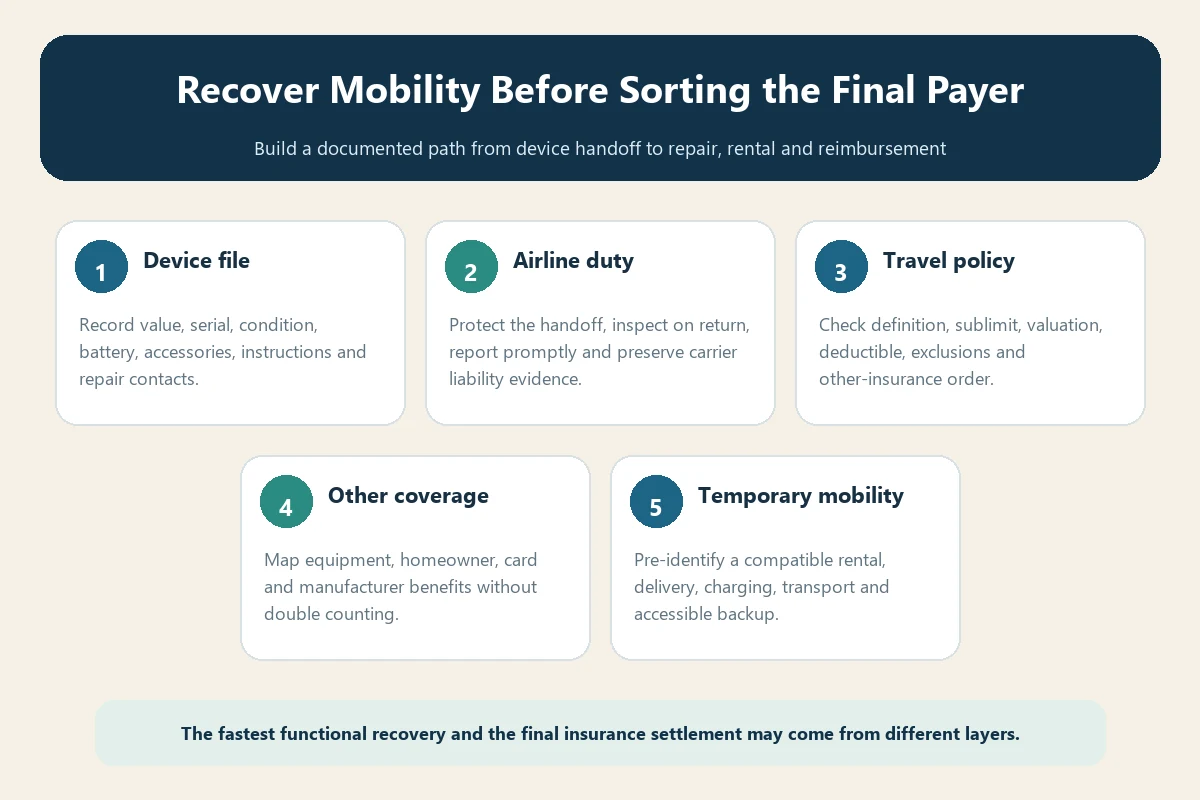
List the chair, scooter, walker, cane, prosthetic component, pressure cushion, charger, battery, controller, mount, ramp, and specialty accessories. Record make, model, serial number, dimensions, weight, battery chemistry, voltage, folding or disassembly method, replacement value, original purchase proof, current condition, and U.S. repair contact.
Add clear handling instructions and photographs from every side. Mark the components that must not be removed and the safe lifting points. Keep a copy on the device and another offline on the phone. The U.S. Department of Transportation recommends sharing size, weight, battery type, and written assembly or disassembly information with the airline.
Layer 1: know the airline’s assistive-device duties
DOT says airlines must stow qualifying assistive devices without a checked-bag fee when cabin storage is unavailable, return them promptly near the aircraft door unless the passenger requests otherwise, and return them in the condition received. U.S. disability rules also provide rights to assistance and information about aircraft limitations.
For damage on a domestic flight, DOT explains that airline liability can reach the original purchase price of the device. For international travel, liability is governed by the applicable treaty and may be lower than the full value. Do not turn that distinction into a claim estimate without checking the itinerary and current legal limit.
Airline liability is not travel insurance. If the carrier caused the loss, file with the airline immediately, obtain the incident or mishandled-baggage number, request a Complaints Resolution Official when appropriate, and keep the damaged device available for inspection unless safety requires repair.
Layer 2: audit the travel policy’s baggage definition
Search the certificate for wheelchair, mobility aid, assistive device, medical equipment, prosthetic, baggage, personal effects, fragile item, electronic equipment, motorized vehicle, battery, wear and tear, and unattended property. Do not assume a wheelchair is treated like an ordinary suitcase.
Copy the applicable maximum and every sublimit. Mark whether payment is replacement cost, actual cash value, depreciated value, or reasonable repair cost; whether the benefit is primary or secondary; and whether carrier reimbursement must be pursued first. The travel medical insurance for mobility aids guide separates medical treatment involving an aid from damage to the equipment itself.
Layer 3: look for equipment, homeowner, and card coverage
A dedicated equipment policy, homeowner or renter policy, manufacturer program, dealer service plan, or credit-card benefit may address loss outside the travel policy. Record territory, deductible, valuation, exclusions, repair network, and coordination with other insurance for each.
Do not count the device’s full value several times. Create one column for each potential payer and one column for the unreimbursed balance. Ask what proof of settlement or denial each secondary payer requires.
Layer 4: fund temporary mobility first
Restoring function can be more urgent than resolving liability. Before departure, identify rental or loan providers at the destination and along the route. Check delivery time, compatible seating and controls, weight capacity, charger and voltage, battery range, hotel storage, transport fit, and weekend availability.
The State Department recommends researching wheelchair or medical-equipment providers at the destination. The CDC advises checking accessibility and necessary accommodations throughout the itinerary. Save two realistic vendor options; a generic promise of “rental reimbursement” is not useful if no suitable device can be delivered.
Ask the travel insurer whether temporary rental is an eligible expense, which benefit applies, whether preauthorization is required, and whether a daily or total sublimit applies. Ask the airline what immediate interim assistance it will arrange after a delayed or damaged device.
Layer 5: separate equipment loss from medical consequences
A damaged chair can cause a fall, pressure injury, missed medication, or inability to reach care, but equipment damage and medical treatment may be evaluated under different benefits. Seek appropriate medical care first. Document the medical event, device condition, relationship between them, and all transport or accommodation changes.
A travel medical benefit does not necessarily pay to replace the chair, and a baggage benefit does not pay hospital bills. If evacuation becomes necessary, review the medical evacuation preauthorization guide rather than assuming the equipment claim authorizes transport.
Compare the four equipment events
| Event | First operational contact | Policy question |
|---|---|---|
| Device delayed by airline | Airline baggage or disability desk | Does delay pay rental, transport, or essentials? |
| Device damaged by airline | Airline and CRO if needed | Is travel coverage secondary after carrier liability? |
| Device stolen from hotel or vehicle | Local police and property operator | What unattended-property and security rules apply? |
| Mechanical failure without external damage | Repair vendor or manufacturer | Are breakdown and wear excluded? |
These are not interchangeable losses. A baggage-delay benefit may cover defined essentials without paying the device value. Mechanical breakdown or gradual wear may be excluded even when theft is covered.
Prepare the airline handoff
- Confirm aircraft type, cargo-door dimensions, battery rules, and connection time.
- Request mobility assistance and seating accommodations directly with every airline.
- Provide the equipment information sheet and retain a copy.
- Remove detachable controls, cushions, and critical accessories when permitted and practical.
- Photograph the device at the handoff with a timestamp.
- Obtain the airline’s device tag or receipt.
- Inspect before use at arrival and report damage immediately.
DOT says a powered-wheelchair traveler must arrive one hour before the normal check-in time. Other advance-notice rules can apply for battery packaging or smaller aircraft. Confirm the current rule and carrier procedure for the actual flight.
Use TSA and destination accessibility resources
TSA Cares can answer questions about screening and facilitate support for travelers with disabilities and medical conditions. Screening assistance is separate from airline loading, travel insurance, and destination accessibility.
Each destination can use different disability, transport, battery, road, and building standards. Review the State Department destination page, hotel details, vehicle dimensions, charging power, local repair resources, and emergency numbers. The accessible travel insurance guide provides a contract-and-itinerary checklist that also applies outside Europe after replacing the destination rules.
Calculate the real equipment exposure
Use five amounts: repair or replacement value, international carrier-liability shortfall, travel-policy sublimit, deductible and depreciation, and temporary mobility cost. Then add the cost of changed transport or accommodation that no policy covers.
The site’s baggage delay and loss guide explains why delayed-property benefits, lost-property benefits, and airline payments use different evidence. Price a travel plan only after the device-specific shortfall is visible.
Build the claim packet before departure
- Purchase invoice, valuation, serial number, and ownership evidence
- Pre-trip condition photographs and service record
- Handling, folding, battery, and repair instructions
- Airline tag, handoff time, incident report, and CRO notes
- Police or property report for theft
- Repair estimate, technician report, and replacement quote
- Rental agreement, delivery bill, accessible transport receipts, and refunds
- Carrier payment or denial and every other-insurance decision
- Travel certificate, declarations, sublimits, and claim correspondence
The claim-document guide offers a useful chronology template even when the primary loss is equipment rather than evacuation.
Questions to ask the insurer
- Is the exact device an insured personal effect or an excluded motorized item?
- Which overall limit and sublimit apply to the device and accessories?
- Is payment repair cost, replacement cost, or depreciated value?
- Must airline, homeowner, or equipment coverage pay first?
- Does baggage delay pay for a suitable temporary rental?
- Are delivery, accessible taxi, hotel storage, or charging costs eligible?
- Is mechanical breakdown excluded?
- How are batteries, controllers, cushions, and detachable parts valued?
- What notice and proof are required before repair?
- Does a medical consequence use a separate deductible or claim?
FAQ about senior travel insurance for mobility equipment
Does travel insurance cover a wheelchair or scooter?
It depends on the certificate’s definitions, exclusions, baggage limit, device sublimit, valuation, and other-insurance rules. The airline can be the first responsible party when damage occurs in its custody.
Who pays if an airline damages a wheelchair?
DOT says the airline is responsible when it damages the device, with the recoverable amount depending partly on domestic versus international travel. A travel or equipment policy may address a remaining eligible shortfall.
Will travel insurance rent a replacement wheelchair?
Only if the issued policy contains an applicable benefit and the expense meets its terms. Verify suitability, authorization, limit, and local availability before travel.
Is mechanical breakdown covered?
Often it is treated differently from accidental damage, theft, or airline mishandling. Search the policy for breakdown, defect, wear and tear, and maintenance exclusions.
Bottom line
Senior travel insurance for mobility equipment is strongest when it supports rapid recovery without confusing the final payer. Document the device, control the airline handoff, audit every equipment sublimit, pre-plan a suitable temporary replacement, and preserve the carrier and policy evidence. The goal is not merely reimbursement; it is safe mobility throughout the trip.
Sources
- U.S. Department of Transportation — Assistive Device Stowage, Damage, and Delay
- U.S. Department of Transportation — Airline Passengers with Disabilities Bill of Rights
- U.S. Department of State — Accessibility Needs
- CDC Yellow Book — Travelers with Disabilities
- Transportation Security Administration — TSA Travel Tips and TSA Cares
