
Travel insurance for a senior traveling alone should be tested for what happens when the traveler cannot manage the claim alone. Most policies do not become broader because a person is solo, but payment, medical records, family communication, trip interruption, and evacuation can fail if no one has the policy, consent, funds, or authority to help.
This U.S.-focused guide builds an emergency-delegation matrix while preserving the traveler’s autonomy. It is educational, not insurance, medical, or legal advice. Health-care authority and privacy documents depend on applicable law; the issued policy controls benefits.
Key takeaways
- Solo status is an operational risk, not automatically a separate insured benefit.
- Choose contacts and permissions with the traveler’s explicit consent.
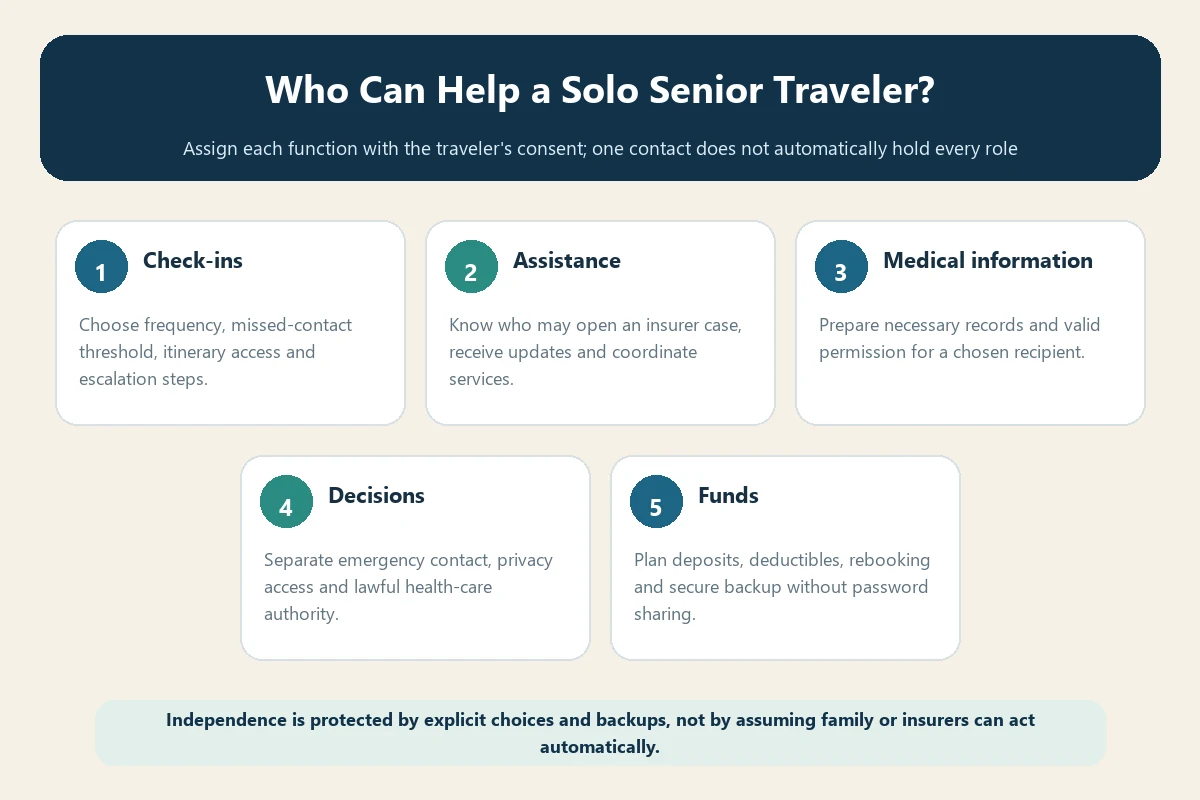
- Separate assistance coordination, claims decisions, medical authority, and payment access.
- Create a check-in plan that fits the traveler rather than imposing constant surveillance.
- Rehearse an emergency from the least accessible point on the itinerary.
Reviewed August 16, 2026. “Traveling companion,” “family member,” “authorized representative,” “assistance,” and “emergency contact” can have different legal and policy meanings.
Start with the solo-trip operating profile
Record destinations, dates, accommodations, transport, activities, cruises or tours, connection times, language, mobile service, current health coverage, medications, mobility or sensory needs, and prepaid costs. Mark the least accessible overnight location and the point where the traveler is farthest from an appropriate medical facility.
Then list tasks the traveler can manage independently: phone calls, online claims, document scanning, hospital deposits, navigation, medication management, and rebooking. Do not infer ability from age. Ask what support the traveler wants and who, if anyone, may provide it.
Solo travel does not create a new insurance category
Compare comprehensive trip protection, travel medical, evacuation, annual multi-trip, and assistance membership products by their actual benefits. A provider page labeled “senior” or “solo” is not proof of age eligibility, foreign medical coverage, or family-visit benefits.
Use the travel insurance age-limits guide to verify the exact age tier. Then confirm trip cancellation, interruption, medical, evacuation, repatriation, baggage, delay, and 24-hour assistance separately.
Build the emergency-delegation matrix
| Function | Primary person or service | Evidence or permission |
|---|---|---|
| Receive a missed check-in alert | Trusted contact chosen by traveler | Itinerary and agreed escalation plan |
| Coordinate insured assistance | Traveler or policy administrator | Policy number and case authorization |
| Receive medical information | Person authorized by traveler where applicable | Valid release or applicable authority |
| Make health-care decisions | Traveler or lawful representative | Jurisdiction-appropriate document |
| Pay urgent costs | Traveler or agreed financial backup | Lawful, secure access and spending limit |
| File or support a claim | Insured or accepted representative | Insurer’s form and claim records |
One person does not automatically hold every role. An emergency contact, family member, health-care representative, credit-card user, and insurance claimant can be different. Obtain appropriate legal advice for any authority document and do not share sensitive information beyond the traveler’s wishes.
Use consent, not assumptions about family
HHS explains that a family member’s right to access a person’s protected health information can depend on applicable authority, the person’s direction, authorization, lack of objection, professional judgment, and the specific situation. Being a son, daughter, sibling, or friend does not automatically create full access.
Ask the U.S. health plan, travel insurer, and treating providers what form they accept for a designated helper. Store only what is necessary and secure. A privacy release is not the same as authority to make medical or financial decisions.
Separate the assistance line from the claims team
The assistance administrator may locate care, coordinate communication, arrange eligible transport, or open a case. The claims department determines reimbursement under the certificate. A solo traveler and trusted contact should know which number performs which task.
The assistance-line versus claims guide provides a call script. Save the emergency number offline, the claims portal, the policy number, and any medical-network instructions. Confirm whether the trusted contact may speak to either team and how the traveler gives consent.
Create a traveler-controlled check-in plan
The State Department advises older travelers to share an itinerary and contact information with at least one trusted person, carry emergency contacts, know the nearest U.S. embassy or consulate, and consider the Smart Traveler Enrollment Program. STEP provides safety alerts and can make it easier for an embassy or consulate to reach the traveler or emergency contact.
Agree on the frequency and escalation before departure: for example, a message after each arrival rather than continuous location tracking. Define what counts as a missed check-in, which hotel or tour contact is called first, when the insurer is called, and when official help is requested. Respect the traveler’s preferences and privacy.
Prepare communication failure backups
Store local emergency numbers, insurer contacts, accommodation numbers, U.S. embassy information, and the trusted contact in the phone, on paper, and in a secure email or document system. Check roaming, local SIM or eSIM capability, charger, power bank, accessibility settings, and Wi-Fi calling before travel.
The State Department’s communication guidance recommends saving important numbers and understanding how to dial foreign numbers. A 24-hour assistance benefit is ineffective when the number, international dialing method, or policy ID is unavailable.
Fund the first 24 hours without unsafe sharing
Some hospitals, hotels, and transport providers may require payment before reimbursement. Estimate the deductible, possible deposit, new ticket, lodging, local transport, and medication cost. Maintain lawful access to more than one payment method.
If a trusted person will provide backup funds, decide the secure method and limit in advance. Do not share passwords or broad account access. Ask the insurer whether direct payment or a guarantee of payment may be arranged and what triggers that service.
Plan the medical information packet
- Conditions, allergies, medications with generic names and doses
- Clinician contacts and concise provider letter when appropriate
- Current health-plan, Medigap, Medicare Advantage, and travel-policy cards
- Relevant baseline records and device requirements
- Preferred hospital or clinician only as a request, not a transport guarantee
- Person permitted to receive information and the applicable document
- Emergency contact, insurer assistance number, and local emergency number
The State Department recommends original labeled medicines, enough supply for the trip, generic names, medical alert information, and emergency contacts. Keep the packet accessible to the traveler and protect it from unnecessary disclosure.
Test evacuation and family-visit benefits
If the traveler is hospitalized, the policy may distinguish medical evacuation, bedside visit, family visit, travel companion, dependent return, and trip interruption. A solo traveler has no traveling companion by default, and a family member flying from home may use a different benefit.
Review the medical evacuation family-visit guide and the home-country evacuation guide. Confirm who qualifies, when the benefit activates, who chooses transport, daily lodging limits, and whether the family member must be named or related as defined.
Rehearse the least-accessible emergency
Choose a realistic scenario: the traveler is admitted overnight, cannot use the phone, and needs a transfer. Write the sequence from local emergency call to provider, insurer case, trusted contact, medical-information release, payment, transport decision, companion or family visit, new return travel, and claim.
Point to the policy clause and document for every step. The medical evacuation claim-document guide supplies the evidence timeline. A rehearsal exposes a missing contact, expired document, unfunded deposit, inaccessible portal, or misunderstood benefit before the trip.
Address pre-existing conditions without reducing autonomy
Use the exact policy definition, look-back period, waiver requirements, stability wording, and age rules. The traveler decides what personal information to share, but an application or claim must be accurate. Ask the insurer how a designated helper can support the claim without receiving unrelated records.
The pre-existing-condition look-back guide explains how to build a date-based medical timeline.
Rehearse a non-medical disruption too
Solo travel can also fail through a stolen phone, canceled connection, missing passport, or hotel closure. Test how the traveler reaches the airline, accommodation, insurer, embassy or consulate, and trusted contact without the primary device. Keep reservation numbers, passport copy, local transport information, and emergency cash strategy separate from the lost item.
Match each loss to the right benefit. A travel-delay claim, baggage claim, document-replacement service, and crisis contact use different triggers and evidence. The delegation plan should help the traveler restore communication and safety without giving another person unrestricted account access.
Questions to ask before buying
- Does the plan treat a solo traveler differently for any benefit?
- Who may open an assistance case if the insured cannot call?
- How can the traveler authorize a trusted person with the insurer?
- Can the assistance administrator arrange direct hospital payment?
- Which family-visit or bedside benefits exist, and who qualifies?
- Does evacuation end at the nearest appropriate facility?
- What happens to return travel after hospitalization?
- Which documents can a representative submit?
- How are pre-existing conditions and related transport handled?
- What communications and evidence must be preserved?
FAQ about senior solo travel insurance
Do seniors traveling alone need a special insurance policy?
Not necessarily. The main need is a contract whose medical, evacuation, interruption, age, and prior-condition terms fit the trip, plus an operating plan for communication, payment, authorization, and claims.
Can a family member call the insurer for a solo traveler?
They can call, but the information the insurer shares and the action it accepts depend on the policy, consent, privacy rules, and any applicable representative authority. Arrange this before travel.
Will insurance fly a family member to the hospital?
Only if an applicable family-visit, bedside, or companion benefit exists and its trigger, relationship definition, approval, and limits are met.
Does STEP replace travel insurance?
No. STEP provides State Department safety information and contact support; it does not pay medical bills, reimburse trip cost, or create evacuation coverage.
Bottom line
Travel insurance for seniors traveling alone works best when the policy and the delegation plan reinforce each other. Verify the benefits, let the traveler choose contacts and boundaries, separate medical authority from information access and payment, rehearse one emergency, and keep the documents reachable offline. Independence is preserved by clear consent and reliable backups, not by leaving every task to chance.
