

Annual travel insurance for seniors works when it matches the trips actually taken, not merely because the policy lasts 12 months. The key distinction is between the policy year and the maximum length of each covered trip. A traveler can hold annual coverage for 365 days and still have no protection after day 30, 45, 60, or 90 of one journey, depending on the contract.
This U.S.-focused guide provides a repeatable way to test annual travel insurance for seniors against several single-trip policies. It does not rank insurers or prescribe a universal medical limit. Benefits, eligibility, state forms, age tiers, renewal rules, and exclusions vary. Verify the issued certificate and declarations.
Key takeaways
- Separate the 12-month policy period from the maximum days allowed on any one trip.
- Confirm the age used at purchase, effective date, departure, and renewal.
- Compare annual benefit caps with the value of every prepaid trip in the year.
- Check pre-existing-condition wording for the annual contract, not a related single-trip product.
- Run a break-even test only after eliminating plans that fail medical, evacuation, or duration needs.
Reviewed August 16, 2026. “Trip,” “departure date,” “return date,” “pre-existing condition,” “period of coverage,” and “maximum limit” are contract-defined terms.
Start with a 12-month trip ledger
List every reasonably expected trip during the proposed policy year. For each one, record departure and return dates, domestic or international status, countries, cruise or tour involvement, prepaid nonrefundable cost, traveler age at departure, medical needs, activities, and whether any deposit has already been paid. Add a row for plausible but unbooked travel.
The annual versus single-trip guide explains the broad product difference. For a senior traveler, the ledger adds age, health, and renewal checkpoints that a simple trip-count comparison misses.
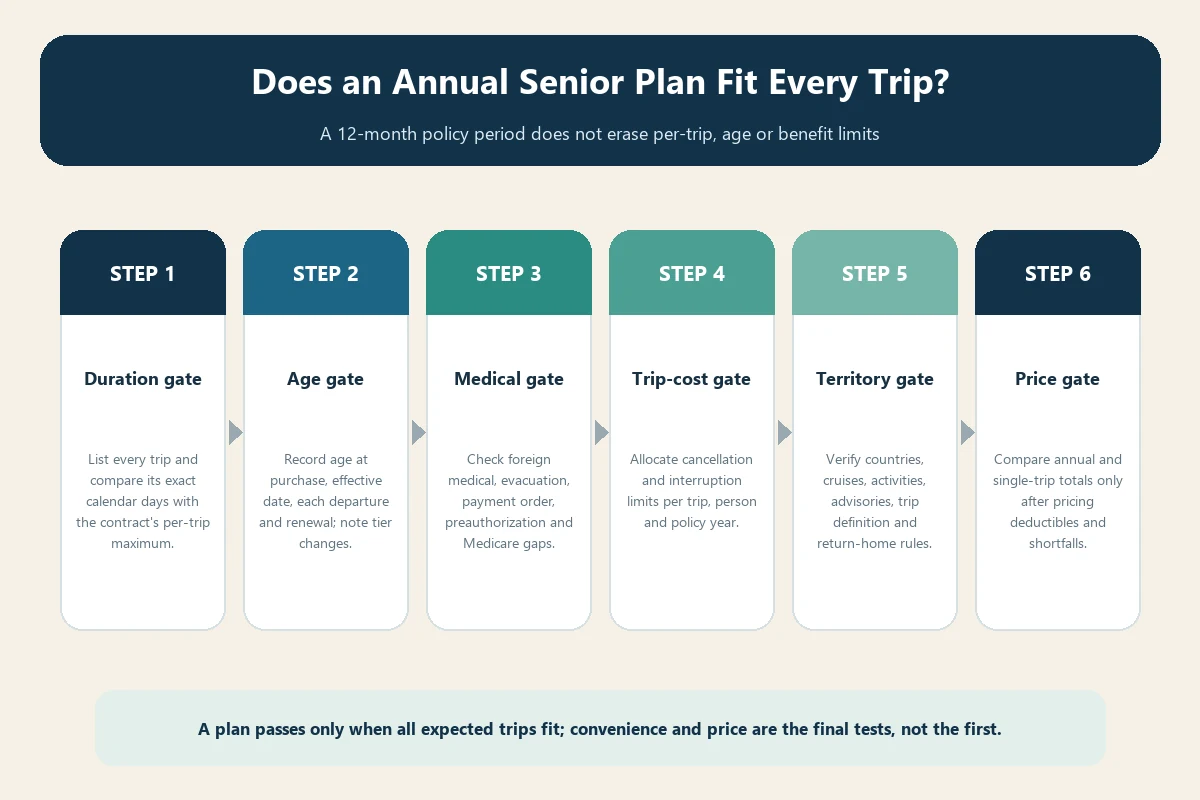
Gate 1: test every trip against the per-trip day limit
Do not write “covered all year” in the ledger. Write the actual maximum trip duration and the contract definition of a trip. Then calculate calendar days exactly as the policy does. A plan that allows unlimited departures can still stop covering one journey when its day cap is reached.
Current product pages illustrate the variation. Allianz says several AllTrips products protect trips up to 45 days while one option can protect trips up to 90 days. Seven Corners describes selectable 30-, 45-, or 60-day limits for its annual travel medical product. IMG describes 30- or 45-day choices for its senior multi-trip product. These are product examples, not market standards, and the issued state form controls.
If any planned trip is longer than the annual plan permits, do not assume a short return home, border crossing, or new hotel booking resets the clock. Find the contract definition of a new trip and ask the insurer to explain the planned sequence in writing. The senior long-trip guide uses six separate clocks to test continuous stays.
Gate 2: map age at purchase and age at renewal
A senior may qualify when the annual policy begins but cross an age tier before renewal or before a later departure. Record the date that controls eligibility and each benefit maximum. Ask what happens when a birthday occurs during the period of coverage, whether renewal is guaranteed, and whether the new age changes the available medical maximum, deductible, or premium.
IMG’s current senior multi-trip page, for example, publishes different medical maximum ranges for ages 65–79 and ages 80 and older. That does not predict another product, but it demonstrates why “senior eligible” is too vague for comparison. Use the travel insurance age-limits checklist to separate enrollment, benefit, duration, and renewal limits.
Gate 3: distinguish travel medical from comprehensive trip protection
| Question | Annual travel medical | Annual comprehensive protection |
|---|---|---|
| Primary purpose | Unexpected eligible medical care and transport | Trip loss plus selected medical and travel benefits |
| Trip cancellation | Often absent | May be included, usually with an annual cap |
| Medical maximum | Can be the central benefit | May be lower than a medical-focused plan |
| Trip cost input | May not be used for cancellation | Can affect available reimbursement |
| Best comparison unit | Medical and evacuation exposure per trip | Total benefit budget across the year |
An annual medical plan and an annual trip-protection plan are not substitutes simply because both renew yearly. IMG’s published senior multi-trip summary, for example, says trip cancellation is not included. Allianz explains that cancellation and interruption limits in its yearly products can apply per insured person per year or per policy per year. Read the benefit schedule and definitions instead of comparing the plan names.
Gate 4: allocate annual limits across all trips
For each benefit, label the maximum as per person, per trip, per occurrence, or per policy year. Then create a running balance. If the policy has a yearly cancellation maximum and the first covered cancellation consumes part of it, the remaining protection for later trips can be smaller.
Use three test events: the most expensive trip is canceled before departure; a smaller early trip uses part of the yearly benefit; and a medical event occurs late in the policy year. The goal is not to forecast claims. It is to expose whether one limit is being counted several times in the sales comparison.
The National Association of Insurance Commissioners describes travel insurance as protection for defined travel risks such as cancellation, interruption, delay, and baggage loss. Those labels do not guarantee that every policy includes every risk or uses the same accounting period. The certificate tells you how the maximum is applied.
Gate 5: audit foreign medical coverage and Medicare
The U.S. Department of State advises older travelers that Medicare and Medicaid do not cover medical costs abroad and recommends considering insurance for emergency medical, dental, and evacuation services. Medicare’s own foreign-travel guidance says coverage outside the United States is generally limited to specific exceptions; some Medigap policies may provide foreign emergency benefits.
Do not mark the ledger “covered by Medicare” without identifying the exact exception or supplemental plan. Ask whether the annual travel policy pays primary or secondary, what proof of denial is required, whether hospitals can be paid directly, and whether treatment must be preauthorized. Review the evacuation preauthorization guide before relying on a transport benefit.
Gate 6: resolve pre-existing-condition rules once, then monitor changes
An annual policy does not necessarily create a one-time blanket waiver for every medical development during the year. Locate the definition, look-back period, purchase deadline, stability requirement, and any waiver conditions in that exact annual form. Confirm how the contract treats a new diagnosis after the effective date, a medication change before a later trip, and a renewal after treatment.
The site’s annual pre-existing-condition waiver guide provides a document checklist. Also compare related evacuation wording: a policy might address an eligible acute event while restricting care linked to a pre-existing condition, or require assistance-company approval before transport.
Calculate break-even without weakening coverage
First remove any option that fails a non-negotiable gate. For the remaining plans, use this comparison:
Annual total cost = annual premium + expected deductibles + uncovered trip-specific add-ons + value of material benefit shortfalls.
Single-trip total cost = sum of premiums for each planned trip + expected deductibles + the same shortfall adjustment.
Run the calculation for confirmed trips only, then again with the plausible trips. Do not claim that a certain number of trips always makes annual coverage cheaper. Age, state, destination, trip length, trip cost, product type, and benefits all affect the comparison. A yearly plan can win on convenience yet lose when its cancellation ceiling, medical amount, or per-trip duration is inadequate.
Use a renewal checkpoint 60 days before expiration
At the checkpoint, update the trip ledger, age tier, residence, medications, diagnoses, deposits, and destinations. Request the new certificate rather than assuming the old terms continue. Compare form numbers, endorsements, exclusions, assistance contacts, and benefit schedules line by line.
If a trip crosses the renewal date, obtain written confirmation of which contract applies and whether continuous coverage is required. Do not let an automatic payment substitute for coverage review.
Questions to send before buying
- What is the maximum length of each trip, and how is a new trip defined?
- Which date determines age eligibility and benefit tiers?
- Does a birthday during the year change coverage?
- Are cancellation and interruption limits per trip or shared across the year?
- Is the product travel medical, comprehensive trip protection, or both?
- How are pre-existing conditions evaluated for later trips?
- Is medical coverage primary or secondary, and is advance payment available?
- Which destinations, advisories, activities, and cruises are excluded?
- Can a trip cross the policy expiration date?
- What changes at renewal?
FAQ about annual travel insurance for seniors
Is annual travel insurance always cheaper for seniors?
No. It can reduce repeated purchases, but price is only comparable after matching trip length, medical coverage, evacuation, cancellation limits, deductibles, and exclusions. A lower annual premium can conceal a material shortfall.
Does an annual policy cover one trip lasting a full year?
Usually that should not be assumed. Annual describes the policy period; product examples commonly impose shorter maximums on each journey. Verify the certificate’s trip-duration and trip-definition clauses.
Can a senior buy annual travel insurance after turning 80?
Some products accept travelers at 80 or older, often with different benefit choices. Availability depends on residence, product, effective date, and exact age rules. An eligibility statement is not proof of a specific medical maximum.
Does annual travel insurance cover pre-existing conditions?
Only as the issued contract states. Look for the definition, look-back period, exclusions, waiver or recurrence wording, purchase requirements, and treatment of medical changes during the policy year.
Bottom line
Annual travel insurance for seniors works when every expected trip fits the per-trip duration, the age and renewal rules remain acceptable, foreign medical and evacuation mechanics are adequate, and yearly limits can absorb the trip-cost exposure. Build the ledger first. Compare price last. Save the quote inputs, certificate, declarations, and written answers together so a convenient annual purchase remains an auditable coverage decision.