

Medical evacuation insurance pre authorization is the process of contacting the travel-assistance administrator before covered transport is arranged. It is not the same as a physician recommending transfer, a vendor accepting a mission, an advance hospital payment, or final claim approval.
This guide concerns emergency travel transport, not routine U.S. health-plan prior authorization. In a life-threatening event, seek appropriate local emergency care first. The guide is educational, not medical, insurance, or legal advice; the issued policy and case instructions control.
Key takeaways
- Open an assistance case as soon as practical.
- Give the reviewer specific medical and facility facts.
- Do not independently book nonurgent transport before understanding authorization rules.
- Record what is authorized, by whom, and subject to which conditions.
- If prior contact is impossible, preserve why and notify the administrator at the earliest reasonable time.
Reviewed August 16, 2026. State forms use different terms, including advance authorization, prior authorization, preauthorization, and arrangement by the company.
Why pre-authorization exists
Medical evacuation is a high-cost, medically complex service. The administrator may need to verify that appropriate treatment is not locally available, the patient can be transported, the destination can accept the patient, and the proposed mode is medically necessary.
The approval-chain guide identifies the attending clinician, assistance medical team, insurer, receiving facility, and operator. Pre-authorization is the timed workflow connecting those roles.
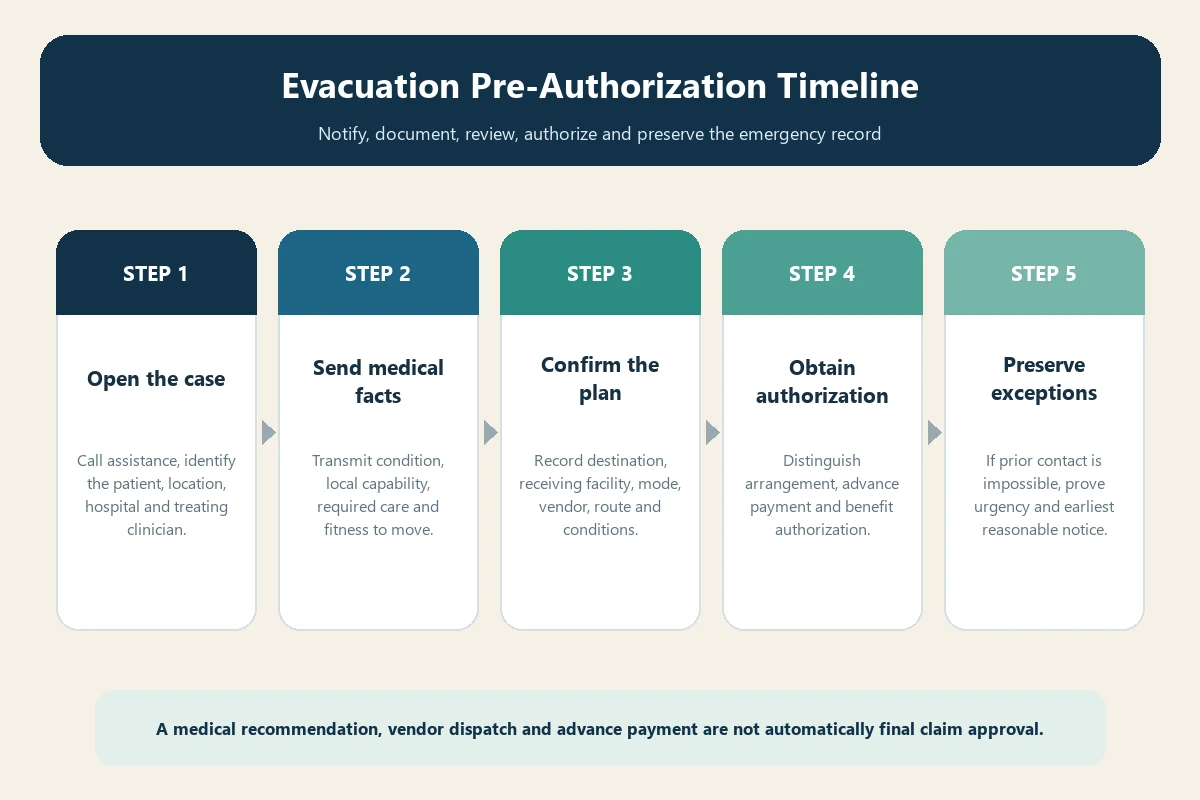
Step 1: Obtain urgent local care
Do not postpone emergency stabilization while searching for a policy page. Call local emergency services or reach the nearest available facility. Once immediate safety permits, have the traveler, companion, clinician, guide, tour operator, or family member contact the assistance line.
The CDC Yellow Book recommends checking preauthorization rules and access to a 24-hour physician-backed support center before travel. Keep the number both on paper and offline on a phone.
Step 2: Open a case with identifying facts
Provide the insured’s name, policy number, birth date, trip dates, current location, hospital, treating clinician, diagnosis or presenting problem, and a callback number. Ask for a case number and secure channel for medical records.
Record the administrator’s name, time zone, date, time, and requested next step. The assistance-line guide explains why this active case is different from submitting a reimbursement claim later.
Step 3: Supply the medical-necessity record
The treating team should document condition, severity, current treatment, services needed, local facility limitations, anticipated hospitalization, safe transport window, and required crew or equipment. A general request to “go home” does not establish necessity.
Ask which specific records remain outstanding: physician note, imaging, laboratory results, vital signs, medication list, fit-to-fly assessment, or receiving-facility acceptance. Use consent and secure transmission procedures appropriate to the case.
Step 4: Let the assistance team evaluate options
The team can compare continued local care, ground transfer, helicopter, commercial flight with escort, stretcher service, or fixed-wing air ambulance. It may locate a suitable receiving hospital and obtain vendor estimates.
That review is not a reason to ignore deteriorating vital signs. Keep the treating clinician and assistance team updated. If circumstances change, ask whether the authorization must change.
Step 5: Confirm the destination
Authorization should identify where the patient will go. Many policies focus on the nearest adequate facility, while later transport toward home can require separate wording.
The destination guide maps local stabilization, suitable treatment, later transfer, and hospital-of-choice options. Do not assume a preauthorized flight goes to the traveler’s preferred hospital.
Step 6: Identify exactly what was authorized
Ask whether the administrator authorizes the benefit, approves a vendor, arranges the service, guarantees payment, or merely provides a referral. Request the mode, route, provider, patient cost, and any conditions in writing.
A phone representative’s statement can be important, but wording matters. Record whether the authorization remains subject to eligibility, exclusions, benefit maximums, or receipt of final medical records.
Step 7: Confirm who makes the arrangements
Some contracts require all transportation arrangements to be made or approved by the insurer or authorized representative. Booking a private air ambulance first and asking for reimbursement later can jeopardize coverage or limit payment.
A state-specific Travel Guard policy example requires advance authorization and says that, when the company could not be contacted, benefits can be limited to what it would have paid. That is one form, not a universal result.
Step 8: Separate authorization from advance payment
A provider may require money before dispatch. The insurer might pay the vendor directly, issue a guarantee, make an advance subject to repayment, or ask the traveler to pay and claim later.
A current state-specific Travel Guard form example says an advance payment is deducted from the benefit limit and is not a guarantee of claim approval. Ask for the exact legal and financial character of any payment.
What if prior authorization is impossible?
An accident scene, unconscious patient, failed communications, or rapidly deteriorating condition can make prior contact impossible. Some forms require notice as soon as reasonably possible when injury or sickness prevents earlier authorization.
Do not invent a delay. Preserve emergency calls, dispatch times, clinician orders, communication failures, transport records, and the first assistance contact. Ask the insurer to apply the policy’s emergency wording to the documented facts.
“As soon as reasonably possible” is evidence-based
The phrase does not create an unlimited grace period. A reviewer may compare when the emergency began, when the patient stabilized, when a phone became available, who could have called, and when notice actually occurred.
Create a minute-by-minute timeline for the critical interval. Separate clinical action from administrative contact so the record shows why each happened when it did.
Self-arranged transport: questions before dispatch
- Is waiting medically unsafe according to the treating clinician?
- Can the assistance team be reached by another channel?
- Does the policy contain an emergency exception?
- Has a receiving physician and bed been secured?
- Is the vendor licensed and medically configured for the patient?
- What amount would the insurer have paid if it arranged the mission?
- Which records prove the need and failed contact?
The evacuation-limit guide explains why unused maximum does not convert an unauthorized service into a covered expense.
Authorization can expire or change
Patient instability, weather, aircraft availability, airport closure, bed loss, or a new medical finding can change the plan. Ask how long the authorization remains valid and whether a mode, vendor, route, or destination change needs renewed approval.
Save every revised plan. Do not rely on the first authorization after the mission materially changes.
The pre-authorization record
| Time | Actor | Decision or fact | Proof |
|---|---|---|---|
| ____ | Treating clinician | Need and local capability | Clinical note |
| ____ | Assistance medical team | Review and requested records | Case message |
| ____ | Receiving facility | Physician and bed acceptance | Transfer record |
| ____ | Administrator | Authorized mode, route, vendor | Written authorization |
| ____ | Transport operator | Dispatch and configuration | Mission record |
After the patient moves
Keep the physician order, complete medical record, assistance log, authorization, receiving acceptance, vendor invoice, route, crew and equipment record, and proof of payment. Submit other-insurance responses if required.
The claim-document framework can be adapted to policy, medical, authorization, and financial proof even when no pre-existing condition is involved.
Government help is not pre-authorization
The U.S. Department of State’s travel-insurance guidance says the government does not pay citizens’ medical costs abroad. An embassy may provide facility information, but it does not authorize a private insurance benefit.
A concise authorization call script
- “Please open an emergency medical evacuation case and give me the case number.”
- “Here is the treating clinician and secure record contact.”
- “Which medical facts and facility-capability records are still required?”
- “Which destination, mode, route, and vendor are under review?”
- “What exactly is authorized, and can you send that in writing?”
- “If the condition changes, which number should the clinician call immediately?”
If the requested transport is not authorized
Ask for the medical and policy reason, the alternative plan, and the escalation route. A denial of one aircraft or destination is not necessarily a refusal of all assistance. The team may propose stabilization, another facility, or a different mode.
If the treating clinician believes delay creates immediate danger, request direct physician-to-physician discussion and document the clinical urgency. Do not ask nonmedical staff to resolve a medical dispute through general customer service.
Family communication without conflicting instructions
Choose one family contact to receive updates and keep the case log. Multiple relatives independently calling vendors, hospitals, and the insurer can create duplicate quotes and contradictory plans.
Confirm who has authority to release records and make decisions if the patient cannot. Keep privacy, consent, and local law in mind while sharing only the information required for the case.
Ask the case manager to identify the next decision time and missing item after every call. That single habit keeps the family, treating team, receiving facility, and transport desk working from the same current plan.
Timestamp every update in the destination’s local time and in UTC. That prevents confusion when the insurer, hospital, family, aircraft desk, and receiving team work across several time zones.
Bottom line
Medical evacuation insurance pre authorization is a documented sequence: emergency care, case opening, medical facts, facility analysis, destination, mode, vendor, and precise written approval. Separate that approval from dispatch, advance payment, and final claim adjudication. If prior contact is genuinely impossible, protect the patient first and preserve the evidence showing urgency and the earliest reasonable notice.
A medical evacuation claim needs more than receipts: eligibility, clinical necessity, assistance authorization, transport delivery and financial loss must agree. Use the medical evacuation claim documents guide to build a timestamped evidence ledger before, during and after the move.
