
Medicare drug plans generally do not cover prescription drugs purchased outside the United States. A senior traveler should arrange an adequate U.S.-dispensed supply before departure, confirm an early refill or vacation override with the Part D plan and pharmacy, check destination medicine laws, and build a documented emergency backup. A foreign prescription receipt should be treated as a likely personal expense unless the exact plan provides a written exception.
This article is educational, not medical, pharmacy, legal, insurance, or financial advice. Never change, combine, stop, or substitute medicine without qualified clinical guidance. Drug, customs, plan, pharmacy, and destination rules can change.
Key takeaways
- Medicare says drug plans do not cover prescription drugs bought outside the United States.
- Request travel quantities early; an override is plan- and pharmacy-specific, not automatic.
- Carry medicines in original labeled packaging with a medication list and prescriber contact.
- Destination laws can prohibit or restrict a medicine that is legal in the United States.
- Travel insurance may help with an unexpected covered loss or medical event, but routine refills and existing medication costs are often outside the benefit.
Reviewed: August 16, 2026.
The Part D rule abroad
Medicare’s travel guidance states that Medicare drug plans do not cover prescription medicines bought outside the United States. Part D is delivered through Medicare-approved private plans with formularies, pharmacy networks, utilization rules, and service areas. A foreign retail pharmacy is generally outside that structure.
This rule is separate from whether Original Medicare might cover a narrow foreign hospital situation or whether a Medicare Advantage plan provides worldwide emergency care. A hospital bill, a drug administered during eligible inpatient care, and a prescription filled at a foreign pharmacy can be processed under different benefit categories. Never assume one covered medical service makes the retail medicine covered.
Start the medication plan four to eight weeks early
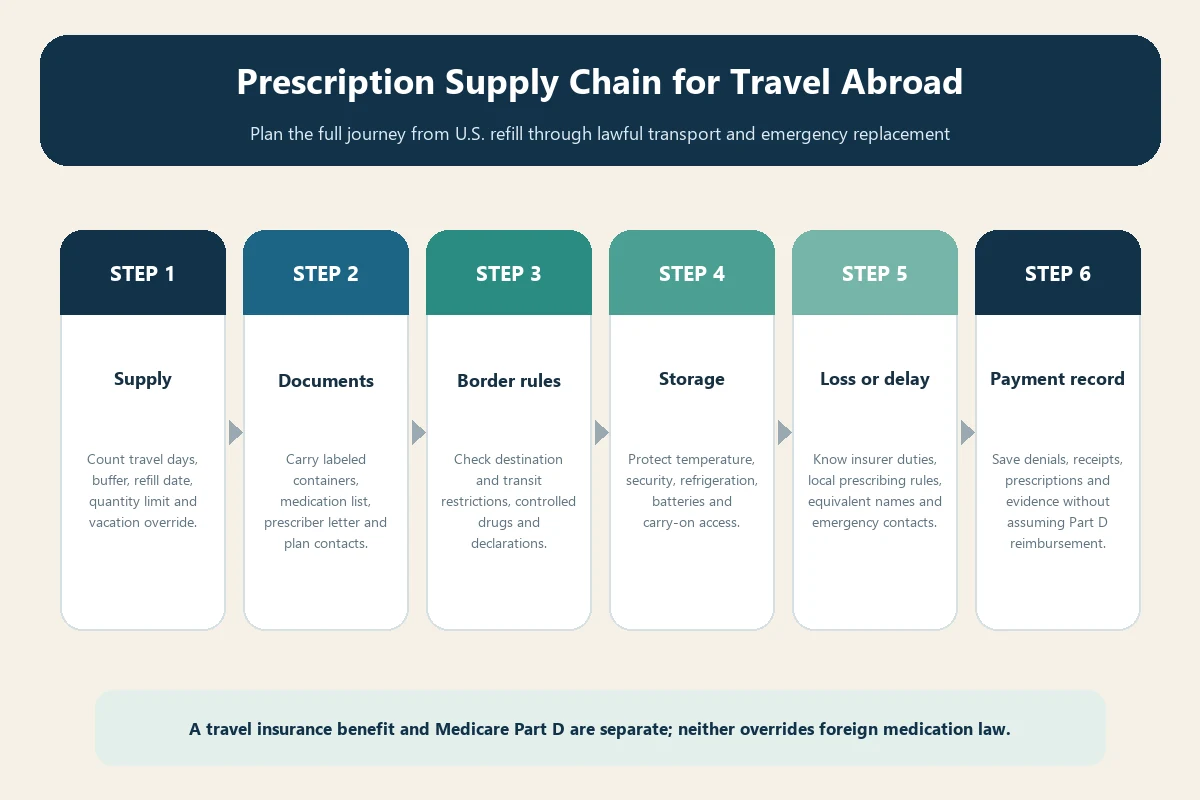
Complex trips need lead time. Create one list with brand name, generic name, strength, dose, form, reason, prescriber, dispensing pharmacy, refill date, storage range, and remaining quantity. Include injections, inhalers, eye drops, patches, creams, rescue medicine, and medical supplies—not just tablets.
Ask the prescriber whether the traveler is clinically stable for the itinerary and whether monitoring is needed. Ask the pharmacist which medications have refill-too-soon restrictions, shortages, controlled-substance rules, temperature limits, or insurance quantity limits. Our travel prescription medication guide provides a broader document checklist.
Vacation overrides and extended supplies
A Part D plan may allow a vacation override or extended fill under its rules, but it is not guaranteed for every medicine or trip. The plan, pharmacy benefit manager, prescriber, and dispensing pharmacy may each have a role. Controlled substances, specialty medicines, and drugs with safety monitoring can follow stricter procedures.
Call the number on the current plan card and ask:
- How many days can be dispensed before departure?
- Is an early refill or vacation override available?
- Must the pharmacy call the plan?
- Does the prescriber need a new prescription?
- Can a network mail-order pharmacy supply the quantity in time?
- What cost sharing applies to an extended fill?
- What happens if the trip spans a plan-year change?
Record the representative, date, reference number, and instructions. Submit the request early enough to solve denials before travel.
Do not mail medicine abroad without checking the law
A U.S. pharmacy’s ability to dispense or mail a drug does not prove that a foreign country permits the shipment. International mail can trigger customs restrictions, temperature excursions, delays, taxes, seizure, or return. Some carriers refuse particular substances or packaging.
Check the destination embassy or health authority and every transit country. Use official sources where available. Do not ask a friend to carry medicine across a border without verifying possession, labeling, quantity, and documentation rules.
Original containers and supporting documents
The U.S. Department of State recommends carrying medication in original labeled containers and checking destination restrictions. A practical packet includes the pharmacy label, generic names, a medication list, prescriber letter when useful, copies of prescriptions where lawful, allergy information, and the clinician’s contact details.
Keep documents accessible but protect sensitive medical information. Store a secure digital copy separately from the physical supply. A paper list helps if a phone is lost or cannot connect.
Carry-on versus checked baggage
Essential medicine should usually remain accessible during transit rather than depend entirely on checked baggage. TSA permits medically necessary liquids and medications under applicable screening procedures, but the traveler should declare and present them as requested. Airline, airport, transit-country, and destination rules still matter.
Split a lawful supply only if packaging and storage remain correct. Never remove identifying labels merely to save space. Carry needed administration supplies and a plan for used sharps. Ask the airline about oxygen, batteries, refrigeration devices, and security screening before departure.
Temperature-sensitive medicine
Insulin, biologics, some eye drops, and other products may require a defined temperature range. A hotel minibar, frozen gel pack, car trunk, cargo hold, or unmonitored cooler can damage medicine. Obtain manufacturer or pharmacist instructions for the exact product and trip duration.
Use a validated travel container when appropriate, keep temperature records if the product requires them, and identify refrigerators or replacement sources along the route. Do not use a medicine after a suspected temperature excursion until a pharmacist or manufacturer advises it remains usable.
Crossing time zones safely
Changing local time can affect insulin, anticoagulants, seizure medicines, Parkinson’s treatment, steroids, and other scheduled therapies. The correct adjustment depends on the medicine, formulation, flight direction, time zones, meals, sleep, and medical condition.
Ask the prescriber or pharmacist for a written schedule using both home and destination time. Avoid improvising by doubling or skipping. Set device reminders only after confirming which time zone they display during flight and after landing.
What if medicine is lost, stolen, delayed, or damaged?
- Contact the prescriber or clinical team for safe guidance.
- Call the Part D plan, even though the foreign purchase is generally not covered, to document the event and ask about a U.S.-based solution.
- Contact travel assistance for a licensed local provider or pharmacy referral.
- File a police, airline, or carrier report when relevant.
- Use generic name, strength, and formulation; foreign brand names can differ.
- Do not accept an unverified substitute from an informal source.
- Keep the foreign prescription, itemized receipt, packaging, and clinical record.
A telemedicine service may not legally prescribe across borders and may be unable to prescribe controlled medicines. Review the limits in our telemedicine abroad guide.
Can travel insurance pay for replacement medicine?
Travel policies vary. A baggage benefit might address the loss of personal property but exclude medicines or value them differently. A travel medical benefit might pay for an eligible physician visit and medication prescribed for a new covered illness, while excluding routine maintenance refills. A trip-delay benefit might provide limited reimbursement for necessities, subject to triggers and receipts.
Ask the insurer to point to the provisions for prescription replacement, lost medicine, new illness, chronic condition, baggage, and trip delay. Do not assume “medical coverage” pays the ordinary cost of medicine the traveler already needed before departure.
Pre-existing conditions and medication changes
A recent start, stop, dose change, refill problem, symptom, or treatment can affect a travel policy’s pre-existing-condition analysis. Policies use their own look-back and stability language. A waiver may be available only when purchase timing and other eligibility conditions are met.
Our medication-change and pre-existing-condition guide explains how to build the timeline. Disclose information as the application requires and preserve the prescription and medical records.
Long trips need refill math
Count the days from the first departure until the traveler can reliably reach the U.S. pharmacy again. Add reasonable disruption time for a missed connection, weather, illness, or quarantine, within prescribing and legal limits. Compare that number with tablets or doses actually dispensed—not the number authorized on the prescription.
A 90-day fill may be inadequate for a 90-day trip when doses are needed during travel to the airport, the return day, or an unexpected extension. The senior long-trip guide helps align medical, insurance, and supply timelines.
Specialty and infused drugs
A specialty drug may require a limited-distribution pharmacy, prior authorization, cold-chain delivery, laboratory monitoring, or administration at a specific site. Use our chronic medication travel guide to map supply and monitoring dependencies. Part D and Part B coverage can differ depending on the product and setting. An overseas infusion should not be arranged from a U.S. benefit assumption.
Discuss whether the dosing schedule can safely fit the trip, whether a qualified foreign site is available, and what the traveler would pay. Obtain written clinical and coverage guidance. If treatment cannot be interrupted or safely moved, the itinerary may need to change.
Hospital-administered drugs abroad
If a narrow Medicare foreign hospital exception applies, some drugs may be included within covered inpatient services rather than processed as a foreign Part D pharmacy claim. The hospital, setting, status, drug, and Medicare rule matter. A retail prescription at discharge remains a separate question.
Request an itemized hospital bill that distinguishes drugs administered during care from take-home prescriptions. If the foreign provider does not file Medicare, the beneficiary may need CMS-1490S and supporting records.
Create a two-layer payment plan
Layer one: prevention. Secure the lawful U.S. supply, labels, storage, timing schedule, and buffer.
Layer two: disruption. Identify assistance contacts, licensed destination providers, trustworthy pharmacies, payment access, travel policy rules, and documentation.
Cash access is not a substitute for clinical or legal safety. It only solves one part of a foreign replacement. The correct product, dose, formulation, storage, and authenticity remain essential.
Questions for the Part D plan and pharmacy
- Does the plan confirm that foreign retail purchases are not covered?
- What vacation override or early-fill process applies?
- Can a 90-day or extended supply be dispensed?
- Which network pharmacy or mail-order service must be used?
- What prior authorization or quantity limit remains?
- How is a specialty or controlled medication handled?
- Can the supply be split into labeled containers?
- What temperature and transport instructions apply?
- What happens if the medication is lost before leaving the United States?
- What documents should the traveler carry?
Questions for the travel insurer
- Does the medical benefit cover a drug prescribed for a new covered illness abroad?
- Are routine refills and existing maintenance medicines excluded?
- Can baggage or delay coverage respond to lost medicine?
- Must assistance approve a clinic or pharmacy?
- How are pre-existing conditions and medication changes defined?
- Is a foreign prescription or police report required?
- What receipt, translation, and proof of payment are needed?
- Does assistance locate an equivalent formulation or only give referrals?
FAQ
Will Medicare Part D reimburse a prescription bought in Europe or Canada?
Medicare says drug plans do not cover prescription drugs bought outside the United States. Treat the cost as personal unless the exact plan provides a written exception.
Can a pharmacy fill medicine early for international travel?
Possibly. Ask the Part D plan and pharmacy about a vacation override, extended supply, prescriber authorization, quantity limits, and cost sharing.
Should medicine go in checked baggage?
Essential medicine should remain accessible and properly stored. Check TSA, airline, transit, and destination rules, and keep original labels.
Will travel insurance replace a lost prescription?
It depends on the policy and cause. Medical, baggage, and delay benefits can treat the event differently, and routine maintenance refills may be excluded.
Bottom line
Medicare Part D is not a foreign pharmacy benefit. The strongest plan is built before departure: obtain the permitted supply, verify an override, protect labels and storage, check destination law, map time-zone dosing, and rehearse a licensed replacement path. Travel insurance can support an unexpected covered event, but it should not replace medication logistics.
